School lunch looks different these days at Litchfield Public Schools. And according to the district’s nutrition director, it tastes better too.
The district and its students are reaping the nutritional and taste benefits of a Farm to School program implemented about four years ago, which focuses on procuring locally sourced foods to be served in school lunches.
Farm to School got its start when Lesli Mueller, director of child nutrition for Litchfield, Dassel-Cokato and Hutchinson school districts, applied for and received a state grant of $9,000. This past year, Mueller and Amy Haag, Farm to School liaison for the districts, received a $126,000 grant for the program.
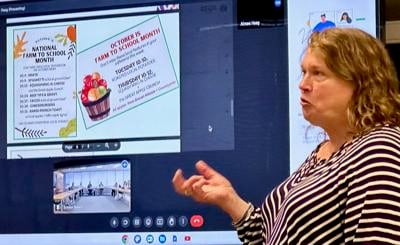
Mueller and Haag gave Litchfield School Board members an overview of the program and what they described as its successes during the regular board meeting Oct. 9.
“The grant is available annually, and it gives us the legs that we need to purchase the high-quality ingredients that fuel the Farm to School program here,” Haag said.
A large influx of federal grant money gave the state’s Farm to School funding a boost last year, Haag said, and more than 100 districts received at least some funds to start or grow their program. While three years ago, it might have been a “little bit weirder” to have a robust Farm to School program, Haag said, “but it’s becoming a best practice” throughout the state.
Some rural districts struggle with the logistics of delivery and procurement of produce for their Farm to School programs, “but we are privileged to be in a place where we have good people growing good food, from beef to apples, grains, honey, maple syrup, all those things.”
“Everybody here should feel, really, pretty dang good,” Haag said, “that Litch is in the top 10 of those 114 schools that were awarded last year.”
The Litchfield, Dassel-Cokato, Hutchinson cooperative has expanded its efforts each year, as state and federal dollars for it grew. From $9,000 the first year, to $35,000 the second, and $126,000 last year.
“That money, of course, gave us the more legs to buy new ingredients and kind of start making what we call the ‘whole tray impact,’” Haag said. “Fruit is really hard to procure at scale in Minnesota. Apples, they’re great, but this year, we were able to bring in strawberries, watermelon and cantaloupe. Locally raised chickens, those are on the rise.”
A farm south of Hutchinson raised 400 chickens for the three districts, the start of what Haag hopes will be expanded availability of poultry for school lunches.
They’ve seen that growth with beef. The program added chuck and sirloin to the ground beef, burgers and brats that have been sourced locally. With that, 100% of the beef in food service is locally raised, Haag said.
“So I think, especially on those proteins, students can smell and taste the difference,” she said. “Proteins are really a comfortable thing. Not everybody’s going to love broccoli or Brussel sprouts or even zucchini, but give somebody a good-smelling, good-tasting, nicely textured burger … that works.”
October is Farm to School Month in Minnesota, and one of the activities Haag and Mueller hope schools in the districts will participate in is an apple tasting event, or apple crisp crunch, in which students are all invited to take a bit of an apple at the same time. That same day, the districts will serve a squash macaroni and cheese with locally grown squash.
Mueller and Haag said they hope to increase their presence in Litchfield schools to help promote and drive understanding of the Farm to School program’s benefits among students.
“As we gain momentum … I hope we can continue to make our kids aware it’s a unique world of making food choices,” School Board Chairman Alex Carlson said. “Them learning about this, and you getting involved with our FACs teachers and our health teachers to make them aware of why one choice is dramatically better than another. We need to keep the momentum going.”