1924: Electus Darwin Litchfield’s son, also named Electus Darwin Litchfield, came by train to visit Litchfield. His father was the man our town was named after. A telegram was sent in advance to the city. The city fathers mistakenly thought that old man Litchfield himself was coming for a visit. They pulled out all the stops, meeting the train with dignitaries, prepared speeches, and bouquets of flowers. Electus Litchfield Jr. showed up to a crowded depot platform and stepped off the train. Everyone, including Electus, was red-faced. The mistake was announced and the program went on anyway. Later, Junior wrote the Independent newspaper a letter of apology for the misunderstanding. “I am afraid the telegram…” he wrote, “may have been worded so as to give you all the impression that my father was to arrive. I hope you will again thank Mr. (Jesse V.) Branham’s daughter (39-year-old Alice) for the beautiful flowers, which his son appreciated no less than would have his father for whom they were intended.” Branham was Litchfield’s first mayor and a wounded hero of the Sioux Uprising of 1862. Junior would go on to design Litchfield’s post office.
1931: Blind Litchfield lawyer Raymond Henry “Ray” Dart became a judge of probate in October 1931. That must have prompted a lot of “justice is blind” jokes. By the way, Ray drove his car around town with his wife sitting next to him telling him when to turn and so on.
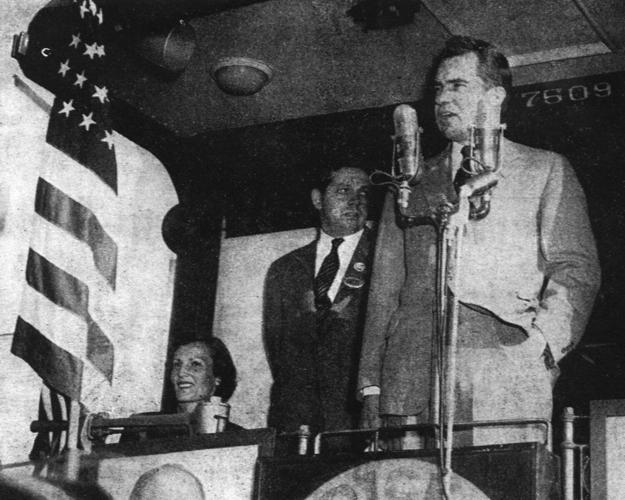
1952: I was in first grade at Washington High School, and for some reason I was uptown at around 2:30 in the afternoon on Thursday, Oct. 23, 1952. I saw a huge crowd down by the train depot at the Sibley Avenue crossing. “Maybe,” I said to myself, “they’re giving something away free!” I ran down the street and mingled in with the crowd of 2,500 people standing on the tracks. A man was speaking from the platform of the last car of a small passenger train. I stood in the crowd, jumping up and down, trying to see over the adults’ shoulders and hear what the dark-haired man was saying. “Who’s this guy?” someone asked a man standing near me. “Richard Nixon,” the other man answered. “He’s running for vice president with Ike Eisenhower.” I still had no clue as to who the man on the train was or what he was talking about, nor did I care. It didn’t look like they were going to be giving anything away free, so I turned and went home. If I had stayed, I might have received an “I Like Ike” campaign button. I wish I had it today.
The 13-car train was the “Dick Nixon Special” and it was the first time a presidential or vice presidential candidate had been in Litchfield since Saturday, Oct. 10, 1896, when William Jennings Bryan came and campaigned from a platform erected at the depot. But the people of Dassel weren’t so lucky. Five minutes earlier, the people of Dassel had gathered at their depot expecting to hear Bryan make a speech, but his Great Northern engine No. 131 passenger train went through the town at 60 mph, killing one man and scattering the citizens in all directions. Because there were no warning signals in Dassel, the killed man’s wife sued the railroad for $5,000 and she won. I don’t think she voted for Bryan either. Franklin D. Roosevelt came through on Monday, Oct. 4, 1937. His 10-car train roared through town at 8:30 p.m. that day. A crowd of 50 onlookers waved from the platform to the curtained windows of the train. No one was killed nor did a sleeping Roosevelt even know he was passing through Litchfield.
1956: A broken ammonia pipe caused an explosion at the Farmer’s Produce (turkey plant) a couple of blocks from our house in October 1956. Women ran out of the building onto Second Street West with their hair and clothes on fire. Fourteen of them were sent to the hospital.
1959: Robert Hilner “Bugs” Bokander gave Litchfield’s teenagers an unintentional thrill one Halloween night on Saturday, Oct. 31, 1959, while we attended a record hop in the rear of the Western Café on Depot Street East. I was 14 and dancing with my classmate Merdice Fortun when someone ran into the room at about 10:45 p.m. and announced, “Hey everybody! Bugs Bokander just got splattered against the depot!” We all ran out of the building and raced the half block to the crossing. Bugs had tried to beat the train to his apartment at the Litchfield House south of the tracks by the old library and he had, indeed, gotten himself splattered against the depot building. Parts of Bugs were everywhere. They picked pieces of him up in buckets as it was easier than dragging around a body bag. Firemen then hosed off the blood stains from the east side of the limestone depot building.
1960: It was a nice Indian summer morning on Thursday, Oct. 6, 1960, at the Herman and Leonora Clausen farm two miles south of town near Highway 22. Then Leonora disappeared never to be found. There were searches for weeks but nothing ever turned up. It’s still a mystery to this day.
1972: When Litchfield policeman and later Meeker County Sheriff John Rogers was off duty and not working with his earth-moving machinery, he liked to go dancing with his wife and friends. He preferred old-time music and would often go to the ballroom in Kimball. One night, in the early fall of 1972, he came out after the dance to see that someone had let the air out of all his car tires. That was a nuisance, but nowhere near the nuisance he encountered several weeks later, as was reported in the Oct. 11, 1972, Independent Review. That time, John came out of the ballroom and discovered that someone had removed the drive shaft from his car. The drive shaft was later found in a ditch near Forest City. A 20-year-old Forest City youth was arrested for the deed and, even though it was obvious that he couldn’t have done the job alone, he wouldn’t give up his four or five helpers. How do you remove a drive shaft on a gravel parking lot without the proper equipment, jacks, hoists, etc.?
1973: On Thursday, Oct. 11, 1973, my mother and stepfather, Helen and Floyd Young, walked up to the North Swift Avenue railroad crossing a block away from their house to view an accident scene. It looked like it had snowed in Litchfield the previous night. White feathers were everywhere, covering the ground like a blanket of new-fallen snow. For a lot of local citizens, Thanksgiving had come early that October morning. Two hundred or so live turkeys were running loose all over town. Most of them never made it to their original destination, the Jennie-O turkey plant (Produce) a block away from the crossing.
What had happened? Dennis Nygaard was driving his truck and trailer full of 1,600 live turkeys across the railroad crossing at about a quarter past five that dark fall morning. Suddenly there was a bump and a jerk and Dennis found himself driving away from the crossing without his trailer full of turkeys. Somehow, the trailer had come loose from his truck and stopped right on the tracks. Nygaard couldn’t hook it back up without a tow truck’s help. He knew that a morning passenger train always came through Litchfield about this time. Thinking quickly, Dennis drove to the turkey plant office where he attempted to call Amtrak and get them to stop the train. Unfortunately, time wasn’t on his side. At 5:32 a.m., the Amtrak passenger train slammed into the trailer at 78 mph. Feathers, turkey parts and trailer parts flew east down the tracks all the way through town to Schwartzwald’s car dealership (later Ferguson’s) three-quarters of a mile away. The impact ripped away part of the crossing’s signal system and disabled the locomotive, so another one had to be sent out to Litchfield from Minneapolis. The Amtrak passengers had to sit and look out their railroad car windows for over two hours as the morning sun came up to shine on a sea of white feathers and mangled turkey body parts.
1987: It was Game 7 of the 1987 World Series featuring the Minnesota Twins and the St. Louis Cardinals. It was played Sunday, Oct. 25. An emotionally spent Kent Hrbek, who had hit a grand slam in Game 6, went home to his house on Lake Minnetonka on Saturday night to find his porch, his lawn and his driveway covered with reporters and TV cameras. Just before 4 o’clock Sunday morning, Kent got up, snuck out of the house, and drove with a friend from his darkened house to do some relaxing duck hunting in, of all places, Litchfield. The reason? Kent grew up near his friend, who was a nephew of Willard Piepenburg, who had a farm just south of Litchfield. Kent had been coming out to Litchfield to hunt long before he became the Twins’ star first baseman. He had even invited the Piepenburg family to his high school graduation. Arriving at around 5:30 a.m., Kent, Willard and Willard’s nephew went out to sit in a chilly duck blind and take Kent’s mind off the most important game he was ever going to play in his life. But that was easier said than done.
“I’d say he was a bit preoccupied,” Willard said later. “When the first flock came over, Kent couldn’t shoot. He had forgotten to put shells in his gun.”
Later that morning, the hunters returned to Willard’s house for breakfast. Kent took his shoes off at the door and wolfed down his food, commenting during the meal that he thought the Twins would not only win that night, but would be a force for years to come. He left for his Minneapolis home about 11 a.m.
Do I really need to tell you what happened that Sunday night at the Metrodome? The game was almost anti-climactic. You knew the Twins were going to win. The Twins scored single runs in four different innings on their way to a 4-2, Series-clinching triumph. The final out was a grounder that went to third basemen Gary Gaetti, who threw it across the infield to his buddy Kent, who caught the throw, toed the bag, and leaped up in the air, again with his arms raised in triumph. Then he ran to the huge pileup of Twins that began to build between first base and the pitcher’s mound. During their previous year as the American League bottom dweller, our team was called a derogative name. The Twinkies. “We are no longer the Twinkies,” said second baseman Steve Lombardozzi. “We’re the World Champion Minnesota Twins.”
— Terry Shaw is a sort of unofficial recorder of Litchfield history, having researched and written two books — “Terry Tales” and Terry Tales II” — of his remembrances of growing up here. In recent years, Shaw has made daily posts on the Old Litchfield & Meeker County Facebook page. This column includes snippets of history from both his books and Facebook posts.