
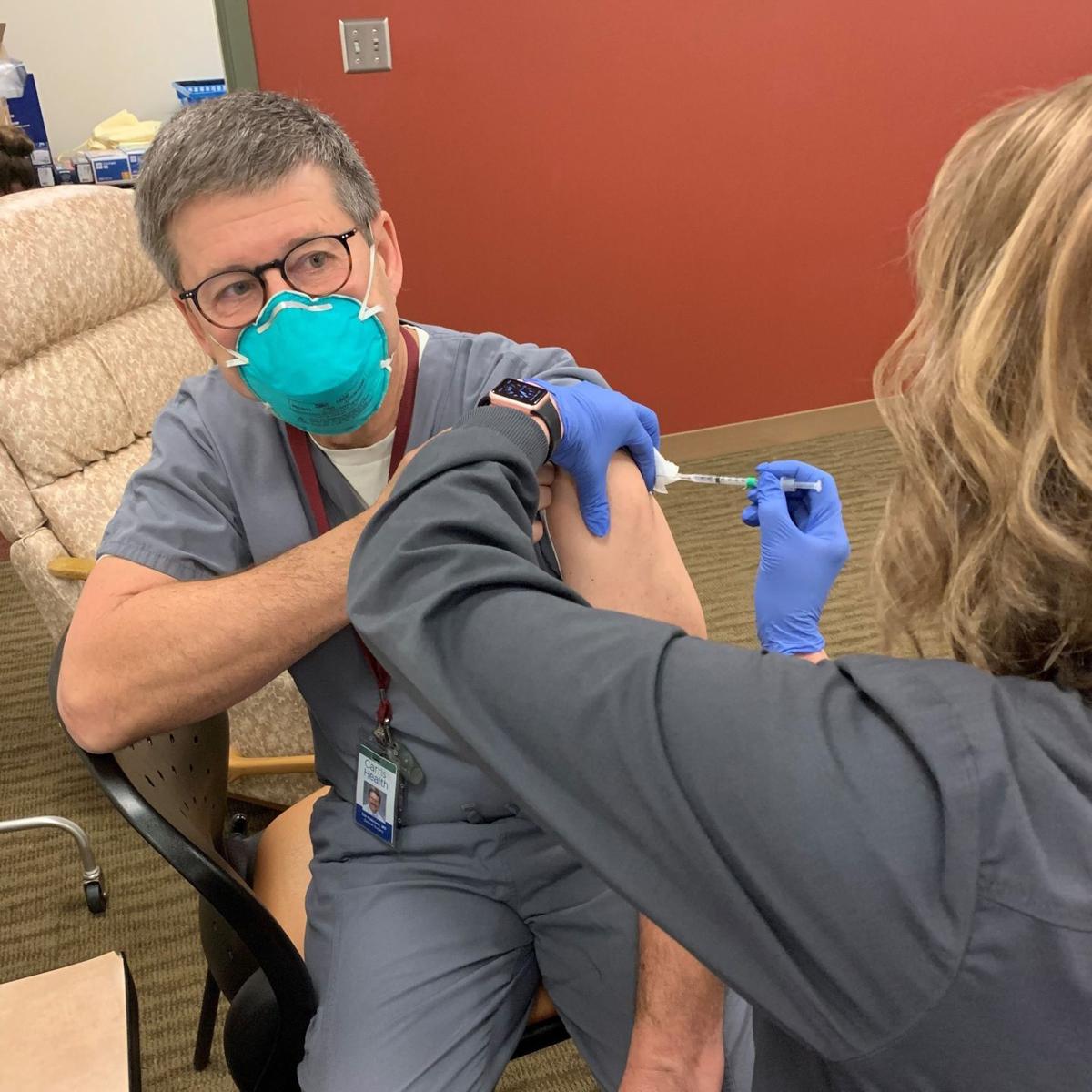
Dr. Tim Peterson receives the COVID-19 vaccine early Dec. 22 morning at Meeker Memorial Hospital. The hospital received its first shipment of the vaccine and began vaccinating frontline workers Dec. 22.

Dr. Deb Peterson, chief medical officer at Meeker Memorial Hospital, was among the staff to receive a vaccination Dec. 22 from the hospital’s first shipment of the Pfizer COVID-19 vaccine.
Meeker Memorial Hospital & Clinics received its first allotment of the Pfizer COVID-19 vaccine and began administering the vaccine to frontline health care workers early Tuesday.
Until the vaccine becomes widely available, Meeker Memorial is urging community members to be patient, continue to wear masks, and social distance while initial doses of the COVID-19 vaccine are distributed.
"We have been working with the South Central Healthcare Coalition and other partners to help ensure that the vaccine gets to those who are in priority populations," said Ann Lien, chief quality officer and incident commander for Meeker Memorial. "The fact is that there are limited doses of the vaccine available during these initial shipments, and it will take time, perhaps months, before it’s readily available to the general public."
Dr. Deb Peterson, chief medical officer, and Dr. Tim Peterson, general surgeon, were among the first to be vaccinated at Meeker Memorial.
“The past months have been challenging here at Meeker Memorial and for our community,” said Dr. Deb Peterson. “The arrival of the vaccine means there is hope for better days ahead.”
Vaccination of other front line health care workers at Meeker Memorial was to continue for the remainder Tuesday, hospital spokesman Marc Vaillancourt said. The Pfizer vaccine requires two doses with the second dose administered in 21 days.
“We are confident that the vaccine is safe, as it has been proven to be 95-percent effective in clinical trials.” said Eric Weller, regional healthcare preparedness coordinator for the South Central Healthcare Coalition. “We also know that the arrival of the vaccine does not mean an immediate end to this pandemic. People will still need to wear masks, social distance and seek medical care if they are feeling ill.”
As vaccinations begin locally, Meeker Memorial providers and staff urged people to continue to practice safety to stop the spread, including:
- stay at least 6 feet away from other people if you are in public places
- telework when possible
- avoid close contact with people who are sick.
In addition, people 65 or older or who have certain underlying medical conditions, should stay at home and avoid situations where you could be exposed, including travel.
Details about the further availability of the COVID-19 vaccine will be released when they become available.
- Updated


It would not be appropriate to say the Litchfield City Council had gone to the dogs.
But council members did spend a significant amount of time discussing issues of the canine variety Dec. 21.
The council voted unanimously to reject a conditional use permit that would have allowed a resident to kennel five dogs. And later in the meeting, councilors heard about a dog owner group’s effort to find a suitable location for a dog park somewhere in the city.
The rejected CUP came after a lengthy discussion of Planning Commission action on Dec. 14, during which an application from Brenda Lindom was denied on a 4-3 vote.
Lindom, who rents a home on North Swift Avenue, applied for a kennel license after a neighbor complained about the health of her dogs. When a Litchfield police officer visited the home, the dogs were found to be in good health. However, Lindom was told that her five mastifs needed to be licensed by the city, and she applied for and received licenses.
At that point, city staff realized there was conflicting information regarding the number of dogs that can be housed at any one residence. City ordinance limits residential properties to two dogs, but police have been enforcing a provision of the ordinance that five dogs are allowed. That provision calls for a kennel license, however.
City staff told Lindom she needed to have a kennel license in order to keep all five dogs at the home. And she applied for a conditional use permit to operate a kennel — even though they all are personal dogs — which sparked the Planning Commission meeting a public hearing, of which neighbors were notified.
One neighbor attended the Planning Commission meeting and spoke in opposition to the CUP, and two other written statements of opposition were received before the meeting. Opponents mentioned the strong odor coming from the dogs’ kennel, and the effect on property values the kennel could have on neighboring properties.
Following the Planning Commission meeting, and the recommendation of denial that was forwarded to the City Council, the city received seven written letters of support for Lindom’s CUP application.
In addition, Lindom sent a letter of explanation. Prior to moving to Litchfield in 2015, she said, she checked on the city’s dog regulations and was told that ordinance limited ownership to five dogs.
The limit was an important consideration, Lindom said, because she owned and actively showed mastifs at competitions throughout the county.
“My dogs have never all been home at the same time,” she wrote. “If I wasn’t showing, I would pay a handler and send them out to be shown.”
All five of her mastifs are AKC champions, she said, with two holding both AKC and international champion rankings. In addition, one of her dogs was purchased as a therapy dog to help with her two adopted children, both of whom are autistic and have fetal alcohol syndrome.
Both of the children progressed well and didn’t need a therapy dog, but “she did make a wonderful companion for them. 11 years now,” Lindom wrote of the dog.
Lindom and her husband paid “thousands of dollars” for each of their dogs, as well as thousands of dollars to prepare them and travel with them to shows, “all parts of the sweat, blood, but mostly love that goes along with having these beautiful babies as part of our family.”
She added that “We give our dogs the best care possible. I didn’t just go by (sic) any dog. I bought dogs that had health tested parents for everything genetic, so I knew they would have a better, healthier, life and longer.”
Denying the conditional use permit would force her to give up some of her dogs or move, Lindom wrote.
City Council members were not unsympathetic. In fact, Coucilor Sarah Miller said Lindom was trying to do the right thing and things “snowballed,” despite the fact that prior to the complaint earlier this year there had been no complaints made to the city about the dogs.
Councilor Vern Loch Jr. said the issue might be looked at in the wrong way. Rather than a conditional use permit, which would stay with the property owner, not Lindom as renter, an interim use permit would be more appropriate, he said. Conditions could be set, just as in a CUP, Loch said, but the interim use would be in place only as long as Lindom kept dogs at the address.
“My heart would be to accept this (CUP),” Councilor Ron Dingmann said, “but JR (Loch) brings up a good point. If we could resolve this with some type of interim use, so not to set a precedent….”
Mayor Keith Johnson sided with opponents. “People that have complained, it’s huge. The smell. What about the value of the home of the person next door? If you’re going back to the Planning Commission (with an interim use request), those are issues that have to be thought about. This is not a place in our community for having five dogs.”
“Those are five large dogs, not toy poodles,” Councilor Darlene Kotelnicki said. “The size of the dogs is a concern to me.”
In the end, the Council voted 6-1 to deny the conditional use permit, with Miller being the lone dissenting vote.
Dog park discussion
Bill Hicks, speaking on behalf of a group hoping to establish a dog park in the city, spoke to the City Council about four possible sites for such a park.
The locations — Memorial Park, Casey Park, North Park and Wellhead Park — all offer pros and cons, Hicks said, and it was the group’s hope that by making the suggestions, they could spark conversation and action toward creating a park.
“This was an introductory first step,” Hicks said after showing maps and discussing pros and cons of each. He acknowledged there might be other suitable locations for a dog park. “We are putting together a bunch of people from the community that would like to see a safer place for their pets. Now we want direction from you guys and city staff.”
City Administrator Dave Cziok said “one of the first steps is staff is going to have to educate themselves. I think … staff has mentioned a couple other locations.”
Mayor Johnson questioned Hicks about the complaints a dog park might draw from nearby residents, especially the odor that might come from the dogs.
“Only if people are not doing what their duty is, which is to pick up after their dog,” Hicks said. “Or if the receptacle for waste has its lid off.”
Dog park supports are looking for a space of about 1 acre in size that could be fenced in, and divided into two or three sections that would accommodate large and small dogs. In addition, Hicks said, there’s generally a strong interest in a long, narrow runway that allows for dogs chasing Frisbees or just running for exercise.
- Updated

Litchfield School District students and staff will return to the classroom beginning in mid-January under a plan announced by Superintendent Beckie Simenson.
“I am so excited to be able to share some good news … the governor is allowing in-person instruction to begin…” Simenson wrote in a memo emailed to district parents Dec. 18.
The district announcement followed one by Gov. Tim Walz, who announced elementary-aged children would be able to head back for in-school learning beginning mid-January.
“We do not need to use the county COVID numbers to determine the elementary instructional model but will continue to use them as data for the middle school and high school,” Simenson wrote.
The district has seen 15 staff members diagnosed with COVID-19 since the beginning of the school year, as well as 37 students, Simenson said. In addition, there were “many more staff and students” who were quarantined due to their exposure to the virus.
Rapidly rising COVID-19 cases in Meeker County are what forced the district to switch to distance learning for all students on Nov. 30. In the week leading up to that shift, the district had seen average staff absenteeism of 8 percent, including one day with 40 staff members absent.
In addition, Meeker County’s COVID-19 case rate rose to 50.26 for the two-week reporting period at the end of October – a significant jump from the 35.96 in the previous reporting period. The case rate continued to climb, reaching 226.18 just before Thanksgiving.
The county had 1,822 confirmed cases of COVID-19 through Dec. 21, with 30 deaths attributed to the virus.
But as numbers stabilize somewhat, getting students back in school has become a priority for educators as well as politicians. And the governor’s decision was greeted with appreciation by local school officials.
“We are excited that we are able to start bringing our students back for in-person learning!” Litchfield School Board Chairman Darrin Anderson said in a statement to local media. “Having our students back in person has always been our number one priority, as they will learn better by seeing their teachers, their friends, and being involved in activities.
“In many cases, like with distance learning, the administration and school board's hands are tied because we have to follow what is set forth by the governor and MN Department of Education,” Anderson continued. “If we do not, as many school districts around the state have learned, there are consequences of fines, loss of funding, and legal action.”
Minnesota Department of Education guidance allows districts to return to in-class instruction gradually, bringing back three grade levels at a time, starting at the elementary level, Simenson said. District administration developed the following return schedule, which still is subject to change depending on conditions:
Jan. 4 - 14
- All student continue On-line Distance Learning
Jan. 15
- Staff Transition Day (no students)
Jan. 18
- Staff Development Day (no students)
Jan. 19 - 29
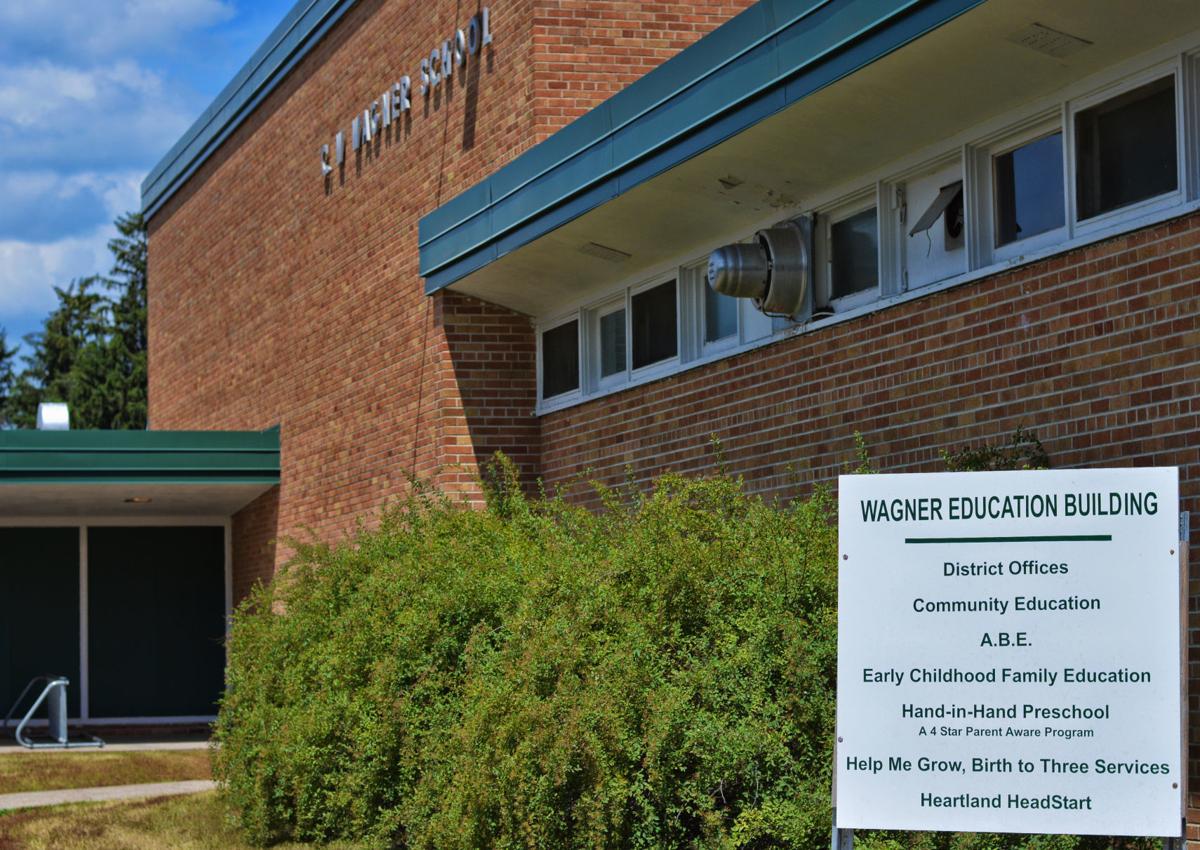
- Wagner Early Childhood Programs begin in-person;
- Ripley grade K-2 students will begin in-person;
- Ripley grade 3-4 students will continue distance learning;
- Middle School (three grades to be decided) will return to hybrid learning, with one grade continuing distance learning;
- High School (three grades to be decided) will return to hybrid learing, with one grade continuing distance learning.
As the transition happs, the district will continue to use its mitigation strategies, Simenson said, including frequent cleaning, taking students’ temperatures and mask wearing. In addition, teachers must wear face shields in addition to face masks, when in-class instruction begins again, as mandated by the Minnesota Department of Education.
Movement around the buildings will be restricted, and special instruction — such as music, library and STEAM — will take place in classrooms. In addition, students also will eat lunch in their classrooms.
“It is my goal to move our district to all in-person instruction as quickly and safely as possible,” Simenson said. “I receive daily communication from MDE so I am hoping for some flexibility to allow more students to come back to the in-person model.”

With Gov. Tim Walz's announcement of Executive Order 20-103, the Minnesota State High School League announced plans for in-person practice for winter sports and activities to begin Jan. 4.
Girls and boys basketball, girls and boys hockey, wrestling, gymnastics and boys swimming and diving can begin in-person practice, and the dance season can resume in-person practice sessions.
Member schools have the option to begin in-person participation at a later date if it best aligns with their district’s COVID-19 response plan, a MSHSL release said.
"While we recognize that our students, coaches and families are anxious to return to activities and athletics, the Jan. 4, 2021, date aligns well with many member schools’ calendars as they return from extended breaks," said League Executive Director Erich Martens. "This opportunity to participate in athletics and activities also comes with great responsibility. It is critical that all students, coaches, directors, and officials maintain the highest standard of health and safety, both in and outside of school. Everyone must actively share the responsibility of reducing the spread of COVID-19 and keeping themselves and others safe and healthy."
The MSHSL will continue to work with the Minnesota Department of Health and the League’s Sports Medicine Advisory Committee to review and update the Sports and Activities Guidance and Information that will further clarify, reinforce and implement the commitment to providing the safest environment for all involved.
"The League appreciates the hard work of Gov. Walz and state departments in recognizing the significance and importance of these activities and athletics for our students," Martens said. "Through participation in League activities and athletics, our students have enhanced physical and mental health and well-being. And, when they participate under the leadership and mentorship of League-trained and certified coaches and directors, implementing League-provided protocols and guidance, they can enjoy the safest possible experiences."
As for youth sports the executive order says practices may also begin Jan. 4. Games and tournaments, though, remain on hold until further directive.
Organized sport activity will no longer be directly tied to county case data or school learning model, the order said.
Additional guidance regarding the resumption of practices will be forthcoming.
HOW DOES THE WINTER SCHEDULE LOOK?
While teams have been given the OK to begin practices in January, there still were some unknowns as to when competition could begin.
MSHSL presented three possible models for returning to play during its December meeting. The second option, with a practice start date of Jan. 4, appears to be the most likely option, but much still depends on when competitions can start.
Here's a look at how that winter 2021 schedule could go:
- Dance: 10 weeks, Jan. 4-Feb. 15; sections Feb. 22 and March 1
- Boys Swimming and Diving: 11 weeks, Jan. 4-March 1; sections March 8
- Wrestling: 12 weeks, Jan. 4-March 1; sections March 8 and 15
- Boys Hockey: 13 weeks, Jan. 4-March 15; sections TBD
- Girls Hockey: 13 weeks, Jan. 4-March 15; sections TBD
- Girls Basketball: 13 weeks, Jan. 4-March 15; sections TBD
- Boys Basketball: 13 weeks, Jan. 4-March 15; sections TBD
All sports should be able to complete 70% of their regular season competitions — a number agreed upon in October by the Board of Directors — with the potential for section and state tournaments.
The MSHSL reiterated on Dec. 16 the "want" for state tournaments in March and April 2021.