


Carriage driver Shari Erickson, also known as Auntie Klaus, and her footmen Frances Brooks, left, and son Matthew Erickson, right, were giving horse-drawn carriage rides this past weekend at Riverside Park in Hutchinson. It’s all part of Erickson’s business plan to spread victorian-themed Christmas spirit.

Shari Erickson, aka Auntie Klaus, spoke to the Litchfield City Council about her carriage ride business during a Dec. 7 meeting.
Holiday activities are limited this Christmas thanks to COVID-19, but folks looking to make merry the old-fashioned way have a new option thanks to Shari Erickson of rural Hutchinson.
Erickson, a horse enthusiast, has started Erickson Acres Carriage Co., which specializes in horse-drawn carriage rides.
“This is my brand new dream,” she said. “My lifelong dream is to do something with my horses that I can make an income with.”
Erickson, or Auntie Klaus as she’s known while in character, recently received approval from Litchfield and Hutchinson city councils to give carriage rides in city limits. This past weekend, she spent Saturday and Sunday giving rides in Hutchinson, near Riverside Park and the Gopher Campfire Sanctuary.
Her carriages and company have a victorian theme, complete with footmen in top hats and livery coats. She has three different types of carriages, including a smaller one and a vis-a-vis, which allows passengers to face each other while sitting.
“Horse-drawn carriage rides are an opportunity for people to take a step back and enjoy a simpler life,” she said. “They don’t have to worry about anything that’s going on, other than enjoying what’s happening around them.”
Another part of the budding business Erickson is proud of are her four driving horses, including her “star,” Thyme, which she rescued from a kill pen.
“These horses are exceptional, and they were cast aside by someone as trash,” Erickson said. “Luckily for me, I was able to find them and they’re my treasures now.“
This is Erickson’s first go at a carriage business, and she also works in health care and commutes to Edina, so she’s not yet able to devote as much time to the carriage rides as she would like. But she’s learning as she goes and developing a plan. Rides typically last about 15 minutes, and the cost to ride is $17 per adult age 18 and older, $9 for kids age 5-17, and rides are free to children 4 and younger.
For now, Erickson’s schedule will be flexible. The best way to know if she’s giving rides is to follow her Facebook page, Erickson Acres Carriage Company LLC, or keep an eye out for her posts on community pages such as Real Life In Hutchinson and Real Life in Litchfield, MN.
The original focus of the business was to give rides from spring to fall. She doesn’t have a sleigh, so she can’t give rides in snow. But with people looking for ways to celebrate the holidays during this difficult time, Erickson hopes her horse-drawn carriages can help “spread some good Christmas spirit of an earlier time.”
“Right now, everybody is experiencing some really strange times,” she said. “So I’m trying to get this done quickly in December, because I really would like to spread some Christmas cheer.”
- Updated


Litchfield City Council approved a 2021 budget Dec. 7 that calls for a 5 percent levy increase.
The budget and levy received preliminary approval from the Council in mid-September, after City Administrator Dave Cziok initially recommended a levy increase of less than 1 percent. But the council members took a more aggressive approach after hearing Cziok’s explanation of the levy versus city tax capacity.
The approved levy will bring in $2.974 million in property taxes in 2021, and despite the 5 percent increase in total levy, it will have little net effect on the taxes paid by the average homeowner in the city.
“One of our goals … is to provide the public a consistent and predictable levy,” Cziok told the City Council, “so they know year-to-year what to expect from the city of Litchfield.”
His presentation included a line graph illustrating the levy’s gradual upward slope compared to the more erratic up-and-down of the city’s net tax capacity.
Cziok described the 2021 budget as a “business as usual” plan, saying that “what we did in 2020, we expect to do in 2021.”
And that’s without significant financial impact to the average homeowner.
The average home value in Litchfield, Cziok explained, is $140,000. If the homeowner’s property value remained the same from 2020 to 2021, they would actually see a $29 reduction in property tax. If the property value went up 5 percent, the tax impact should remain flat.
“Administration puts a heavy emphasis on conservative budgeting and a microscopic review of expenditures,” Cziok wrote in the 2021 Budget Book introduction. “The budgeting goal is to provide the Litchfield City Council with a consistent document that provides the same level of services year after year. The Litchfield City Council can be assured that the day-to-day activities will remain the same unless specifically modified to meet the council and community’s need.”
The levy helps support a total budget of $25.6 million, which includes eight separate funds, including a general fund budget of $5,963,358. Other large funds include electric ($10,687,505), sewer ($4,191,593), liquor store ($2,980,400) and water ($1,000,429).
Council members asked only a few questions regarding the budget.
Eric Mathwig wondered if the city should consider charging a fee or annual dues for use of the city compost site.
Cziok said the biggest question for him has been whether a distinction should be drawn between city residents and the rest of Meeker County. It is believed that about 25 percent of the traffic and compostable material at the site comes from those outside the city. That could make a case for the city asking the county to share some of the cost of operation, he said.
The budget presentation also included an opportunity for public comment, and two residents on Harmon Lane questioned their taxes as they relate to city services. Their planned unit development and services such as street cleaning and snowplowing are done by private contractors, hired by their homeowners’ association.
The residents expressed disappointment that services that normally are handled by the city are instead an extra cost to them.
Cziok explained, however, that the PUD developer signs an agreement that street maintenance is the responsibility of the developer or homeowners association, not the city.
With the close of the hearing the City Council proceeded to vote on four resolutions. All received unanimous approval, with the exception of the resolution calling for the 5 percent tax levy increase, which Council member Darlene Kotelnicki voted against.
- Updated

Federal CARES Act dollars flowed to 45 Meeker County businesses during the past few months, with the county distributing more than $1 million in assistance to both businesses and nonprofits.
Those figures were shared in a news release distributed at the Litchfield City Council meeting Dec.7.
The program, whose funding was created by congressional action, wound up distributing 55 grants to 45 businesses that totaled $773,135. Thirty-four non-profit organizations also received grants.
Distribution of funds went countywide, with businesses in six cities and eight townships receiving funds.
Litchfield participated with Meeker County and other municipalities and townships in the county to create an assistance program for businesses and nonprofits that were negatively impacted by COVID-19. The businesses and organizations submitted applications for assistance, with Meeker County Economic Development Authority reviewing business applications and a CARES Committee reviewing requests from nonprofit organizations.
The county received 74 applications, and five were determined to be ineligible for the program either because they were located outside the county, did not meet criteria, or were not in business until 2020 and were unable to show financial impact a one-year financial impact.
That left 69 applications for review. Four requests were incomplete and did not provide required documentation and were dismissed. Another 10 businesses received no award, because it was determined they did not suffer losses once other federal or state assistance was considered.
Of the 45 businesses receiving grants, 21 were located in Litchfield and received $299,250 in assistance. Those businesses employ 70 people, according to the news release.
Countywide, businesses receiving assistance — who employ a total of 156 people — received an average grant of $17,180. Grants ranged from $550 to $50,000.
And as the county’s CARES Act goals stipulated, it was truly small businesses that benefited, with number employees among businesses receiving grants ranged from one to 17, and the average being three employees.
Application details from the businesses showed they experienced a revenue decline of about $4.5 million and a loss of profit of $2.6 million between 2019 and 2020 in designated reporting periods of March through July or March through October.
Some of the businesses also took advantage of $1.2 million in other assistance, such as the Paycheck Protection Program, Economic Injury Disaster Loan Grant Advance, and State Business Relief Grant. That assistance was considered when determining CARES Act fund distribution, the county said.
Nonprofit help
The county also received 40 applications for CARES funds from nonprofits, and through various considerations, the news release said, grants were distributed to 34 organizations.
Those groups employ 181 people, with total employment ranging from one to 149 people. Grant awards ranged from $340 to $50,000, with the average nonprofit receiving $7,480.
The selected applicants experienced a loss of $1.1 million in revenue and more than $530,000 in profit.
In addition to the CARES funds, the selected applicants received $1.1 million in federal Paycheck Protect Program funds.
- Updated

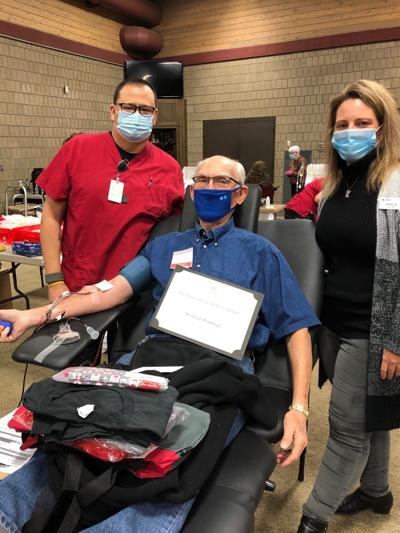
Willard Wendorff has donated to the American Red Cross 184 times now to share his blood with those in need. He was recognized for reaching the 23-gallon milestone last month.
According to the American Red Cross, one donation of blood can save up to three lives. For Willard Wendorff of rural Hutchinson, those three potential lives have multiplied quite a few times over the years.
“The first time I donated, the Red Cross had come to Cosmos in 1964,” the 77-year-old said after donating blood in late November. “My mother talked me into it.”
Since then, Wendorff has been a regular donor. He reached his 23rd gallon at a November blood drive at Peace Lutheran Church in Hutchinson. Eight donated units makes a gallon.
To reach his most recent milestone, Wendorff maintained donations whenever he was allowed, save for a time when he couldn’t for a medical reason, and when he’s been deferred for low hemoglobin.
“He’s just so determined to give,” said Shirley Wurdell, who coordinates blood drives at Peace Lutheran. “He’s very dedicated.”
If ever Wendorff has been deferred, she’s seen him return soon after making adjustments to his diet to stay healthy.
The American Red Cross allows donations once every eight weeks, or once every 16 weeks for those who give a Power Red donation, which takes two units of blood and returns plasma and platelets to the donor.
“3M years ago would have the bloodmobile come right out to the plant a couple times a year,” Wendorff said. “So I donated there the 35 years I was there.”
He’s kept at it because it’s the only way to make sure those who need blood in an emergency have it.
“They haven’t come up with anything for artificial blood,” Wendorff said. “So it helps.”
It’s safe to say needles don’t bother him very much. He’s up to 184 donations now and has set a goal of reaching 200, or about 25 gallons.
“As long as the good Lord keeps me healthy enough,” he said.