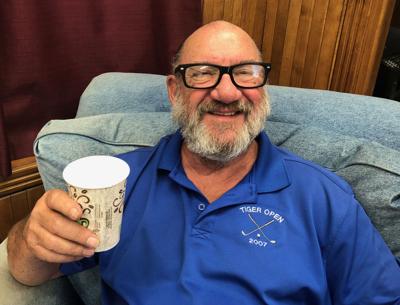
When farmers across Minnesota have a question about mental health or suicide, they call Ted Matthews of Hutchinson.
The 71-year-old psychologist was recently selected as the Ag Person of the Year by the the University of Minnesota Extension and Hutchinson Area Chamber of Commerce Agri-Business Committee for his work with the Minnesota Department of Agriculture. But Matthews, whose help is always free, is the only person on the job in Minnesota. The demand for his time is high and growing, but two new bills introduced in the Minnesota Legislature this session may lead to some support.
“We have Ted Matthews, and while he is wonderful, he is getting close to retirement,” said Debra Kiel, R-Crookston, who represents District 1B. “We need to be able to replace [the position] but also expand. We don’t have enough Ted Matthews to go around.”
Kiel introduced two bills to address the problem. One bill, H.F. 84, calls for $150,000 from the general fund for “statewide mental health counseling support to farm families and business operators through the Minnesota State Agricultural Centers of Excellence.” The money will add up with $113,000 designated in 2017 to support the mental health program until June 2020. Another bill, H.F. 82, calls for $330,000 in 2020 and 2021 for “statewide mental health counseling support to farm families and business operators through the Minnesota State Agricultural Centers of Excellence.”
Kiel said she split the funding into two bills in the hopes that one could pass quickly and get the ball rolling on expanding the program. The second bill would provide funding for the near future.
“We need to get going,” she said.
As a farmer herself, Kiel has seen the stress caused by challenges farmers face.
“While you make choices, a lot is out of your control, so you try to do the best you can,” she said.
Looking ahead
Matthews was at the capital Jan. 24 to speak with lawmakers about his program and the bills.
“I was pretty impressed with how it went, how it’s going and the support I’m getting from Democrats and Republicans,” he said. “I couldn’t tell the difference between Democrats and Republicans. To me, that’s a good sign. ... They work together well.”
Matthews discussed with lawmakers a plan to fund the expenses of the mental health program, improve salaries and grow its staff. Kiel added that funding would also go to support services that aid Matthews.
“I’m very optimistic,” Matthews said. “[Legislators] were disappointed they put [rural mental health funding] into an omnibus bill, and it wasn’t signed [last year]. It was left there by the governor.”
Matthews said another person to help him cover the state and administrative duties would go a long way.
“It’s impossible for one person to do the state,” he said.
Though the program may be small, it is ahead of the curve nationally.
“Frankly, no one else in the country is doing the things we’re doing,” Matthews said.
The Farm Bill, approved late last year in Washington, D.C., includes $10 million annually for five years to provide rural mental health services. Matthews said he has questions about who is going to train people to provide rural mental health services and what the program will look like.
“I don’t think they know,” Matthews said. “But I’m optimistic.”
Kiel said there is still more work to be done in the Minnesota Legislature – markets need to improve to stabilize life for agriculture and its associated businesses to smooth the transition for the next generation.
“We have to think about ... a lot of farmers getting close to retirement or in retirement,” Kiel said. “There are some real challenges in that transition.”
Help is available
In the meantime, Kiel wants Minnesota’s farmers to know they aren’t alone and that help is available. Matthews, whose phone number is 320-266-2390, often takes calls from people who just need a question answered and no further commitment is required. In other cases, an appointment is appropriate.
“I would encourage people, if you see someone stressed, be sure to talk to them. Ted Matthews is a great resource,” Kiel said. “It feels like a lot of guys feel like generations before them didn’t fail, and they are struggling. But it’s way more than one person can control. We need to be sure they see that.”
Kiel said that more than ever, husbands and wives are becoming teams on the farm, and the daily or hourly side-by-side partnership creates a unique bond. But she still sees husbands worried about burdening their wives with more stress that they may be holding onto.
Kiel’s friend lost her husband to suicide.
“It didn’t solve anything,” Kiel said. “It just created another mountain for her to climb and without her partner.”
Matthews encourages people to always have a plan.
“Who do we call if we think someone is suicidal?” he asked a Hutchinson crowd in December. “If we don’t have an answer to that, we will do nothing.”
In addition to Matthews and state services, possibilities include social services, the sheriff’s office or a clergy member.
“If indeed they weren’t going to kill themselves, OK, so you wasted a little time. You feel a little embarrassed,” Matthews said. “But what if they were? How important is that? The amount you gain is life-giving.”