

Sunday, Nov. 10, 1940: “41 degrees and dampness all day.”
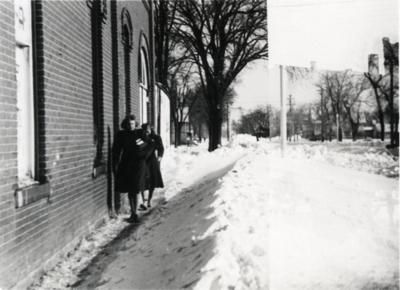
Monday, Nov. 11, 1940: “Turning into an old-time snowstorm ... the worst storm since Oct. 14, 1880.”
Andrew Anderson of Hutchinson kept a weather journal, and not just any weather journal. It was a day-by-day climate recording spanning from 1898 to 1943, a treasure trove for any meteorologist studying weather history. On most days, Andrew’s recordings were nothing more than a simple figure showing the highs and lows of the day. Sometimes he would include a brief description of the weather that day. On Nov. 11, 1940, however, a nearly half page account is given. It was the day of the Armistice Day Blizzard, and a day that etched itself into the memories of all who lived through it.
On Nov. 11 of each year, Americans celebrate Veterans Day, but in 1940, it was referred to as Armistice Day: A day to celebrate the signing of the armistice between the Allied Forces and Germany that effectively ended World War I. In 1940, Armistice Day fell on a Monday.
As Anderson noted, the days leading up to Armistice Day were warm. Much of the Midwest was experiencing an “Indian summer” that year. In fact, one old duck hunter who shared his story remarked on how the weekend before, he and his partner were swatting at mosquitoes while sitting in the marsh. As the days crept closer to Armistice Day, the temperature began to slowly drop, typical for this time of year. By Saturday, Nov. 9, seasonal temperatures had finally arrived to Minnesota, bringing with it drizzle and light rainfall.
The misty rain fell all weekend long. Light snow was forecast for the morning of the 11th, but nothing severe was in sight. For many, namely the duck hunters, the promise of snow sent them out into the marshy sloughs and river bottoms, hoping the snow would trigger the great waterfowl migration and that good shooting would follow.
The sky was dark and gloomy when Armistice Day dawned, and the drizzle was turning to light snow. Still the temperatures were reasonable, and most who ventured out that morning did so in light jackets. The duck hunters were some of the first to note the weather change. They watched the light snow turn into large, fluffy flakes that fell into the tranquil waters.
After a while, they began to notice that their decoys were swaying atop the calm water, signaling a shift in the wind. In a matter of minutes, the wind shifted to the northwest and the temperature dropped dramatically, worsening as the wind grew stronger and began to gust.
It was a warning from nature that many ignored, however, as the strong winds also brought waves of ducks fleeing south ahead of the coming storm. The hunters who survived what was to come often remarked on how the ducks were frantic in their flight, swooping down from the sky with wild abandonment. By the time many of the hunters drew their attention away from the birds, it was too late.
The wind was gusting as high as 60 mph and the waves on the lakes and rivers were far too rough to navigate with small canoes and duck boats. Most were forced to stay the night under overturned duck boats, huddling together or hugging their dogs for warmth. Those who ventured out that morning in light shooting jackets, got wet or found no shelter in the marshes died from exposure.
It was just as bad for motorists. People caught on the roads and highways were forced to stop or found themselves stuck in drifts. Stranded motorists were either welcomed into farmhouses or forced to ride out the storm in their cars. Some of the latter were discovered frozen to death in the days after the storm.
The situation in rural areas became treacherous. The snow fell so hard and the wind blew so furiously that many farmers lost their way from the house to the barn. Livestock stuck in pastures froze standing up, and whole flocks of domestic turkeys were lost.
In rural schools, teachers were forced to choose between sending the children home or trying to keep them safe in the one-room schoolhouses. At the Lamson School in Meeker County, just across the county line, Elaine Linder Lundeen was forced to deal with this same problem during the killer storm.
The younger children were sent to a neighboring farm to stay the night, the older children, as well as Lundeen, stayed huddled in the drafty schoolhouse overnight. A neighbor trudged through snow drifts up to 10 feet tall and brought food to the students. The following day when the snow subsided, the children were brought to their homes.
The snow was done falling on Nov. 12, but the temperatures clung to single digits and the strong winds brought a windchill well below zero. Search parties were sent out across the state to find those who were stranded in the storm. Many were saved, but many were not. When it was all said and done, a death toll of 49 people was counted across the state, most of whome were duck hunters.
To this day, the Armistice Day Blizzard sticks out as one of the worst blizzards ever experienced. Though a mere 16 inches of snow fell (nearly 3 feet of snow if measured with today’s methods), the lack of warning is what made it so deadly. Since then, weather predicting has changed and a storm of this magnitude can be predicted days in advance. Yet, when chilly temperatures roll in with the November winds, and a light, unexpected snow flurry begins to fall in the duck blind, one can only wonder if a new storm of the century lurks over the cloudy horizon.

