

We’ve all heard this before: To arrive at your destination safely, don’t drive intoxicated, put down the phone, pay attention to your speed, and buckle your seat belt.
Last year, the failure to use seat belts factored into 82 people losing their lives on Minnesota roads. Among them were two McLeod County crash victims who were ejected from their vehicles.
“The passenger compartment of their respective vehicles remained intact and did what it was designed to do, showing us that had they been wearing their seat belt, they likely would be with us today,” said Scott Wawrzyniak, a patrol sergeant for the McLeod County Sheriff's Office and a member of the McLeod County Toward Zero Deaths Safe Roads Coalition.
Wawrzyniak explained that the coalition, which includes public safety officials and other public members, annually review facts and photos collected after fatal collisions. Based on what is learned, the group recommends actions that might help prevent future crashes. Among those actions is increasing public awareness of the lifesaving capabilities of seat belts.
“My belief is that increased vehicle safety, along with the increased use of seat belts, has lowered the number of people injured despite the increased number of crashes,” Wawrzyniak said.
2023 was a deadly year on the county’s roads. Six people died in motor vehicle crashes, compared to the historic average of two or three per year.
Higher speeds, impairment caused by alcohol and cannabis use, and other risky driver behaviors were involved in the majority of 2023’s fatal county crashes, according to Wawrzyniak.
But the one factor that helped save lives in many of last year’s 426 county crashes was seat belts.
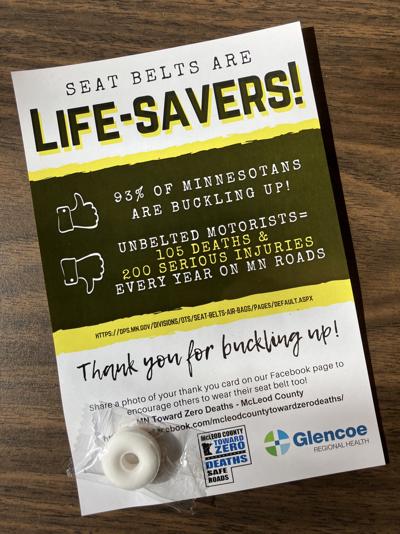
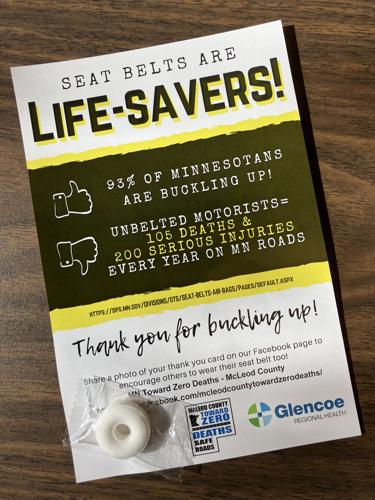
“In 2021, 93% of Minnesotans were using seat belts,” he noted. “That number has increased upward of 10 percentage points since the early 2000s and hopefully we can reach the upper 90s in the percentage of Minnesotans using seat belts by the late 2020s.”
To reach that goal, the McLeod County Toward Zero Deaths Safe Roads Coalition — a nonprofit that works to decrease traffic-related injuries and fatalities through partnerships that promote safety — is partnering with 15 banks to remind their drive-thru customers that seat belts are lifesavers. More than 3,000 informational flyers with LifeSavers mints attached are being distributed to bank customers who are spotted using their seatbelts. The effort is a reward for good driving behavior, Wawrzyniak said.
“Everyone can set a good example for others by using their seat belt,” he said. “Parents educating their children and teenagers requiring their passengers to buckle up are huge components to increasing seat belt use.”
Statewide, the number of road fatalities — 413 in 2023 — fell slightly from 414 in 2022, and 458 in 2021. But totals for all three of those years were a jump from a previous decades-long trend resulting in fewer fatalities. During the late 2010s and in 2020, annual totals deaths numbered fewer than 400.
A dramatic rise in speeding at the start of the pandemic in 2020 is largely to blame for the increase, state public safety officials say.
Tragically, four of the six people who died on McLeod County roads last year perished in three separate crashes along a short stretch of State Highway 7 west of Silver Lake.
“This is one of those statistics that I believe is an anomaly, similar to the stretch of County Road 7 north of Stewart was in late 2018/early 2019,” Wawrzyniak said. “The state has gone to great lengths to improve safety on the stretch of Highway 7 in McLeod County and we have seen the addition of passing lanes, bypass lanes, center-turn lanes, to name a few. All of these have increased safety on that road within the county.”
One thing that engineering cannot control is personal behavior, Wawrzyniak added.
“As we have said many times over the last several years, slow down, pay attention to the road, wear your seat belt and drive sober,” he emphasized. “Following those rules greatly decreases your chances of being involved in a serious crash.”
Among the 2023 county crash data findings:
- A total of 426 crashes, 107 involving injuries, were reported.
- Ten crashes involved serious injuries.
- Four of those crashes occurred in work zones.
- Commercial vehicles were involved in 42 crashes.
- 6 to 7 p.m. was the busiest time for crashes; 2 to 3 a.m. was when the fewest crashes were reported.
- February, a snowy month, saw the largest number of crashes: 53.
- The highest number of crashes occurred on Thursdays, followed by Fridays and Mondays. Saturdays, typically when a higher-than-normal number of crashes occurred, were the day of fewest crashes.
- Distracted driving such as using a phone — often cited by the public as a dangerous behavior — was identified as a factor in only one in four crashes.
“Crash statistics are driven by what law enforcement investigating the crash can prove,” Wawrzyniak said. “Oftentimes, law enforcement cannot prove that phone distraction was a cause of the crash, and thus that is not listed in the report as a contributing factor.”
With the recent legalization of marijuana in Minnesota, Wawrzyniak had one more word of caution for people who plan to use cannabis and drive — don’t.
“Just like drinking and driving, the responsibility relies greatly on the user,” he said. “Using any substance that has the ability to impair comes with great consequences, and that should be considered prior to getting behind the wheel to drive.”


