

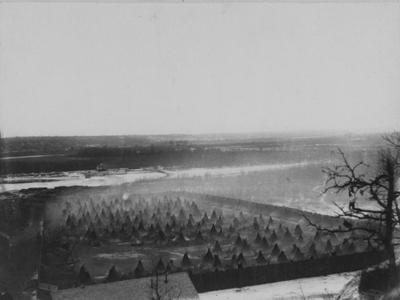
If you’ve been a regular reader of my column, you’ve likely noticed that I enjoy writing about the U.S.-Dakota War of 1862, sometimes referred to as the “Sioux Uprising.” Not only do I enjoy writing about the topic, but I also enjoy educating museum visitors about it.
The war was the bloodiest event to ever take place in Minnesota, and one that in many ways still raises controversy when talked about today. In fact, it wasn’t long ago that a sculpture at the Walker Art Center in Minneapolis raised eyebrows for its depiction of the gallows used to execute 38 Dakota men who took part in the war. Most recently, however, the topic among historians has been the Dakota Internment Camp at Fort Snelling, the place where 1,700 Dakota men, women and children were held while their fate was decided.
Before I get too far into the latest controversy, I suppose I should offer a brief history of the war and what part the internment camp played. In August and September of 1862, a large faction of Dakota warriors who felt cheated by the U.S. government began killing white settlers, women and children included, along the Minnesota River Valley. By the war’s end, about 600 settlers had been killed. Many more were displaced and found themselves living inside makeshift forts along the frontier, many of which were little more than dirty refugee camps filled with hunger and disease.
For the Dakota in Minnesota, a similar fate awaited. Many warriors were killed, but those who were not fled the state to the Dakotas and Canada. Those who stayed behind, however, were forced from their homes on the reservation, marched across the state and held in an internment camp at Fort Snelling.
The camp was a dreary, devastating place. Winter had just begun and a bone-chilling cold had set in. In all, nearly 1,700 Dakota were crammed together inside a wooden stockade overlooked by the fort. Much like the stockades on the frontier where displaced white settlers found shelter, it was cold, people were starving, disease was prevalent and the inhabitants were uncertain about their future.
To make matters worse, the camp’s inhabitants were innocent of any wrongdoing. Nearly all of the killings in the war were committed by warriors from Little Crow and Shakopee’s camp. They, of course, fled to the Dakotas or Canada at the war’s end. Those left behind were peaceful, many of whom played no part in the war and even aided white settlers to safety. Yet they were made to pay the price and would eventually be exiled from the state.
Today, many historians look back on the camp as little more than a concentration camp. Even for me, this was the focal point of the camp when studying it in college. Yet some historians are beginning to take a new look at the camp, and some are even providing evidence that may change the way modern historians view it.
In the past month, two articles have appeared in the Star Tribune that adhere to the thought that although the camp was far from an ideal place to live, it may have been the safest place in the state for the Dakota at the time.
(A quick disclaimer. In no way am I sharing my own views in this article, but rather sharing some thoughts that other historians have put forth recently.)
White settlers in Minnesota were furious in the aftermath of the Dakota War. Nearly everyone knew of someone who was killed, wounded, displaced or suffered some form of violence at the hands of the warriors. Historical records show that while the Dakota were being marched from the reservation to Fort Snelling, the army that accompanied them had to continuously protect them from not only angry white settlers, but from soldiers within the guard.
The Dakota were attacked while marching through New Ulm, where emotions ran high as the citizens, on that exact day, were re-burying family and friends who were killed in August. It was reported that residents threw boiling water at the Dakota. They were again attacked while marching through Henderson, where a white woman grabbed a Dakota baby from its nursing mother and smashed it into the ground.
When the Dakota finally reached Fort Snelling, they were put inside the stockade internment camp and a guard was set to watch over them. What few realize, however, is that the guards were not trying to prevent the Dakota from leaving, but from whites in the area entering and causing problems. In fact, records show that the Dakota were allowed to come and go to hunt, fish, trade and sell items in the city. White residents, however, were not allowed to enter without a pass.
In the meantime, newspapers across the state called for attacking any Dakota found on the countryside and groups of men were patrolling what was left of the frontier settlements in search of war parties, some of which were still at large.
With these facts coming to light, it does indeed beg the question of just what was the purpose of the internment camp. As stated earlier, the common thought is that the camp was little more than a concentration camp, yet new revelations surely make us give it some more thought. Perhaps the internment camp, like so many other things in history, shows that even when we think we know it all, there is always more to the story.


