


Plastic shopping bags often end up in the trash or stuffed in a cupboard to use for another day. Others are returned to the grocery store to be recycled into something else such as new bags, outdoor patio furniture, water pipes and plastic lumber.
But some local groups are turning plastic bags into sleeping mats for the homeless, an initiative started by a Litchfield woman six years ago.
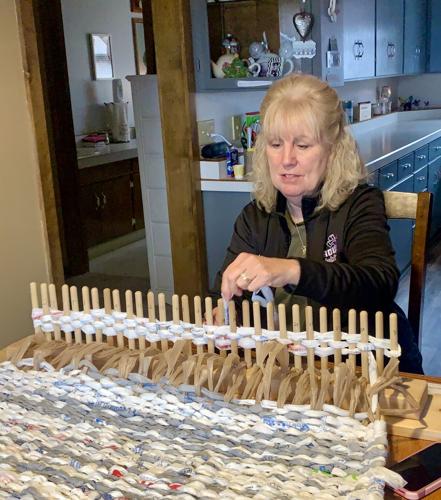
Peggy Eddy helped launch the effort at United Methodist Church in Litchfield, later teaching Nancy Marcks of Hutchinson how to make the mats. Together the two women have assembled a small group of community members to weave and crochet sleeping mats for the homeless.
“It started out as something to do,” Eddy said, “but now it’s something that’s needed for the homeless. I know we have a terribly huge population of homeless people. Most people don’t realize how big it really is. Even in Litchfield, there’s homeless people. You may not see them, but they’re there and they need help.”
Marcks brought the idea to her church, Oak Heights Covenant, and the congregation started its Mat Making Ministry a year ago. Together with Dassel Covenant, United Methodist and River of Hope, the group makes approximately 10 mats a month. Their mats then are delivered to Minneapolis homeless by Jeff Schmidt’s ministry Operation Hope.
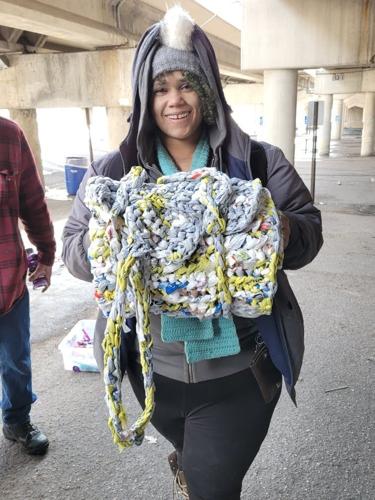
“The mats provide a little cushion and a barrier against the moisture in the ground,” Schmidt said. “People appreciate them, and I like what Nancy’s doing, making them portable … They recognize them and they want one.”
Schmidt and his team go to Minneapolis every three to four weeks to distribute items to homeless people, and the sleeping mats are a hot commodity.
The first time Schmidt brought the mats, they were gone within minutes.
“That gave us the desire to make them a little bit quicker,” Marcks said.
The raw material for the mats comes from recycled plastic bags collected from Walmart and Cash Wise. The stores have been supportive, with Cash Wise even providing a $25 donation and a box of bags, Marcks said.
However, the group is facing a challenge — there aren’t enough hands to weave the mats to keep up with the growing stockpile of plastic yarn, or “plarn.”
Oak Heights and Dassel Covenant have six weavers, while River of Hope makes the plarn for the mats. In Litchfield there are two crocheters, but they have to make their own plarn, which is time consuming, according to Eddy.
“If Nancy’s got an overabundance of bags, because her church does it, if she’s got more than she needs, she shuffles them my way,” Eddy said. “But a lot of the time I do my own cutting. Now I’ve got people all over town collecting bags for me. I’ve even done dumpster diving at Walmart when I didn’t have enough bags. I go into their recycling bin, they said I can have them. I go in and take bags out of if I get really short.”
Marcks uses 1,000 plastic bags to weave one sleeping mat, and it takes about six to seven hours to complete. It takes Eddy about 28 hours to crochet each mat she produces.
“I usually work on it a little bit each day,” Marcks said. “They both (weaving and crocheting) come out pretty soft and pretty durable. The advantage of the mats is that Number 1, we make handles for them they can carry, most people have to carry all their stuff with them. And Number 2, if they get dirty, you just rinse them off with a hose. It keeps you up off the ground, so the ground isn’t quite as cold. Plus, it keeps you a little bit more dry.”
Weaving sleeping mats is pretty simple, according to Marcks, who said anyone can do it. She’s even offered lessons to anyone willing to try.
“If they can’t afford the $10 for the loom, I’ll help them,” she said.
A 2018 Minnesota homeless study found 11,371 people were homeless across the state, which is a 10% increase from 2015.
“The people, we can’t fix them. We can’t solve all their problems. We can brighten their day,” Schmidt said. “We can help them with something.”


