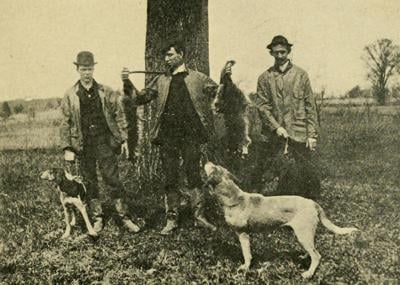
The year was 1913. It was winter, and near Belle Lake, in the woods that would become Piepenburg Park, 14 armed men, some of whom were charter members of Gopher Campfire Club, prepared to rid the woods of a few local menaces — skunks, coons and any other predator animals that roamed the woods. Walter Clay, “Big Chief” Huderle, and two other “Indians” made an advance trip to the woods to scout and find a campsite for the rest of the hunters.
After picking a good campsite, the four men set out to find some camp meat. Their quarry was skunks that were fast asleep, hibernating in their underground burrows. The tools for the job were of course guns, but also sulfur, charcoal, matches, bellows, tin pipe, shovels, picks and axes for cutting away roots. Once they found where a skunk was burrowed, they’d dig into the skunk’s den and smoke them out before killing them.
The rest of the party was led by Sam Anderson Jr. They came the following morning and were treated to a hot meal prepared by Joe Eheim. The remainder of the day was devoted to setting up camp, eating skunks, and hunting rabbits for additional meat. As the sun set, however, the real fun began when a Winsted man let loose his celebrated coon hound.
The dog was a sight to see. He worked the woods in search of raccoons. Eventually he’d come across a scent, and that’s when the real fun began. Under the cover of a cold, night sky, the men watched the canine’s silhouette weave between the trees, duck under brush, and crisscross over the trail. His tail wagged with vigor and his pace quickened as the scent of a coon grew stronger. His nose worked like a finely tuned instrument, and soon it led him directly behind a raccoon that was scurrying hard to climb a tree. The dog, unable to climb after the varmint, stood on his haunches with his front paws resting on the tree and howled loudly.
Echoes of the dog’s cry cut through the cold night air like a sharp knife. The hunters, knowing well that the sound meant a “treed coon,” followed their ears through the darkness until they came to the tree. With the aid of a few lanterns, and against the backdrop of the sky, the men scanned the tree’s limbs until they spotted the racoon. After bringing it down, the dog was congratulated with pats and scratches, then sent back into the woods to repeat his task.
Raccoons weren’t the only animals being hunted that night. While the hound dog hunted for raccoons, he came across a new scent and followed it up until he treed the animal. The men followed the howls. Instead of finding a raccoon up a tree, however, they spotted a large bobcat — an elusive predator. Like the racoons, the bobcat was brought down. Upon inspection, it was deemed to be the largest bobcat ever killed in McLeod County to that time.
So went the great predator hunt of 1913. It wasn’t the first, and it certainly wasn’t the last. As all things, however, the great organized hunts of the day eventually faded away — too much development, and not enough places to hunt, I guess. It, like so many other things, has become a part of history.
— Brian Haines is executive director of the McLeod County Historical Society and Museum, 380 School Road N.W., Hutchinson. Do you have a historical anecdote to share? Haines can be reached at 320-587-2109, or by email at director@mcleodhistory.org.