

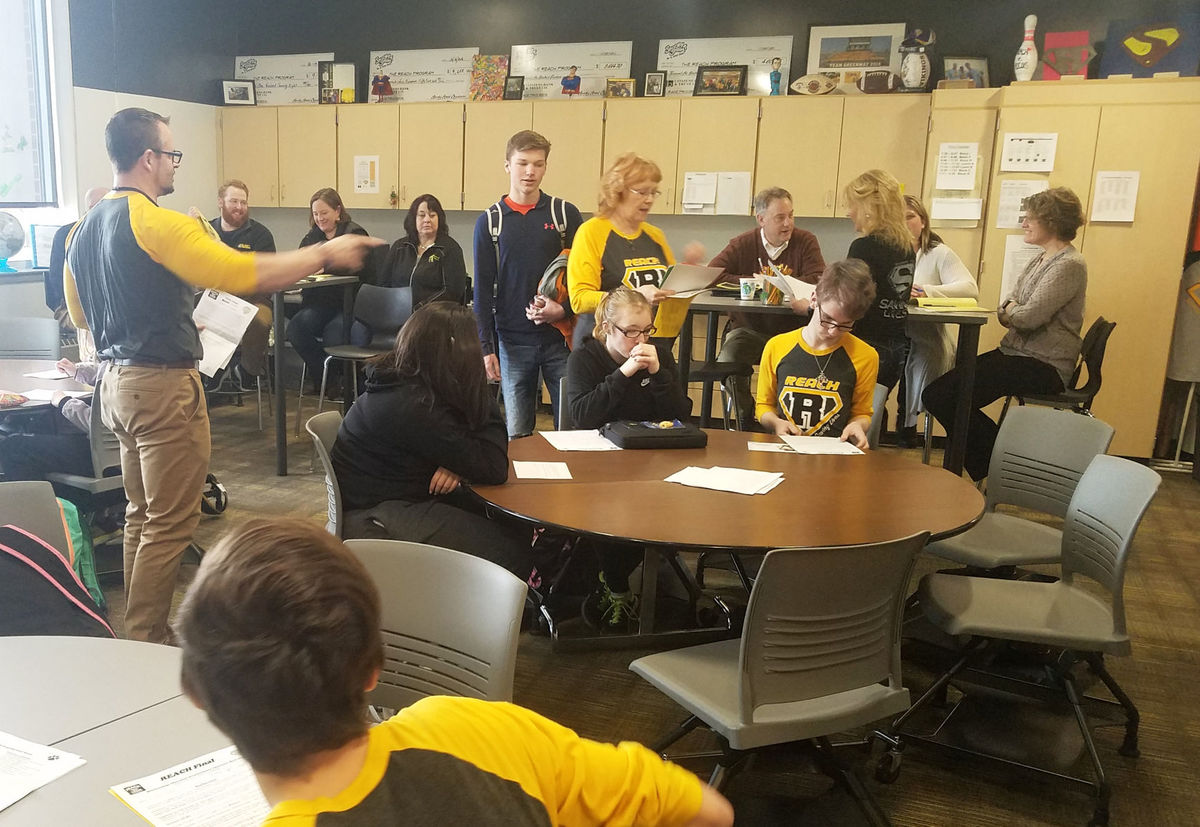

In their new classroom at Hutchinson High School on a recent Friday morning, students in the REACH program started their third block by talking about some of the challenges in their lives, and their hopes for the future.
One student hoped to build a better relationship with her parent, to be more open about her feelings, and make it to college. Another hoped to offer a life without violence and chemicals to his own kids one day. Yet another hoped to create healthy boundaries, and not do anything to disappoint his family. One student said she wanted to take better care of herself, and improve at school, in art and at work.
“Where we are today doesn't have to be where we end up,” said REACH director Chad Harlander, who encouraged students to identify the road blocks in their lives, and make a plan to overcome them.
It wasn't an unusual exercise for the students, who on Fridays focus on goals. Every day at REACH — which is scheduled during the day like an ordinary class — lessons hone in on one of the standards of relationships, education, accountability, character and hard work.
What was out of the ordinary on this particular Friday were tables of guests from schools in Minnesota's Iron Range: Mesabi East, Eveleth-Gilbert and Northland Learning Center in Virginia.
“The social/emotional component of schooling, I think, is starting to be more focused on in schools right now,” said Gary Pernu of Northland Learning Center. “All schools have been practicing components of kindness, responsibility and character over the years, but there are students who need it focused on a bit more … All kids have unmet territory, whether it's with academics, whether it's with anger, just navigating through every day life.”
He learned about REACH three years ago during a state conference in Duluth. For the past 10 years, the Hutchinson program has offered social and emotional help to students. In many cases, that help has translated into more classroom success.
“They have more time to think about schoolwork if we can help them find the skills to deal with anxiety or mental health that is weighing them down,” said Angela Young, who provides educational support with REACH. “Kids that are struggling academically often have other things going on.”
PASSING CLASSES
After REACH's first trimester, its students were passing 68 percent of classes, compared to having historically passed about 25 percent of classes. Today, REACH students pass an average of 93 percent of their classes. But it isn't just test scores the REACH team focuses on.
“(We are seeing) less coping skills, an inability to work through stress,” said Rhoda Hubbard, REACH teacher.
REACH attempts to teach those skills with class exercises and discussions.
“Social anxiety was the first thing I talked about with (REACH),” said Cheyenne McCoy, an 11th-grade student at Hutchinson High School. She joined REACH about a year ago.
“I was so extremely shy and I hated the thought of interacting with other people,” she said. “One of the REACH teachers would come up to me and create a small conversation and then say, 'OK, go talk to somebody else, go start a conversation with them.' Before that we would run through conversation starters, or how to keep a conversation going.”
Hubbard said many people have support networks that form naturally in their lives, whether it's talking with colleagues around the water cooler, or sharing worries with friends while hanging out. But some students, she said, don't naturally create those connections, or know how to, and REACH offers a safe place to start that learning.
Other REACH strategies include encouraging students to accept the responsibility of making healthy choices, including those relating to chemical use, and talking about life outside of school.
When Pernu learned about REACH's approach, he took it back to his school. Over the next few years, Northlands Learning Center joined numerous other schools that created their own REACH programs. There are now 29 in Minnesota, and two in South Dakota.
“(REACH helps) address the changing day-to-day concerns of our students,” Pernu said. “We focus on the MCA's, but … even kids who receive decent grades have outside personal concerns that need to be addressed, whether it's responsibilities on a job, or kindness, or manners.”
He said it is important for schools to recognize students have varying family structures.
REACH acknowledges this, and the fact that a lot of a student's life happens when they are not in school. That's a reason why its team helps provide resources to families when needed, and finds ways to connect students with their community. In Hutchinson, REACH students volunteer at the Spooky Sprint, which is a fundraiser for the program, and volunteer locally at an annual holiday dinner, as well as other community service projects that let them “give back.”
Word spread from Pernu to the nearby Mesabi East and Eveleth-Gilbert schools. Before staff from those schools sat in on a REACH class, they had a chance to ask questions of the team.
“So it's not lowering the rigor of classes?” asked one visitor.
The REACH team said that rigor in classes stays the same for students.
“How do you define chemical dependency? I look at my class and I can think of two kids who don't drink on the regular,” asked another visitor.
Harlander said students with chemical dependency issues often identify themselves when they learn REACH is a safe place, and that over time, the staff notice signs. To help with the conversation, and to approach the issue of responsibility, REACH students are asked to sign a contract stating they will not use chemicals, won't skip class, and will stay up to date on assignments.
MENTAL HEALTH IN THE HEADLINES
While the concept of a student's mental and social well-being is nothing new for school districts, or REACH, the subject has recently been thrust into national headlines due to school shootings.
The morning after the Feb. 14 school shooting in Parkland, Florida, Minnesota Department of Education Commissioner Brenda Cassellius wrote to Harlander in an email: “In light of yesterday's events, I just once again want to thank you for your work with our kids who often feel disconnected or unappreciated. Thank you for loving them and providing them with support and care.”
A Feb. 27 meeting of law enforcement, pastors, education and mental health professionals and others in McLeod County focused on school safety, the needs of residents, and the resources in place.
“If there was something in common with all school shooters it may be mental health,” David Conrad, executive director of New Discoveries Montessori Academy, said during the meeting.
Later, the Rev. Tim Vanden Langenberg said, “We are missing the spiritual aspect of the person. We say it is a mental health issue, but I want to say we have ignored the spirit part of the body. We need to start saying that is a huge part of the human condition.”
“The kids are starving for love and safety,” said Jim Rogers of Crow River Youth for Christ.
According to Harlander, REACH is an example of one resource already in place to address that kind of need. He said that as students find safety in REACH, and see it as a kind of family, it makes it easier for the team to connect them with professional services they may need outside the school.
“Our goal was to provide the hope and the how by creating a safe culture through relationships,” Harlander said, “for each student to develop a sense of belonging.”
He said Hutchinson Public Schools' administration benefited students when it was willing to think outside the box 10 years ago, and recognize the need for emotional and social support.
“REACH was designed for all kids, not 'those kids' or 'at-risk kids,'” Harlander said. “Mental health, or self-doubt or today's pressures don't care what your GPA is. At the end of the day we all have a story, and along our journey there are times we need that support.”
When speaking to the visiting school representatives Monday, Hubbard said the timing is right to have support programs in place, as it appears more people are recognizing something has to be done about increased violence in schools.
“If money starts coming down the pipeline, if you have programs in place that are already doing things and having an impact on mental health, then you don't have to take the time to build,” she said. “Programs like REACH are really poised to spread like wildfire.”


