

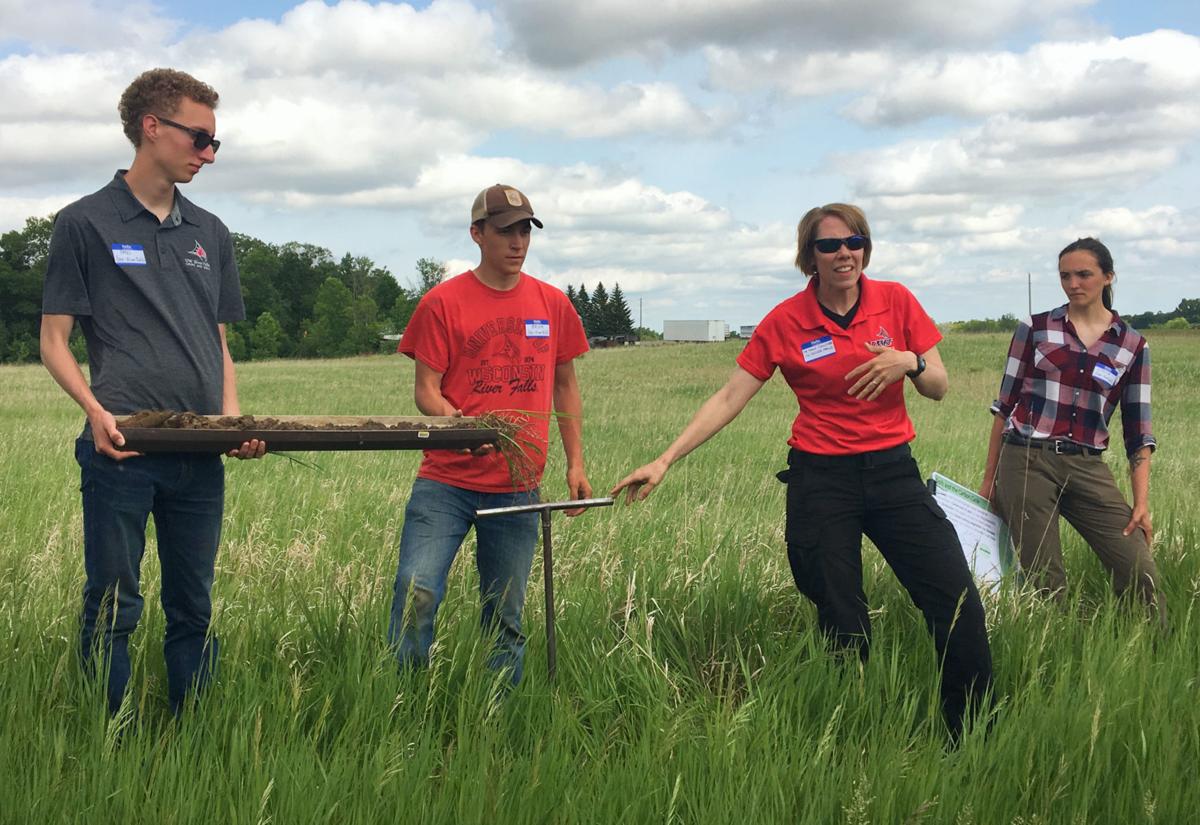
Meeker County residents were recently invited to spend an afternoon in a farm field to learn about soil in a conservation reserve program, or CRP.
About 20 people attended “Soils and Sod Field Day” in Watkins June 6 to get better insight into soil conservation and how to improve and retain the quality of soil on a farm.
Holly Dolliver, an associate professor of geology and soil science at the University of Wisconsin-River Falls, led the conversation along with three of her students — Stella Pey, Briar Golden and Paul Tietz.
“Much of the conversation when we’re considering CRP or when we’re talking about CRP naturally goes toward the conversation on habitat,” Dolliver said. “We’re thinking about the grasses, we’re thinking about the wildlife habitat, we’re thinking about the values that grass and permanent vegetation can provide.”
Dolliver, a Litchfield High School graduate, grew up on the farm in Watkins where she and her students had prepared a presentation and discussion about the different effects farming and cultivating ground can have on the soil quality.
In four separate locations on the farm, Dolliver and her students had extracted soil samples to compare health of the soil. According to Dolliver, the site allowed for easy comparisons due to the farm’s multiple purposes.
“For this particular research that we’re doing out here, what we’re trying to understand is how is the soil health in an area where we’ve done conservation like CRP different than maybe the soil health where we’re actively farming,” Dolliver said.
With each site, whether it was undisturbed or had 80 years of tillage history, the soil Dolliver and her students pulled up exemplified the capabilities of healthy soil in holding nutrients versus the decades of damage in the soil’s profile.
The profile of the soil is typically a length of 100 centimeters going down. According to Pey, things to keep an eye open for in a profile includes the structure as well as the strength of aggregates — clumps in the dirt — and whether they could help in the prevention of erosion.
The first soil core extracted from the ground that Dolliver showed the group was a rich dark brown — a healthy example of what soil could be.
“In these natural soils, since it was prairie vegetation, you’re pulling organic matter really far down,” Pey said. Each profile, she and Dolliver explained, is broken into “horizons” where the soil can retain different nutrients and properties.
In comparison, a soil profile was pulled after decades of agricultural production. When the soil cores were beside one another, the differences in color and structure were apparent.
More than half of the surface horizon in the profile had been lost compared to the undisturbed soil. Dolliver guessed that less photosynthesis contributed to the depleted health, as well as erosion from continual disturbance.
But one thing to take away from the field day was that land in a CRP program can give soil a chance to make a comeback, according to Dolliver. When examining a 30-year-old CRP site, which was taken out of production, the soil’s health had started to improve structure-wise. That structure will help water seep into the soil and reduce compaction.
“Meeker County is a great place to do work,” Dolliver said. CRP is no strange concept in the area, Dolliver added, explaining that there are almost 20,000 acres enrolled in CRP and other conservation programs.


