

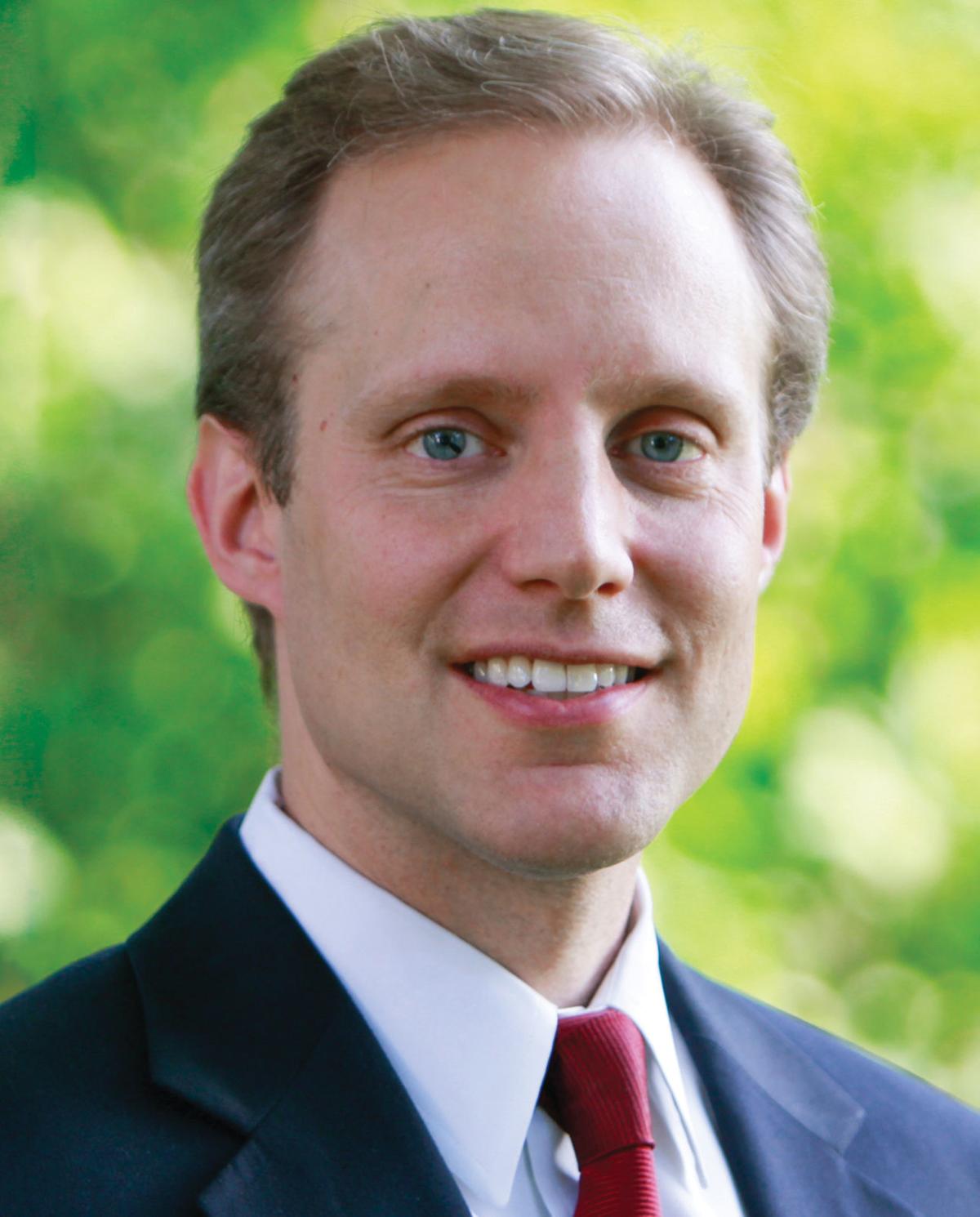


Minnesota Secretary of State Steve Simon made a stop in Litchfield Feb. 9 for a meeting with Meeker County Auditor Barb Loch.
It was the second day of Simon’s fourth statewide, 87-county tour since taking office in 2015.
During a private meeting, Simon and Loch discussed the 2018 election, preparations for the 2020 presidential primaries, the work he is doing around cyber security and elections, and a grant Meeker County recently received to replace aging election equipment.
“We talked about what’s going well, some of the challenges, turnout issues. Just making sure things are functioning smoothly,” Simon said.
Meeker County, which has 30 voter precincts, was awarded a $55,740 grant from the Secretary of State’s office to assist with purchasing new voting equipment. The grant requires a matching amount from the county of $43,000.
Loch said the new equipment will be used at this year’s November election.
Last year, the Minnesota Legislature authorized $7 million in grant funding to assist with the purchase of new voting equipment in the 85 counties that requested it.
The new legislation provides up to a 50-percent match for mandatory equipment, such as optical scan precinct counters, optical scan central counters, or assistive voting devices, and up to a 75-percent match for electronic rosters.
“This is an important step for election integrity by ensuring that voting equipment is up to the standards Minnesotans expect,” Simon said. “However, local governments requested nearly double the amount of available funds. It is clear that replacing our state’s aging election equipment is an ongoing need.”
Touring counties, polling sites
Typically, Simon said, his annual tour of county seats begins in January and concludes in October or November.
Loch also visits every election poll site in Meeker County each year. “If I don’t go to them, how can I know what’s happening,” Loch said.
A highly anticipated grant
“There’s several parts to the grant, but the most intriguing for Meeker County is the electronic polling,” Loch said. “Quicker registration, more accurate.”
The election equipment Meeker County has been using is about 12 years old, Loch said. “That’s a very good run,” Simon said.
Simon likened advances in election equipment to those of cell phones. “How many people do you know that have their 2005, 2006 flip phone,” he said. “Things turn over really quickly.”
Heightened cyber security
Minnesota has a strong election system, but Simon says it must be protected from cyber-attack,” Simon said.
Since taking office, Simon has devoted significant resources toward upgrading the security of election systems and putting new security measures in place. He created a cybersecurity team, hired an outside consultant to assess cybersecurity improvements and worked with partners in other agencies (including the U.S. Department of Homeland Security) to minimize the chance of any intrusion.
As a result, the Secretary of State’s Office had new protections in place for the 2016 election. However, the risks are not going away any time soon, he said, and cybersecurity strategies are now a necessary part of election administration everywhere. That’s why he intends to seek help from the Legislature to make sure the Secretary of State’s Office has the tools it needs to keep the state’s system secure.
“A point I’ve been making across the state is, this is one aspect of just being more careful about cyber security threats,” Simon said. “You read it in the headlines. It’s something that we in our office are very focused on. We’re working with the Department of Homeland Security on all sorts of best practices.”
“The odds are that there would be more possibility of intrusion when it comes to the big databases than there would be in a given precinct, because, under state law, none of the given precincts can be hooked up to the internet,” he said.
Proud to be No. 1
Loch said Meeker County has a high number of voters, and its high voter turnout isn’t contingent on the scope of the political race, as people tend to visit their precincts regardless of the social or economic climate.
“It’s been kind of characteristic,” Loch said. “We start from a pretty solid base to begin with,” Simon added.
“We are very proud of the fact that we are now back at No. 1 in the country in Minnesota,” Simon said of the state’s voter turnout. In 2014, Minnesota was No. 6, “which is still very good, of course, but our big goal was to get back to No. 1, and we did in 2016.”
Minnesota was No. 1 with 74.7 percent, much higher than the national average.
A couple years ago, Minnesota passed a law that allows people to cast absentee ballots without citing a reason. “As a result, the percentage of people choosing to vote before election day has skyrocketed,” Simon said.
Prior to that legislation, Minnesota’s voter absentee average was between 8 and 10 percent, Simon said, but it jumped to almost 23 percent in 2016. Loch and Simon believe that trend is going to keep rising.
“People want convenience,” Loch said.
“I think we’re lucky in Minnesota,” Simon said. “We have a very solid system that enjoys tremendous public confidence.”
Minnesota has a well-run, honest voting system that’s primarily run at the county level, Simon said. “Our office doesn’t count a single ballot. We compile everyone else’s count, but it’s great work done — county by county by county.”


