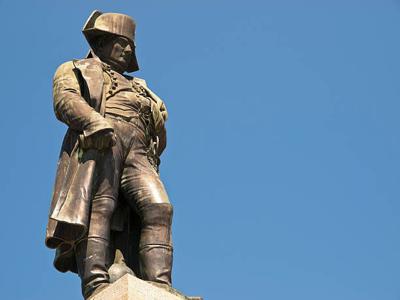
The figure of Napoleon has long been an object of fascination, but the new Ridley Scott biopic makes one wonder why.
The film, perhaps inadvertently, partakes of the spirit of the times. The so-called Great Man theory of history — that it is exceptionally talented men who bend events to their will — is out of favor. Accordingly, the movie renders the stereotypical great man, Napoleon, as doltish and uninteresting.
No man is a hero to his valet, goes the old saying. But can’t he at least be a hero, or a compelling persona, to the director of a $200 million movie about him?
Napoleon can be considered a proto-fascist dictator, or an enlightened reformer, or some of both, but he could never be considered dull, at least not until portrayed by a stolid Joaquin Phoenix, seemingly unaware that the general was a sparkling personality, a hugely energetic reformer and an inspiring leader of men.
As the Wall Street Journal critic Kyle Smith puts it, “Mr. Phoenix’s Napoleon could never have commanded so much as a squadron of the Salvation Army.”
The Great Man theory is now considered simplistic and even dangerous, and has about it the stale stench of dead white males. Academic historians tend to obsess with broad economic and social forces or with minutiae, while the largest impersonal force of all, the climate, occupies an outsized place in the political debate of advanced countries.
We don’t have to swoon like the philosopher Georg Wilhelm Friedrich Hegel, who enthused after catching sight of Napoleon in Jena about “this world-soul, riding out of the city on reconnaissance.”
But the general and emperor demonstrates that great men matter — not that they are virtuous or good, or that they can overcome every obstacle put in their way by themselves or others, or that large-scale factors don’t count, but that individual leaders take a hand in shaping events, sometimes decisively.
Would any Macedonian other than Alexander the Great have toppled the Persian empire and marched on India? Would any Frenchman besides Charlemagne have united much of Europe under his rule and brought about an intellectual and cultural renaissance? Would any Russian other than Peter the Great have modernized the Russian empire, defeated the Turks and Swedes, and built St. Petersburg?
It’s not a story that should occasion hero worship, or romantic images like the famous Jacques-Louis David painting of Napoleon crossing the Alps. But it’s not a story devoid of interest, or featuring a slightly ridiculous dullard at its center. Hollywood, in a rank distortion, somehow has made it so.
— Rich Lowry is editor of the National Review. © 2023 by King Features Syndicate Inc.