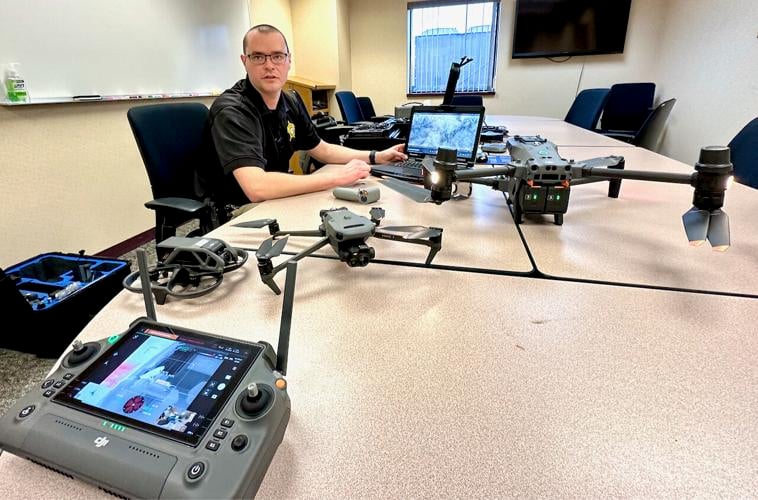


It didn’t take long to validate the Meeker County Sheriff Office’s latest investment in law enforcement technology.
Just a few months after spending $30,000 to purchase equipment, the agency’s new drone program played a key role in a search and rescue operation that not only helped find a suspect and likely saved the man’s life — reaffirming Sheriff Brian Cruze’s belief in his agency’s newest tool.
“We knew we would use it,” Cruze said. “I don’t think we were expecting right out of the gate we’d use it.
“That’s the pitch when we start this is, ‘Hey, this is technology to save somebody’s life, and right out of the gate you do,” Cruze continued. “I mean, it just puts an exclamation point on that. And obviously, it’s gonna save somebody else’s life in the future. We’ve demonstrated how you can use this and the capabilities of it.”
Detective Ryan Schutz helped launch the program. Schutz started working with the department in 2013 as a corrections officer and as a reserve officer and became a full-time deputy in 2014. He worked with the CEE-VI drug task force for a few years before becoming a detective in 2021.
A drone hobbyist for about a decade, Schutz began seeing how law enforcement agencies were using the flying technology and thought Meeker County could benefit from it, as well.
“There are a lot of valuable things that drones can do,” Schutz said, “between searching out in a field or searching inside a house where it doesn’t put officers or other people’s lives in danger while they’re searching.”
Meeker County benefited from drone assistance in the past, most notably two years ago when a rural Dassel man was holed up in a house after taking hostages and shooting at law enforcement.
“We called other agencies in to send drones in, because we didn’t know where he was at. We didn’t know what he was doing in there,” Cruze said. “That’s when we really started talking about it more and more, just the safety aspect of it for people involved in those situations.”
With Schutz an enthusiastic supporter of a drone program inside the department, they agreed to pursue it last year. Unfortunately, by the time they made the decision, they had missed the county’s budget cycle.
Neither Cruze nor Schutz wanted to wait another year to put together funding.
“We knew it’d be another year out” before county funds could be allocated to purchase drones, Cruze said. “So Ryan was tasked with reaching out to businesses and individuals, and it didn’t take long. It was well-received in the community, and obviously, we’re extremely thankful.”
“I sent a letter to some of the local businesses, and some other people around the community heard about it … some that were sought out and some that were just kind of people coming to us and wanting to donate to the program,” Schutz said.
The donation letter went out around June and by October the department had received $30,000 from 13 businesses and individuals and was purchasing its first of three drones. Each a different size — small, medium and large — the drones are equipped with cameras, thermal imaging, and surveillance and tracking technology.
Schutz was the first member of the sheriff’s office to receive certification to fly the drones. Another deputy has since received training.
During his decade of flying drones in his private life, Schutz became pretty skilled. But he said the drones purchased by the sheriff’s office are easier to control than others he has piloted.
“If you do nothing with the controls, they’ll just hover in place,” Schutz said. “So it’s a lot easier versus a fully manual drone where you have to control the throttle to take off. These are a lot easier to fly.
“We’ve been taking some time to get used to them,” he added. “For others that haven’t flown drones, we’re coming up with a little program to help teach them how to fly.”
One of the drones includes a flight simulator program, in which trainees wear goggles that allow virtual flight. But physically piloting the craft is only part of the training, Schutz said.
“You need to know a lot of aviation information — how to read aviation maps, how to read aviation weather, which is completely different from weather you’d see on the news,” he said.
Schutz has been called out three times since the program launched, once to check on an ATV partially submerged in the Crow River. The drone allowed a closer inspection and identification of the vehicle, and it was determined to have been stolen and abandoned. Another instance involved an ATV that had gone through the ice on Lake Jennie. It was a foggy day, which required Schutz to seek a waiver from the Federal Aviation Administration in order to fly. By the time he reached the scene, people associated with the ATV had been found.
The most noteworthy incident, however, came in January.
A suspect fled deputies in a vehicle, which he later abandoned after getting stuck in a ditch around 9 p.m. The temperature that night was in single digits, blowing snow from blustery winds reaching 30 mph.
Deputies lost sight of the man after he fled on foot into a marshy area southeast of Litchfield.
“He probably would have died out there, because he was stuck,” Sheriff Brian Cruze said. “And given the conditions, and where he was at from where we last saw him, and you couldn’t follow footprints … it’s a high probability we would never have found him without the drone searching for him.”
Deputies first requested assistance from the State Patrol helicopter to search for the suspect, but they eventually told windy conditions made that impossible. Meanwhile, they put in a call for drone support.
Schutz was not working that night, but when he received the call from his supervisor requesting a drone, he rushed to the office to pick up the largest of three drones the sheriff’s office purchased and rushed to the scene.
Once in the air, it didn’t take long to find the man.
“With it being so cold out, his heat register stood out quite a bit, so I could almost see him from about a quarter-mile away,” Schutz said. “And I flew to where he was at, and then was able to see him that way.”
The large drone has a speaker and spotlight onboard, and Schultz used both, telling the suspect through the speaker that help was on the way and lighting up the area so the search team could find him. From the time the suspect’s vehicle was found in the ditch to the time Schutz found him in the marsh was about 45 minutes.
“It’s an awesome feeling to be able to get this program started, get it up and running,” Schutz said. “And all the hard work I did for it and to have a success like that pretty quick into it, that was great.”
Knowing the difference his work with the drone made was reward enough, Schutz said, but he also received thanks from the suspect— albeit secondhand.
“The next day, he talked to the chief deputy and the chief deputy said, ‘You know, you could have died out there.’ He acknowledged it and was thankful that they found him,” Cruze said of the man. “(He) was remorseful about being in the pursuit, but I think he fully understood the predicament he was in.”
The flat, swampy area, bounded by trees, combined with frigid, windy conditions and blowing snow meant a low probability of finding the man with traditional searchers-on-the-ground approach.
“With the conditions that night, (it) would have been easy to walk by him and him not hear us,” Cruze said. “And we don’t make it a practice just to walk into cattails and start searching those unless we’ve got a reason, and there was no reason, because we couldn’t find the footprints.
“Everybody says, that was a bad guy. Yeah, it was a bad guy, but still a human being who made a mistake, and we saved his life,” Cruze said. “And without this piece of technology … who knows how long before somebody would have actually discovered (the body). He wasn’t at a place where people would normally be checking.”
Dramatic as that incident was, Schutz and Cruze believe the department’s first three drone missions only scratch the surface of the program’s utility. Other possible uses range from crash reconstruction to searching buildings without having to send an officer into a potentially dangerous environment, or the ability to do reconnaissance of a disaster site, such as a train derailment.
“There’s a lot of different things,” Schutz said.
“But then when you expand it, it’s the public safety piece of it,” Cruze added. “Catching bad guys is one piece, but also helping people, whether it’s a lost child or somebody with dementia or Alzheimer’s (who) wandered off. These things can cover a lot of ground and … we can detect a heat signature from a quarter-mile away. That’s a lot of ground that we physically can’t cover that can be done in seconds. So it has huge benefits.”
During a recent staff meeting, Cruze said, he and Schutz discussed with other deputies how the drone program could assist in a variety of law enforcement tasks.
“It’s another tool in the tool belt,” Cruze said he told the deputies. “So now I gotta remember I got that tool and ask for that thing.”