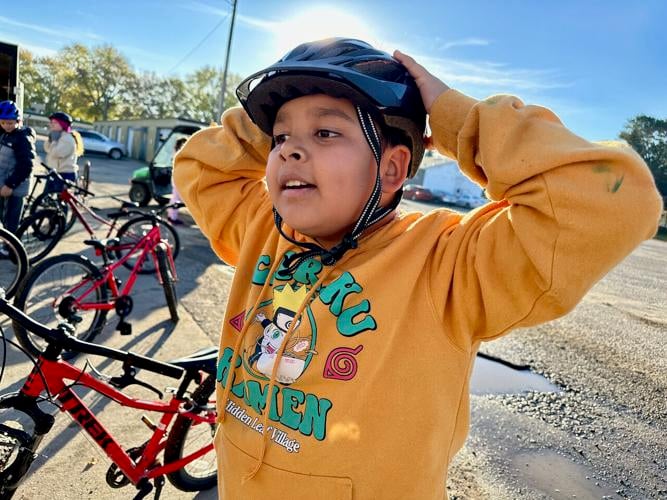

For many, riding a bicycle is one of the joys of childhood, delivering a sense of freedom and adventure that pedestrian life cannot.
But some kids miss out on, or don’t get the experience they should from biking, for a number of reasons.
A program offered through Meeker McLeod Sibley Community Health Services and classroom units like one teacher Tyler Storm wrapped up last week at Litchfield Middle School are changing that.
“I would say, overall, the kids have enjoyed it,” Storm said of the two-week bicycling unit he taught to four sections of fifth-graders. “I love that we can bike, swim, ice skate, all those things, which I think are essential for Minnesota kids to be able to do. There’s so much kids can get out of the bicycling (unit) — exercise, safety, some bike maintenance.”
Teaching a unit on bicycling wasn’t always easy or reasonable, however. For instance, getting the more than 80 fifth-graders in Storm’s four classes to all ride their bikes to school for the same two-week period would have been next to impossible. Some wouldn’t remember. Several likely do not have a bike of their own.
But Meeker McLeod Sibley Community Health Services stepped in with a solution.
CHS used grant money and donations from local businesses to purchase 40 bicycles, helmets and maintenance equipment, along with a trailer to transport all of it, early this year. And they began making the kind of moving classroom experience available to schools throughout the three-county area this past spring.
Brett Nelson, coordinator of the State Health Improvement Partnership program for the public health agency, began working on the bicycle effort nearly two years ago. A member of the Hutchinson Bicycling and Pedestrian Committee, he and others in the group were looking for ways to promote bicycle use as a public health initiative as the county began emerging from COVID.
The state’s SHIP grant program stipulated that funds be used for a program that would benefit all three counties, rather than just Hutchinson. In addition to SHIP funds, Hutchinson Health Foundation provided a grant.
“The broader reach was good,” Nelson said of the three-county program. “What helped on my side to think this was a great idea (in grant writing) is a community health assessment. One we did showed (combatting) obesity was a priority in our three counties. We know biking is great for exercise and helping with the obesity problem. Biking is a lifelong skill to have and learn, especially at a younger age.”
Meeker McLeod Sibley Community Health Services’ trailer purchase — done through a cooperative effort with Hutchinson Park Recreation Community Education department — was well-timed, as it turned out, because the Minnesota Legislature this year passed a law requiring that schools teach pedestrian and bicycle safety to students in kindergarten through eighth grade.
The bike fleet was purchased early this year. Stored and administrated by Hutchinson PRCE, the trailer full of bikes was first loaned out to area school districts this past spring.
It was an immediate hit.
Five schools borrowed the bike fleet for two-week courses, with about 1,430 students using them in the spring.
“That’s a great number, especially for a first time,” Nelson said. “We were pretty happy with that.”
Five more schools requested to use the bikes this fall, including Litchfield Middle School. One of the requirements for borrowing the bikes is that teachers who use them be trained in the Walk! Bike! Fun! curriculum created by Minnesota Department of Transportation’s Safe Routes to School program and the Bicycle Alliance of Minnesota.
Litchfield Middle School’s Storm was ahead of the curve on that requirement, having received the training and used a bike fleet through Bike MN for a bicycling unit he taught for the first time during last school year.
“We added it last year before the mandate went through,” Storm said of the Walk! Bike! Fun! curriculum. “And then (after the change in state law) it was like, well, this is just super fitting that it was something that we’re addressing.
“So, you know, we’ve taught them how to safely cross the road, we taught them how to ABC check — air, brakes and chains,” he added. “The kids have learned to just do the general maintenance on (the bikes), which is great.”
Keeping all of the bicycles in safe, rideable shape sometimes can feel like a part-time job, Storm said.
“But you know what? Kids get to rid bikes,” he said. “It’s worth it.”
And ride they did. The bicycling unit came to a close Wednesday last week, the last day of class before the MEA break. To cap off the unit, Storm planned a class ride from the middle school to a park on the northeast side of town, near the Capwood Addition, and back to school. It was a 2.5-mile-plus ride, nothing too far, but enough for the students to get heart rates up and earn some red cheeks by the time they returned to school on the chilly morning.
Before they left the south parking lot at the school, Storm reminded each of the five classes of the thing they had learned — and should be practicing — during the ride. Things like hand signals, correct right- and left-hand turns, safe stopping. Some of the classes were led by a high school youth service student on a bike, while in other classes Storm entrusted a couple of fifth-graders to lead their classmates on the ride. He followed behind on a golf cart, monitoring the 40 cyclists ahead of him and stopping to offer help or encouragement to those who needed it.
A lot happened in the fairly compressed class time of 40 minutes. And likely none of it would have happened without the availability of a bike fleet.
“I think they don’t realize how much they work,” Storm said of riding bike. “I mean, they biked 2 to 3 miles today. That’s good exercise, and they have fun.”
Those are gratifying words for folks like Nelson and others at Meeker McLeod Sibley Community Health Services, confirming the investment in the bike fleet is paying dividends as it makes the health benefits and fun of cycling available to more people.
“It’s a huge deal,” Nelson said. “Even when we were looking at purchasing these bikes, they’re $300 to $500 a bike. A family of five having to buy new bikes, that’s a lot of money to spend.
“And then, once you buy a bike, you should have it for a while,” he said. “So we’re education kids on how to properly maintain them and fix flat tires … those are great lessons to have.”
Much was learned during the first phase of loaning the bikes to area schools, including that not all school-age children have learned to ride a bike. So training wheels were purchased — equipment that Storm verified had been used in his classes — to help foster learning to ride. Nelson said the program also is looking at purchasing adaptive bikes, such as three-wheelers to make the offerings more inclusive.
“In the evaluations … students said they went home and practiced and got the family involved (in riding bikes),” Nelson said. “There’s definitely a lot of good things.”