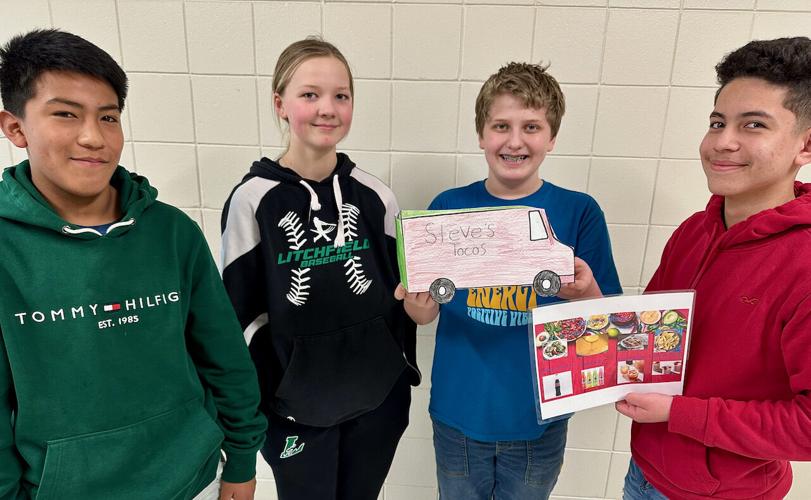



Bryce Barka and his crew figured there was nothing like the old-fashioned Americana of hamburgers to sustain a food truck business. Another team went more eclectic, letting pickles play a prominent role on his menu, while another decided tacos and other Hispanic food would fare best.
In the end, Baseball Burgers, with its all-American menu and wrapped-in-the-flag, red-white-and-blue marketing won the day.
But Litchfield Middle School teacher Riley Johnson hopes all of the seventh-graders in her family and consumer science, or FACS, class were winners in terms of the learning they did during her Food Truck Wars segment.
“My seventh-graders, that grade focuses on food, and this would be part of their food unit,” Johnson explained Thursday afternoon as she oversaw the food truck lineup in the middle school lobby. “But it was also bringing some business sense into it, as well as creativity, just to give them a different project to do.”
Johnson is in her first semester teaching, having been hired as a longtime substitute to take over FACS classes when long-time teacher Julie Rick retired.
As she considered different units she could bring into the curriculum, Johnson struck on the idea of the growing food truck trend. The students didn’t actually do the cooking, but their educational challenge involved almost everything else, from researching rules and regulations governing food truck operation, popular food truck menus, pricing, marketing and other details.
The process included a visit from the Herradura Family Mexican Restaurant owner Luis Alvarez, who took the students in groups of five on a tour of the restaurant’s truck.
“He brought them into his actual food truck and explained all the different equipment, told them the cost of putting it together and also discussed the different areas or events that he brings his food truck to, like graduations and weddings,” Johnson said. “They got to have a good sense of what it looks like inside, as well as the money that has to go into creating an actual food trucks.”
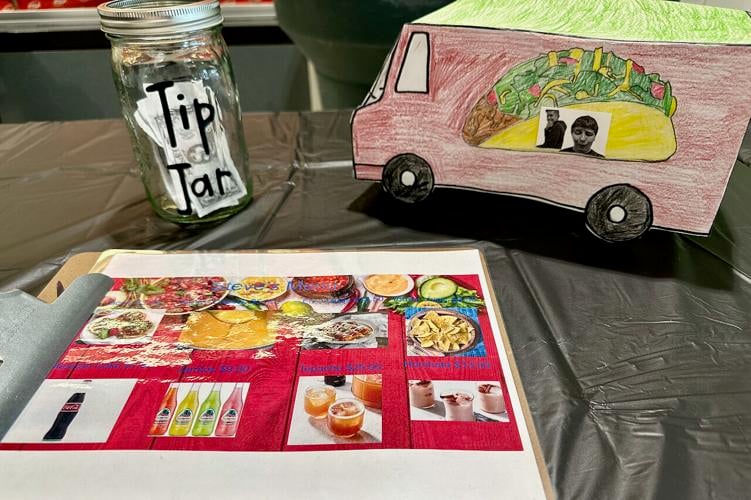
Armed with their own research and tips and information from Alvarez’s visit, the students set about creating their own food truck businesses. In groups of four, the students worked out their menu plans and the exterior design and graphics of their food truck. They used computer software to create a printed and laminated, menu board, like the kind that might be posted near the order window of a real food truck. They also designed a food truck, cut from poster board.
Adding a touch realism, the eight food trucks “parked” in the middle school lobby for about two hours around midday Thursday for their Food Truck Wars. The student body, fifth through eighth grade, teachers and staff then visited the lineup to “order” from their favorite truck — dropping a play money bill into the truck’s tip jar.
When the FACS class met later that afternoon, Johnson announced the three food trucks receiving the most votes. Baseball Burgers, a team of Barka, Lucas Elwell, Vivian Miller and Tory Nelson, took the top spot. Second place went to Steve’s Tacos, the team of Steve Alvarez, Izzy Voight, Jayden Sheldon and Danier Ribera. And third place was Big Dill, a team of A.J. Fenrich Hudson, Braydn Field, Mesa Hicks and Evvy Culbertson.
Barka, who teammates credited with the all-American burger idea, said he enjoyed the food truck unit, and even learned a little along the way.
“Burgers is cool,” Barka said in explaining how they chose the truck idea. “And then, America goes with baseball, so we thought this would be good.”
As for what they learned?
“That we all need to work together, use our strengths,” Miller said.
“That food trucks cost a lot of money,” Barka added.
Both answers were correct as far as their teacher was concerned.
“I hope they’re understanding that putting together a business takes a lot of time and effort and thought,” Johnson said. “I just hoped they would have a better understanding of a business. That’s why I had Luis (Alvarez, from Herradura) bring in the actual food truck, so that they could have that experience of actually seeing one in person and getting into it, looking at the equipment.
“And then also just working together in a group, that experience is good,” she added. “I was really surprised with the strategies I heard being discussed in the classroom, like, ‘Oh, we’re going to go this route, because everybody plays that game, or like the pickle one, I thought that was pretty creative.”