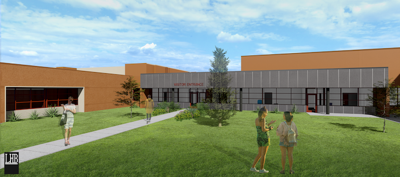

Once construction work is completed at ACGC schools this summer, cabinets, desks, chairs and computers need to be part of the big picture.
At its WEBEX virtual board meeting on April 25, the Atwater-Cosmos-Grove City School Board awarded contracts to suppliers of this essential equipment to selected bidders. Board members also discussed items that might need to be ordered later this summer, should unallocated funds and/or contingency funds remain after completion of the $21 million renovations.
Chosen contractors included Innovative Office Solutions and Interium, for furnishings, fixtures and equipment, and technology contracts totaling $162,204.86 to Tierneys, Connecting Point, and Innovative Office Solutions for 54 HP and 25 Chromebook computers, interactive monitoring systems (23 monitors and two mobile carts) and 13 wall-mounted 65-inch smart televisions. LHB architect Troy Miller noted that all of the technology has five-year warrantees.
Since some initial bids for construction came in higher than expected, the school board and its construction managers had “value engineered” the bond-funded project to fit funds available. The result is that a few hundred thousand dollars are still unallocated. Several hundred thousand dollars were also set aside in a contingency fund because, as ICS construction manager Collin Rehbein put it, “There are always some fun surprises on construction projects.”
One “surprise” in this project was the need to replace water lines at the Atwater site, as excavation revealed that current pipes appear to be near the end of their lifespan — and it would cost significantly more to dig things up and get them replaced at a future date. The board conceded that would be a good use of some of the contingency funds. There is also a need to either replace a wireless tower between the buildings or to run fiber optic cable beneath railroad tracks to retain intra-facility communications.
Even with those, and a few smaller expenditures, added to the project, about $213,000 is expected to remain in unallocated resources. A utility rebate of about $53,000 is also expected, so the board discussed kitchen and maintenance equipment that would be useful to add. Another potential add-on would be paving the south access road to Meeker County Road 11, behind the junior-senior high school complex. (Although an initial rough estimate for paving this was about $90,000, board members noted that current low petroleum prices might make this a cheaper, timely investment.) Another “nice to have” feature would be a sound system at the elementary gymnasium. At some future point, roofs need to be replaced as well, Rehbein noted.
Decisions about “add-ons” will be made at a future date, once the full extent of potential unexpected costs is known. Onstad noted that preferred add-ons would be “things that would be far more costly to do at a later date.”
In response to concerns from board members that the COVID-19 outbreak might delay FFE deliveries, Miller said both winning furnishings contractors are Minnesota firms that promise product within six weeks of order.
Among other business at the virtual meeting:
- In personnel matters, the board hired Catherine Mages as a FACS teacher and Angela Walsh as a fifth-grade teacher for the 2020-2021 school year. A list of spring activity coaches was also approved. Tenure was granted to six teachers: Tyler Bulau, Heather Gaarder, Stephanie Mucciacciaro, Ben Sovacool, Sharon Theis and Abigail Zylstra.
- Business Manager Kathryn Haase has accepted a lead finance position with the Willmar Public Schools and will be leaving ACGC in June. She pledged to help orient her replacement.
- The board adopted a high school course guide for 2020-2021. Principal Robin Wall noted that the only “weighted credit” classes this year are those offered by Southwest State University. Other online classes get regular high school credits, as do in-classroom and ITV offerings.
- Superintendent Onstad and principals reported that distance learning required by the COVID-19 emergency orders was going fairly well, with less than 1 percent of students failing to log in to the system set up by staff one month ago. Adaptations to year-end events like graduation have been made with the assistance of a planning committee. Although logistics for summer school programs and next fall are still uncertain, “We are going to make the best decisions we can with the information we have at the time,” Onstad said. He expressed appreciation for the work teachers, custodians, kitchen workers, administrators, parents and students had done to accommodate distance learning.