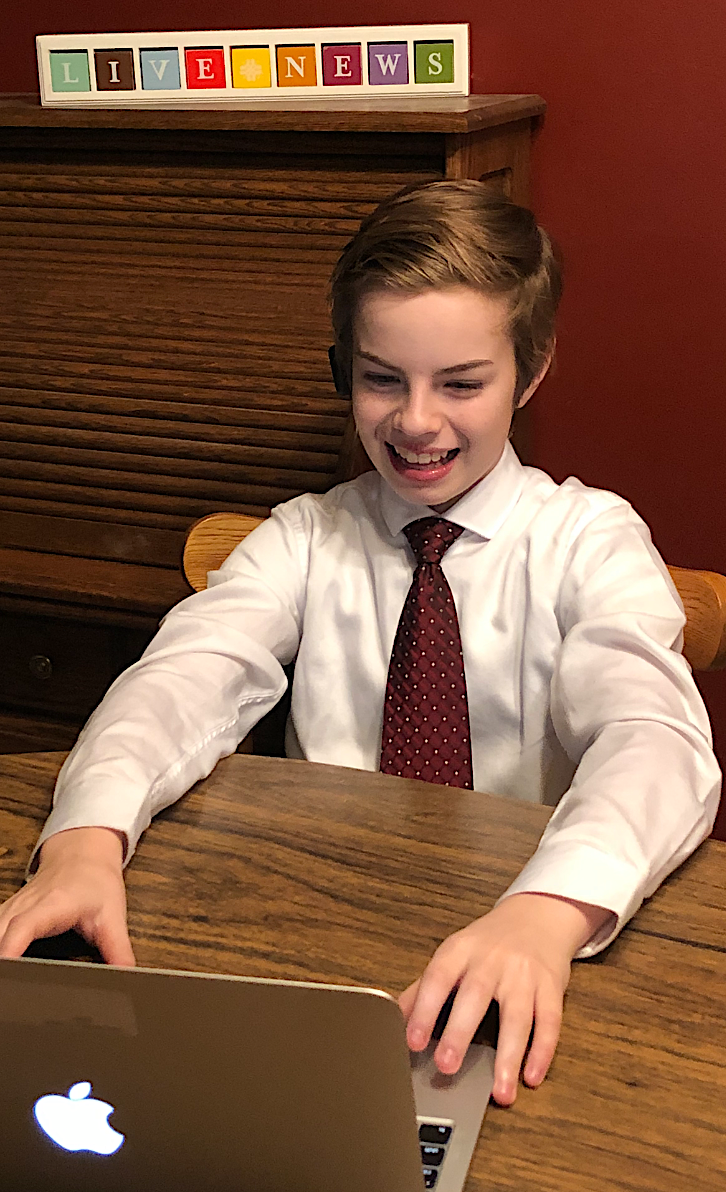



College basketball's version of March Madness might have been canceled by a historic pandemic, but a tournament of another kind — one focused on historic people — continued for Litchfield Middle School seventh-graders.
And after six rounds of presentations about American history's heavy hitters — from George Washington to Ronald Reagan, and Neil Armstrong to Christa McAuliffe — Ben Olson and his telling of the John Glenn story emerged as the champion of American History March Madness.
"I'm kind of a competition kind of person, so this was fun," Olson said. "I thought I had a shot (at winning), but there were some good videos."
Chief among those other good videos was one created by Maddie Hanson and Addy Zens, who teamed up to tell the story of Microsoft creator Bill Gates, a story that got them all the way to the finals before falling to Olson.
American History March Madness has been a staple in Bill King's seventh-grade social studies class at Litchfield Middle School since he started it seven years ago as a way to spark interest in historical people and to give students experience in researching and presenting information.
"I started March Madness ... not knowing how popular it would be," King said. "I have had many ex-students comment that March Madness was one of the highlights of seventh grade social."
King said he did a Google search for the most influential people in American history to come up with the original list of subjects for students to research, names like Abraham Lincoln, Franklin Roosevelt, Amelia Earhart, Thomas Jefferson, Hellen Keller and Martin Luther King Jr. The March Madness pool expanded in succeeding years to include inventors and more recent historical figures, like tech giants Steve Jobs and Bill Gates.
Students pair up or work individually, selecting their historical figure via a blind draw, then spending about three weeks researching their person and compiling the findings into a video that must be between 2 minutes and 2 minutes and 30 seconds long.
From there, the students and their videos are pitted in head-to-head matchups, with the vote of their classmates determining the winner in each historical battle. These contests whittle the field of 64 famous people down to one eventual winner.
Of course, historic people doesn't necessarily mean well-known — especially not among a generation who don't know a world without internet, cellphones or SnapChat.
Take, for instance, Olson's reaction when he drew John Glenn's name.
"I don't think I really even heard of the name before, to be honest," Olson said of Glenn, the first astronaut to orbit Earth in 1962, several years before even his parents were born. "I was kind of nervous."
It was a similar, if slightly less opaque, understanding for the Zens-Hanson team when they drew Gates' name.
"All I knew was that he invented Microsoft," Hanson said. "But we were glad we drew somebody we already knew something about, so the research wouldn't be so hard."
Olson said the most interesting fact he uncovered about Glenn was that the astronaut-turned U.S. senator became the oldest man in space when he flew on the space shuttle Discovery at age 77 in 1998. (Still nearly a decade before Olson was born.)
"There's obviously a good amount who have gone into space, but it was kind of cool to know that he was the oldest one," Olson said.
Hanson, meanwhile, said the most interesting fact she and Zens learned about Gates was that he became one of the world's wealthiest people, built on his founding of Microsoft.
While gathering the facts is important, production value becomes equally important as the students assemble their projects.
Olson said he knew from the start that he wanted to do a sort of interview program that would allow him to put his research on display. In his video, he plays three roles — TV news anchorman, a female reporter and Glenn — with Glenn's answers to the reporter's questions offering details about his life.
Hanson and Zens used a voice-over approach, standing in front of a green screen reading facts about Gates while photos matching the story flashed in the background.
Whatever the method, the students agreed that learning history the American History March Madness way has definite advantages over a teacher's lectures.
"I like how we get to do it ourselves and put it into a little show," Hanson said. "It takes more work (but) I think it helps us learn more that way."
Said Olson: "I kind of actually like presenting in front of people, so it was a fun way to learn."
That's music to the teacher's ears, a kind of historic jingle, if you will.
"...(T)he project provides a great opportunity for (students) to show their creativity using technology," King said. "They also get exposed to 64 important people who had a great impact on our country. This new learning can also be tied to current event discussions, such as comparing the impact of the Great Depression to the COVID-19 virus."