

“To save a life is a real and beautiful thing.” — Vincent Van Gogh
It takes a special kind of human to work in emergency medical services, or EMS, Elie Deeb believes.
“Their hearts have to be in the right place,” said Deeb, operations supervisor for Gold Cross Ambulance. “They have to take charge in situations and have a lot of compassion.”
Deeb oversees stations in St. Cloud, Little Falls and Litchfield with roughly 110 employees. Last week, from May 20-26, those employees, including paramedics and emergency medical technicians, or EMTs, were recognized in a national celebration called EMS Week.
Authorized by Gerald Ford in 1974, EMS Week celebrates those who dedicate their lives to saving others’. According to the National Association of Emergency Medical Technicians website, EMS Week “brings together local communities and medical personnel to honor the dedication of those who provide the day-to-day lifesaving services of medicine’s ‘front line.’”
EMS Week for Gold Cross Ambulance in Litchfield, a branch of Mayo Clinic since 1994, is typically celebrated with crew meals and a company picnic according to Deeb. The recognition of those who work in emergency medical services is also a chance to learn what emergency medical services personnel do on a regular basis.
A DOCTOR ON WHEELS
“When you come out to rural Minnesota, EMTs are the mobile doctors on wheels,” Deeb said, commenting on the distance between hospitals in rural locations, including the Litchfield area, and how EMTs and paramedics are crucial in emergency situations.
Paramedics provide advanced life support, such as advanced airway management including endotracheal intubation, electrocardiographs — or ECGs — insertion of intravenous lines and defibrillation. They are also capable of administering medication appropriate for the situation. According to Deeb, emergency medical services personnel also have the skills to administer a paralytic agent to a patient.
EMTs are entry-level care providers, while paramedics are advanced providers of emergency medical care.
And with about 23,000 emergency calls annually to Gold Cross throughout all three cities, there’s no room for error in applying the skills necessary to save a life. Training to become an EMT involves working through several months of training in medical services. To become a paramedic, further college education is required.
According to the National Association Emergency Medical Technicians website, skills necessary in becoming licensed as an EMT (and from there, a paramedic) include knowledge of CPR as well as recognizing and therefore treating life-threatening emergencies outside a hospital setting. Other skills include how to handle cardiac and respiratory arrest, heart attacks, seizures and diabetic emergencies. Training also involves managing traumatic injuries such as falls, fractures, lacerations and burns, as well as taking vitals and performing patient assessments.
THE FIRST RESPONDERS
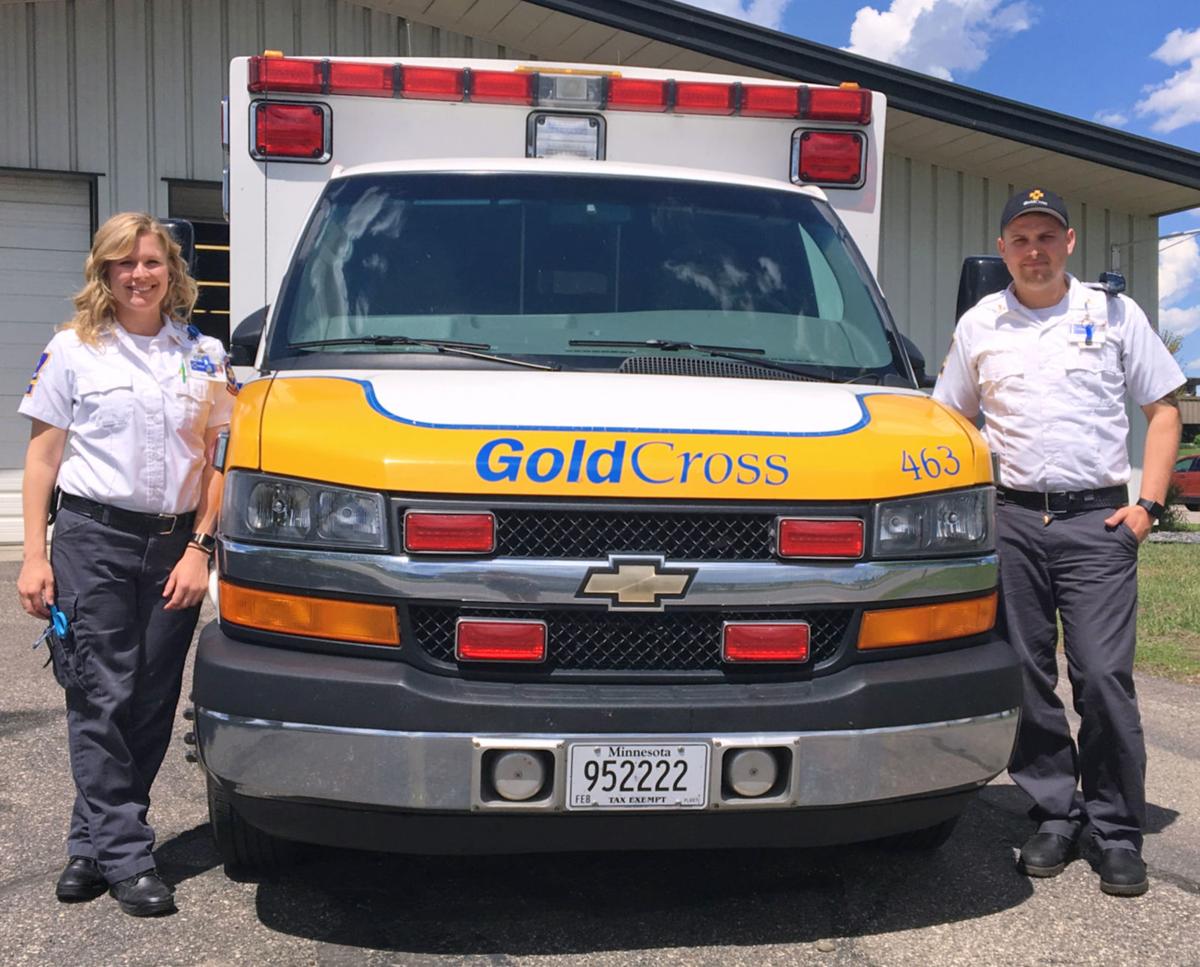
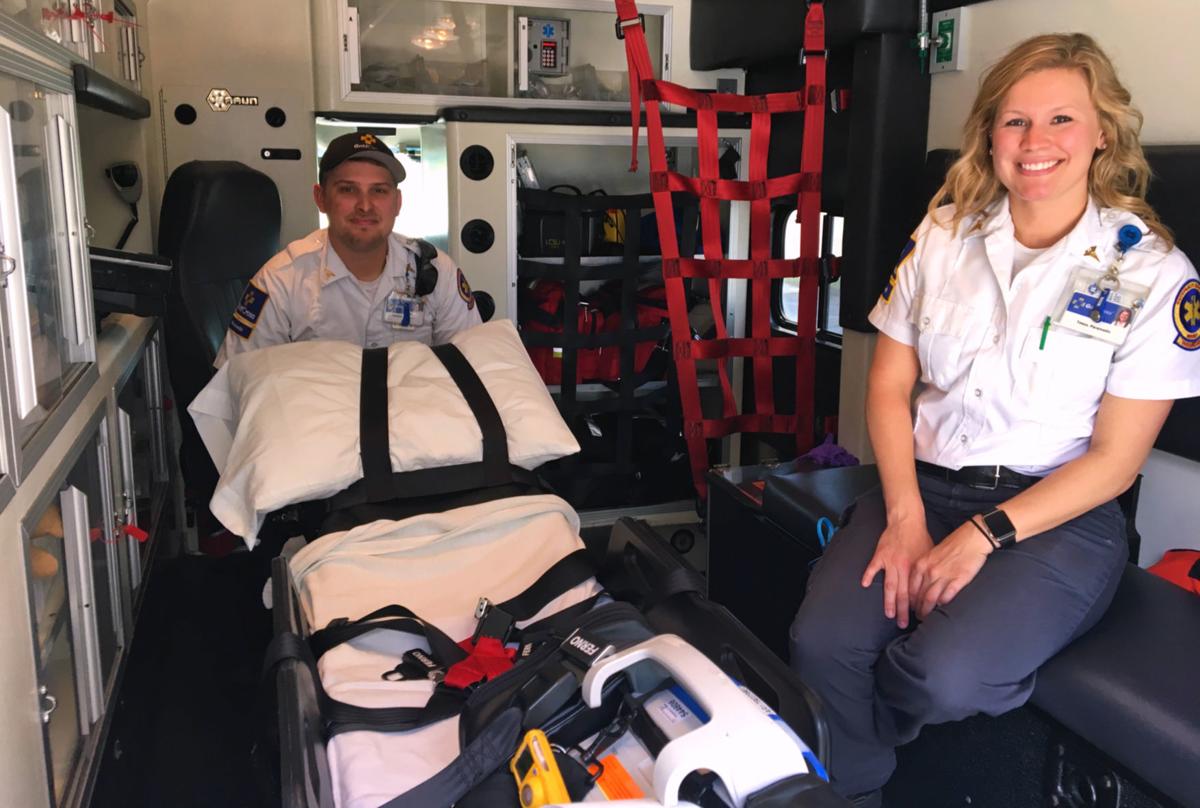
Tessa Hansen and Nicholas Engler, two paramedics in Litchfield, want people to know something important about their job.
“We’re not just ambulance drivers,” Hansen said. “We go to school for two years to become a paramedic; we’re like a mobile hospital and it’s just one person in back most of the time trying to save a life.”
Hansen, who has been a paramedic in Litchfield for four years, and Engler, who has been a paramedic for almost three years, are passionate about what they do for a living. They’re more than a provided ride to a hospital; they’re a lifeline.
“I didn’t grow up wanting to do this job,” Hansen said. “I just took an EMT class to fill some credits and I wound up really liking it, and decided to go into the program at St. Cloud.”
“My stepdad was an EMT and that drove me to be curious about it,” Engler said. “I had no idea that I wanted to do it until I took the EMT course at St. Cloud, and that’s when I realized how much I liked it.”
But like any job, there are bad days emergency medical services personnel have to power through during their 12-hour shifts.
“Sometimes the emotional stress that comes with it,” Hansen said. Her least favorite part of the job: the “tough calls” that they respond to. Critical emergencies can be a high source of stress for the EMTs and paramedics, but their training and ability to respond to the situations make them well-equipped for it.
“There are plenty of good and bad calls, but you have to be able to separate the bad calls from yourself at the end of the day,” Deeb said.
As two crew members, they want the community to recognize that they’re more than truck drivers, and EMS Week helps that initiative.
“I think EMS goes a lot under the radar,” Engler said. “Bringing this out kind of shows everyone what we actually do. And that’s nice because a lot of people don’t actually know what we do and what we’re here for.”


