

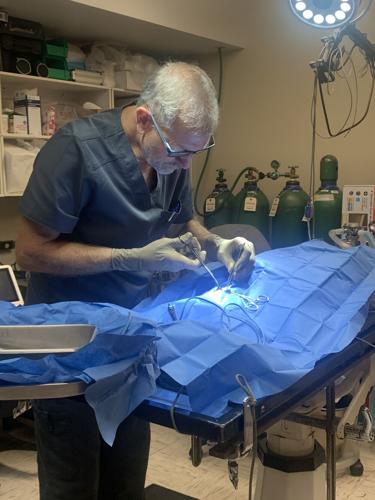


Outside the Animal Medical Center on Crow River, a line of pets and their owners wait for the clinic to open at 7 a.m.
Some pets have appointments, while others are dropped off with the hope that Dr. John Froning and his team will be able to examine them sometime during the day.
Scenes like these are repeated at veterinary clinics across the country, as people increasingly struggle to find care for their household and large animals alike. Between retirement and burnout, the number of veterinarians leaving the field is more than the number of new veterinarian program graduates entering the field, causing a shortage across the United States.
The U.S. Department of Agriculture found more than 500 counties in 44 states had veterinarian shortages in 2019, noting many of them in rural areas, where access to veterinary care is already limited. Farmers and livestock owners in these regions face difficulties finding veterinarians to provide essential care for their animals. Pet owners in remote areas struggle to access basic veterinary services, which puts their pets' health at risk.
“That’s kind of a whole other nightmare for pet owners now, is finding after-hour service,” Froning said. “There is just not really anybody besides the emergency clinics in St. Cloud, the Twin Cities and Mankato that provide that type of service. So, we get a lot of calls, I’ve had calls from Wisconsin when the emergency clinics in the Cities are at capacity.”
Animal Medical Center on Crow River is a mixed-animal practice. The clinic sees companion pets such as dogs, cats, hamsters, rabbits, guinea pigs, and larger breeds like horses, cows, pigs, alpacas and goats.
“It’s nice for the veterinarians to work here to be mixed animal so that I don’t have the entire load for that, Froning said.”
On a typical day, the clinic sees 45 animals, performs four to six surgeries and often gets called out to visit sick or injured livestock. The team includes 12 to 13 staff, depending on the day, and two veterinarians.
Between appointments and drop-offs, Froning charts his patients’ visits and reviews labs. Most labs are completed in-house by his highly trained certified veterinary technicians.
“When I started, you sent off all your blood work and waited a day or three for results,” Froning said. “I can’t imagine running a clinic without having that in-house chemistry equipment and having the answers right in front of me now.”
Froning, who’s been a veterinarian since 1991, graduated from Kansas State University and knew he wanted to work with all animals.
“I grew up on a ranch situation with cattle and horses,” he said. “When I was going to school, with my background, I knew I wanted to have a large-mix practice.”
Most days, Froning and his staff work non-stop, which he prefers.
“Sometimes the day becomes addictive,” he said.
Knowing that there are not many options for pet and livestock care in the area, Froning and his team do everything they can when they get an emergency call, and they try to work them in the schedule, he said.
Recently, Froning was called out to examine a colicky horse.
“It turned out to be intestinal parasites, and horses are a little more susceptible to that,” he said. “They don’t have much immunity against parasites, but that one went well. We got it dewormed and taken care of.”
Horses with colic get bad stomach aches, and when horses lay down they try to roll to make the pain go away, which can lead to their intestines twisting and lead to surgery, Froning said.
The scarcity of veterinarians outside the Cities is an ongoing concern for Froning.
“It’s difficult outside the Twin Cities or the larger cities to attract veterinarians and there’s fewer and fewer,” he said.
According to Froning the veterinary shortage is multifaceted.
“I can’t entirely blame the veterinary colleges, but they’re 20 years behind for kicking out more veterinarians,” he said.
There are 32 accredited veterinary schools in the United States with an average class size of 112 and an acceptance rate of 11.7%. By 2030 there will be an estimated shortage of 15,000 veterinarians, according to a study done by Mars Veterinary Heath in 2022.
Currently there are eight schools pending approval from The Council on Education, which is the U.S. Department of Education accrediting agency for colleges and schools of veterinary medicine.
“The college education is pretty intense,” Froning said. “If those new schools got accredited, that would kick out 800 students a year in addition to what’s already out there now and that would be a drop in the bucket.”


