
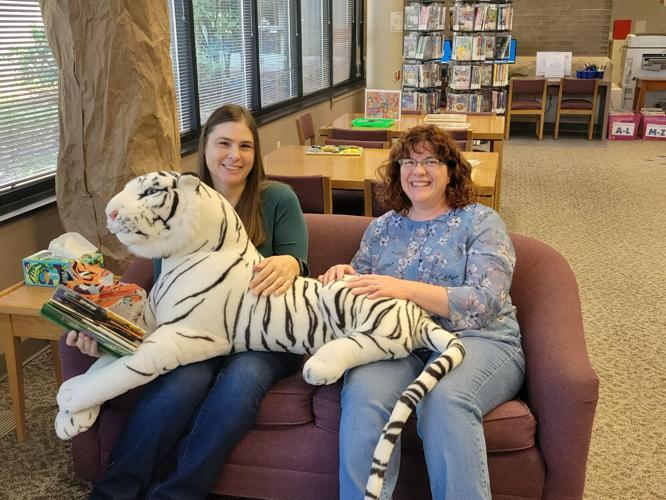
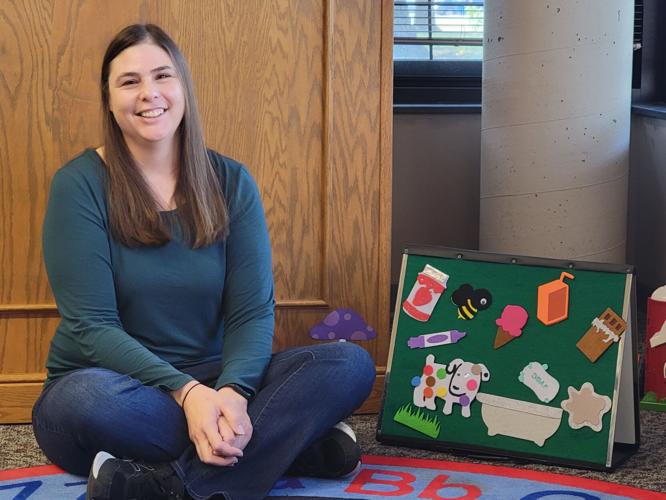
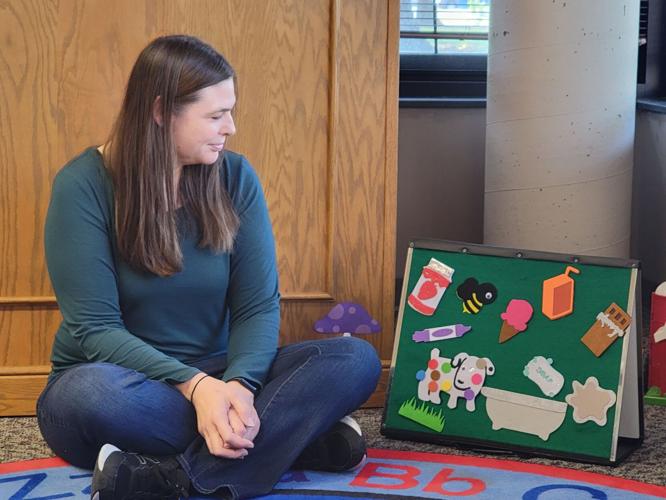
Among the many activities for children of all ages in the area, one stands out for its longevity.
Story time — also known as story hour — has been offered at area public libraries for years and has evolved to offer much more than just a story read to a group of preschool children.
Both Hutchinson and Litchfield public libraries have offered story hour opportunities since the 1960s.
In Hutchinson, the American Association of University Women provided an adult reader in the upstairs library to start the program. In 1963, the Hutchinson Library Board voted to include a children’s library section in the basement of the original building, and it hired the first children’s librarian, Gail Thovson.
“They held story hour upstairs until the children’s library was added,” Thovson remembered. “It was AAUW members who organized it until I came.”
Litchfield saw the children’s library established in the mid-1960s in the basement of the Carnegie Library on Sibley Avenue. Under the direction of children’s librarian Gerda Welch, volunteers read to the children during the summer Story Hour.
Story Time — as it’s referred to now — is still as popular as ever at both libraries.
“We average about 18 toddlers and infants on Wednesdays and 25 children on Fridays,” said Beth Cronk, head librarian at the Litchfield Library. The summertime session is a lot looser and has a wide range of participants.”
Litchfield offers two sessions — on Wednesday and Friday mornings. Both sessions are for infants and toddlers accompanied by parent or caregiver. The Wednesday session starts at 10:15 a.m. and is a simpler and shorter class. Friday’s session, which starts at 10 a.m., is longer and includes crafts, paint or clay, sensory bins, music and movement that reinforces the book selection.
Hutchinson has one session, at 10 a.m. Thursdays, that is open to all ages — infant-to-school age, and parents or caregivers are encouraged to attend.
“We have found that it’s a good way for the adults to get know one another, too,” said Katy Hiltner, head librarian at Hutchinson Library. “There is time for them to chat while the kids are busy with their sensory activities.”
Parents also have an opportunity to learn during Story Time, especially ways to build the reading habit in their children.
“Parent attendance is also valuable because we are modeling the way to read to children,” Cronk says. “We can point out challenges, get them outside their comfort zone having fun with their child, give them ideas they can do at home and, of course, recommend books to take home.”
“We believe the more the child sees the parent do the activity, the less intimidated the child will be themselves.” said Rachel Clark, youth services librarian at Litchfield Public Library.
The image of story time with children gathered around quietly while an adult reads to them isn’t the norm anymore. It isn’t that formal.
Elisabeth Kable, youth services librarian at Hutchinson Library, said her role with Story Time is to “have the time be low-key ... laid back. I’m flexible and go with the flow.”
Clark agreed that flexibility is a key during Story Time.
“You can plan and plan, and the kids will throw you for a loop,” she said. “You just roll with it. Who knows ... things may turn out better because of it.”
“The kids love her,” Cronk said of Clark. “She has built up the program, making it fun and accessible for them.”
Story Time tries to reinforce skills children are learning elsewhere. It introduces literacy skills through letter sounds and rhymes. School readiness come through interaction with other children. Social skills, like taking turns and sharing, also are learned. Hands-on opportunities incorporated with sensory activities can help build STEM skills.
“We try to be outside as much as possible,” Clark said of STEM activities. “We will be doing so as long as the weather is nice through the fall.”
Overall, though, the key aspect of Story Time is introducing children to the library.
“We hope to springboard a child toward books,” Cronk said. “We promote the books and materials at the library that they can take home. We have Discovery Boxes that are kits with music, letters and activity suggestions families can take home and don’t have to find storage for. They can just bring them back to the library.”
“We hope to have children see the library as a fun, safe space,” Hiltner said. “We feel discovering books when they’re young will get children used to them, enjoy them.”
“I see them take ownership,” Kable said. “After a while, the children come to feel they own the library. It is their place.”
“That has always been the focus — to be child centered,” Hiltner said.
“I love having the families and kids come,” Kable shares. “They shouldn’t worry about being on time. Being late is OK.”
“Families don’t have to feel they need to come every week, either,” Hiltner added.


