


The original plat maps for Harmony and Hutchinson, supposedly drawn in 1855 by city founder Lewis Harrington, are hanging in the City Council chambers of City Center. The City Council is considering different ways for preserving them.
Staff photo by Stephen WiblemoWhere, oh where should the
ts go? And where, oh
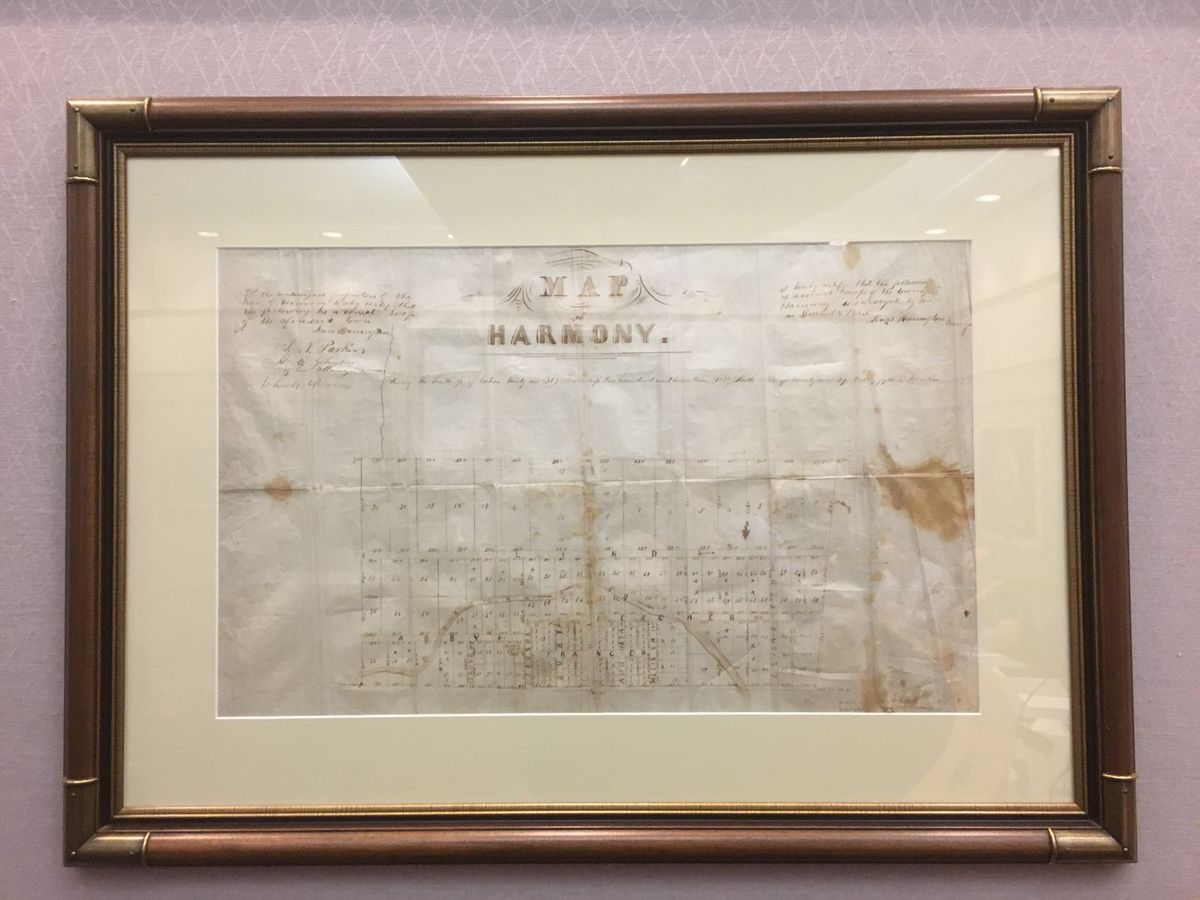
The original plat maps for Harmony and Hutchinson, supposedly drawn in 1855 by city founder Lewis Harrington, are hanging in the City Council chambers of City Center. The City Council is considering different ways to preserve them.
Staff photos by Stephen Wiblemowhere have they been? Those were a couple of the questions the Hutchinson City Council mulled over during last week’s City Council meeting.city pla
The plats are the supposed original maps of Hutchinson and Harmony, drawn up by founder Lewis Harrington, who was a surveyor, in 1855. What is Harmony, you may ask? Here’s a quick history lesson for you:
- In 1855, when Hutchinson was founded, it was originally platted as two cities due to legislative restrictions on the size of a townsite. So two towns were registered: Harmony, north of the river, and Hutchinson, south of the river.
- Later, when the Legislature passed an act permitting larger townsites, the two towns became one.
Currently the maps are framed and hanging on the wall at City Center. They were donated by local attorney Neil Jensen about 30 years ago.
Why are they the “supposed” original plats? According to Steve Cook’s account of court documents involving Harrington and the placement of Park Elementary School, at one point the original plats could not be found and reproductions were made.
Further adding to the mystery of the documents, they’ve likely never been authenticated. At least not to the knowledge of Lori Pickell-Stangel, the executive director of the McLeod County Historical Society.
Which leads us back to the original question the City Council is considering: What to do with the possibly 162-year-old documents.
According to recommendations from the Historical Society, the way the plats are framed and displayed now are likely causing gradual, long-term damage. Ultraviolet rays, stress from hanging, exposure to acidic adhesives and fluctuation in temperature and humidity all take a toll over time if nothing is done.
“Most people think of preserving things in their own lifetime. Yes, they’ll be around for our lifetime. That’s not a problem,” Pickell-Stangel said. “But if you want them to be around for 500 years, then you have to actively do some of these things.”
Also in the Historical Society’s recommendation were two plans of action the city could take. The first plan is for the museum to add the maps to its collection.
This plan allows the museum to go through all the steps approved by the Minnesota Historical Society for preserving them. That includes encasing them in a breathable, mylar envelope and storing them in the museum’s fire-proof, temperature- and humidity-controlled vault.
The museum would also scan the maps to create digital images for its collection, and provide the city with high-resolution copies for display.
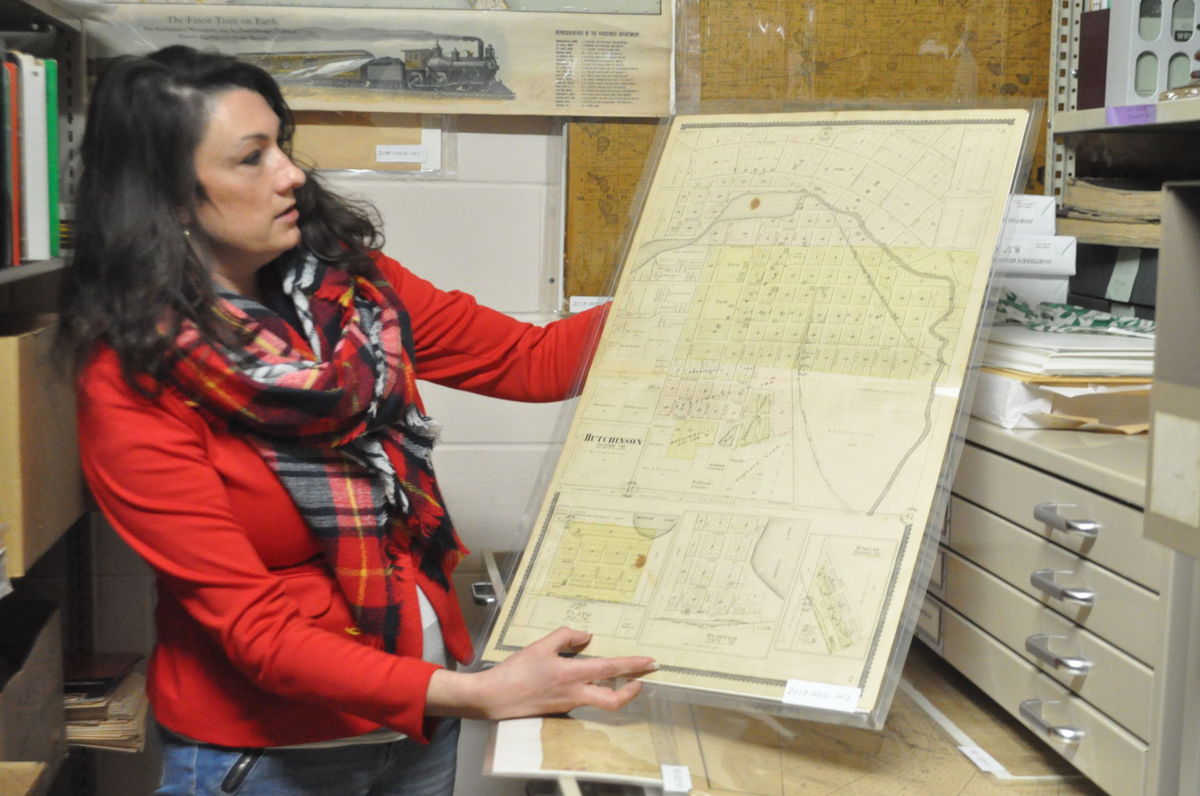
Lori Pickell-Stangel, executive director of the McLeod County Historical Society and Museum, showed how the old maps in Hutchinson City Center would be preserved if donated to the museum. They would go in a breathable, mylar envelope and stored in the museum’s fire-resistant, temperature- and humidity-controlled vault.
Staff photo by Stephen WiblemoThe crux in this plan is that the city is giving the maps away. If the city does not want to donate the maps, the other plan is a temporary loan for the museum to make a digital copy for its collection and to display.
The responsibility for preserving the original maps would then fall on the city. If council members go this direction, they are recommended to store the maps in mylar enclosures, inside metal-edged, acid-free boxes. And if possible, in a place where they aren’t exposed to fluctuating temperature and humidity.
While council members agreed that high-quality copies of the maps are sufficient for displaying, and the originals should be preserved, there was a difference of opinion about how to do it.
Council Member John Lofdahl, who is also a member of the McLeod County Historical Society board, made his position clear.
“The only way to really preserve these is by storing them at the Historical Society properly,” he said. “… It’s not the Declaration of Independence, but it is kind of the Declaration of Independence for the city of Hutchinson.”
Council Member Steve Cook, on the other hand, was apprehensive about donating the maps.
“I agree that a high-quality copy is good for display, but why can’t we (store originals at City Center)?” Cook said. “We store all kinds of records here, don’t we?”
According to Planning and Zoning Director Dan Jochum, City Center has filing cabinets where important property files are stored, but he didn’t think it was equipped to preserve delicate documents such as the maps.
Although there was discussion by the council about whether it could loan the maps indefinitely to the museum, therefore preserving them and maintaining ownership, Pickell-Stangel said the museum has policies regarding that type of arrangement.
“Everybody wants that. They want us to take care of everything, preserve it and pay for it, then they want to be able to do whatever they want and own it,” she said. “We can’t do that for a couple reasons: No. 1, it ties our hands when at any time someone could come in and say, ‘I want to take it.’ We can’t protect and care for the piece if we don’t truly own it.
“And then, insurance is an issue as well, unless we have special insurance on it. That’s why we, traditionally, in our collection policy do not take un-ended, long-term loans. Nothing perpetual. The longest we usually take is a year.”
At the end of discussion, council members determined to do a little more research before making their decision, including asking Jensen, who previously owned the maps, for his input.
“It’s one thing to preserve it, I just want to know where the life of it should stay,” City Administrator Matt Jaunich said. “And I don’t think there is a clear answer from the council.”


