


The McLeod Soil & Water Conservation District’s collaboration with the city of Winsted to construct a wetland that filters residential stormwater before it enters Winsted Lake builds upon its previous work with farmers to curb field erosion upstream.
Judicial Ditch 111 flows through the wetland to the lake, carrying runoff from farm fields to the west and from residential lots in town. Winsted Lake is impaired for aquatic recreation.
The $80,975 project drew from a $123,546 multipurpose drainage management grant the Minnesota Board of Water and Soil Resources awarded to the SWCD in 2022. The city’s engineering consultant, Bolton & Menk, designed the wetland. McLeod County made $45,000 available to the city for its construction, tapping Coronavirus State and Local Fiscal Recovery Funds from the U.S. Treasury Department.
Together with grade stabilization structures, side inlets and water and sediment control basins upstream, the constructed wetland will help to improve water quality of the lake, and will allow the ditch (previously known as McLeod County Ditch 11) to function as designed and reduce the need for maintenance in the long term. The upstream work is backed by two multipurpose drainage management Clean Water Fund grants BWSR awarded to the SWCD: the 2022 grant, plus an $111,000 grant awarded in 2019.
“Projects like this just don’t happen without collaboration, and we have a really strong group working on all the projects as part of this process,” said Coleton Draeger, McLeod SWCD resource conservationist.
That group included South Central Technical Service Area (TSA) engineers, and the neighboring Wright SWCD, which worked with landowners on a water and sediment control basin that flowed to a McLeod County project site.
Multipurpose drainage management targets critical pollution source areas to reduce erosion and sedimentation, reduce peak flows and flooding, and improve water quality while protecting drainage system efficiency and reducing drainage system maintenance.
In McLeod County, the Ditch Authority — composed of the five county commissioners — is responsible for maintaining the county ditch system. First District Commissioner Nathan Schmalz, a fourth-generation crop farmer, represents an area including the city of Winsted and Winsted Township.
Schmalz elaborated on elements of the grant-supported work that extend beyond land drained by the judicial ditch: “Along with those benefits are the conservation benefits that some of these projects will give us. Whether it’s (reducing) streambank erosion, whether it’s water-storage capacity, whether it’s stormwater treatment — those are all worthy benefits.”
Draeger explained the water-quality improvement piece of the project. “The whole aim is, at the end of the day, water-quality (enhancement) in the receiving water body of the drainage system and Winsted Lake. We’re going to reduce phosphorus- and nitrogen-loading, reduce our TSS (total suspended solids) load, and, overall, hopefully see a water-quality change in the lake itself.”
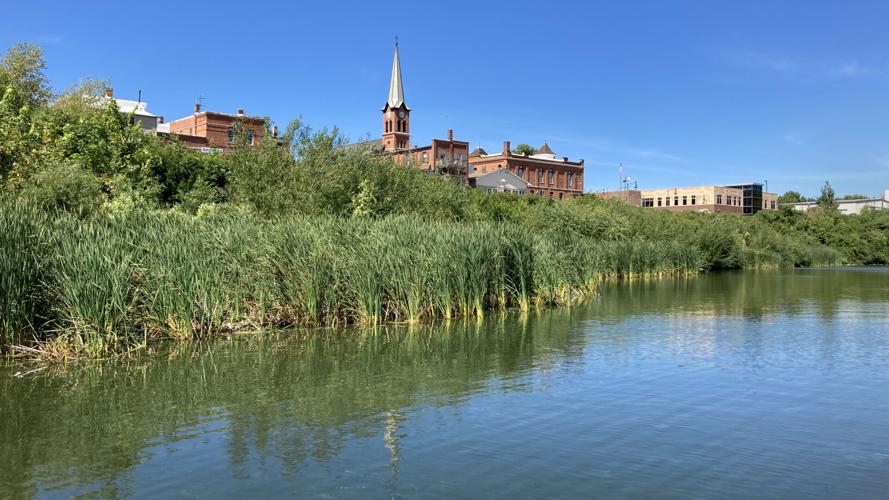
Winsted Lake is a focal point of the town situated on its western shore. A paved path runs from City Hall to a park with a fishing pier. The Luce Line State Trail curves around the south shore to a county park with a public water access.
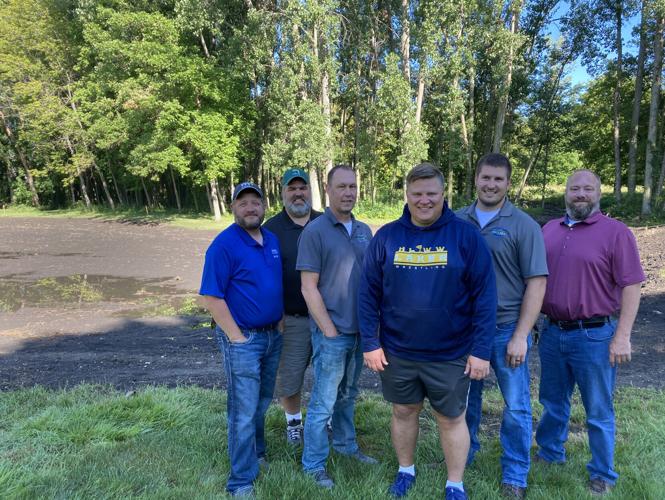
The wetland is tucked into a triangle of unimproved city parkland within a residential neighborhood. Contractors excavated the half-acre wetland in August. It will treat 15 acres of city stormwater runoff — allowing sediment and the pollutants it carries to settle out.
Bob Bean of Bolton & Menk said getting buy-in from residents adjacent to the site proved challenging. Some were concerned the wetland would be a “mosquito nest.” He said seeing the design and knowing that it would help to improve the water quality of Winsted Lake drew their support.
“Lake Winsted has four incoming ditches from the county. This ditch is extremely large, with over 10 square miles of drainage area, and it’s been dumping a lot of sediment into the lake at the connection. Any amount of effort we can do to reduce that has been instrumental in trying to preserve (Winsted Lake) from degrading further,” Bean said.
When SWCD and city staff viewed the site on Aug. 15, the outlet structure awaited installation and the site awaited seeding. Construction finished later that month.
Draeger explained the effect on the drainage system upstream: “We’re reducing erosion and sediment delivery into the drainage system — on the system and off the system, so along the drainage corridor as well as in the uplands — to try and treat water, slow flow and eliminate some of the erosion that’s on the drainage system’s banks, which then makes its way into the drainage system and later Winsted Lake.”
In addition to the constructed wetland, the two multipurpose drainage management grants together backed 11 grade stabilizations and nine water and sediment control basins involving eight landowners and 10 parcels.
Projects installed in fields upstream have benefited farmers by eliminating gullies (which may have been too deep for equipment to cross), temporarily retaining water, and transporting it underground (which reduces erosion and nutrient loss).
“It’s a collaborative effort with the city of Winsted and the residents here, and also the upstream land operators who work and farm those lands,” said BWSR Board Conservationist Jeremy Maul, who had recommended the constructed wetland to the SWCD.
“There are benefits to the lake for intercepting (nutrients) before they get to the lake. It creates some water storage that allows the water to get held up long enough so the water upstream has a chance to flow in,” Maul said. “In the long run, there’s nutrient savings. There’s also hopefully cost savings to the producers because there’s going to be less cost for maintenance on the drainage system as a whole.”
Together, the multipurpose drainage management grant-backed projects are estimated to reduce sediment-loading by 228 tons, soil erosion by 127 tons, phosphorus-loading by 255 pounds and nitrates by 91 pounds annually.
“It’s a lake that’s in recovery,” Schmalz said. “Decades ago there weren’t the concerns of pollutants entering the lake, and now there’s an awareness. Now there’s an opportunity for a healthier lake, a healthier ecosystem for fish to survive in the lake. As a society we’re all more conscious of water quality today, and this is a step forward in that direction.”
Winsted City Administrator Neil Schlagel grew up in Winsted, where he swam in the lake as a kid, and noticed the gradual decline in water quality. He taught high school business classes before he became city administrator in summer 2023. A former business owner and financial adviser, he sees the potential for water-quality improvements to spark economic development.
“If it had more use, the lake would bring more people to town. (With) more people coming to town, we have more opportunities for businesses to expand, or more opportunities to bring in new businesses. I do believe it would be a driving force for economic development,” Schlagel said.
“Our lake has potential,” Schlagel said.


