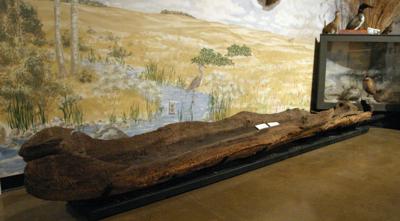
There’s no doubt that McLeod County has a rich history. From the Dakota campsites in Hutchinson and Glencoe, to remarkable stories of Martin McLeod and the Hutchinson singers, this county is blessed to have an amazing backstory. Of all the known history in the area, however, one question remains — when did the first humans call the area home? In addition, who were the first people to call McLeod County home?
Most historians agree that the first people in Minnesota came toward the end of the last Ice Age, some 10,000-12,000 years ago. That being the case, it is unlikely human beings settled in the area due to the glacial ice that made the land unfit for human settlements. It wasn’t until about 9,000 B.C., after the glaciers receded, that humans began living in the state. As far as McLeod County goes, however, it would be some time before a human decided to call the area home.
There’s no question that pre-historic hunter/gatherer groups passed through the region — there were humans in other parts of the state and the presence of ancient Clovis points suggest that people from those regions were present in the county, but there is little evidence that they ever “lived” here. That being the case, there are those who will dispute the claim that no prehistoric people settled in McLeod County.
In 1914, on the shores of Belle Lake, lived a man named Carl Radanz. Like many, Carl was a farmer, who constantly found himself in a battle with rocks. Carl’s rocks were different, however, as they were stone tools such as hammer heads, axes, spearpoints, and other ancient relics that he was plowing up. This led Carl, as well as many others, to assume the farm was once the site of the mysterious “mound-builders.”
If you’re not familiar, the mound builders were a civilization that existed during the “woodland period” of native history around 2,000 years ago. Evidence of these people, aside from stone tools, is found in the mysterious earthworks they created. Mounds have been found in many places around the state, and while some historic sources claim mounds exist in McLeod County, those mounds pale in comparison to the others. And, according to the experts, they are questionable in their authenticity. That being the case, locally found artifacts from this period do prove that the mound builders, at a minimum, passed through the area. In fact, the museum is home to the oldest dugout canoe ever found in Minnesota. The canoe is dated to this period in history. Dugout canoes were heavy, however, and were usually stored where they were needed rather than brought “home,” indicating that the discovery site was unlikely a village site.
Fast forward to the 19th century, when Euro-American fur traders were traveling through Minnesota. At this time, most Dakota village sites in the state were near present-day Minneapolis, or along the Minnesota River in the west. There were two prominent “campsites” in what would become Glencoe and Hutchinson, yet neither of these sites were permanent villages and instead served as stopping points for hunting and trading parties visiting the “Big Woods” region of the county. As a matter of fact, neither of these places became permanent village sites until the communities of Hutchinson and Glencoe were established in 1855.
Looking back through history, there’s no denying that McLeod County was once part of a much larger holding of Dakota, and prehistoric American’s land. Did anyone ever have a permanent village here prior to 1855? That is perhaps a question that cannot fully be answered, and possibly never will. What the question does demonstrate, however, is that we know far less about our history than what meets the eye.
— Brian Haines is executive director of the McLeod County Historical Society and Museum, 380 School Road N.W., Hutchinson. Do you have a historical anecdote to share? Haines can be reached at 320-587-2109, or by email at director@mcleodhistory.org.