Hutchinson is facing a critical housing shortage. With limited inventory, rising costs and a pressing need for solutions, city officials gathered last week to discuss the city’s housing challenges.
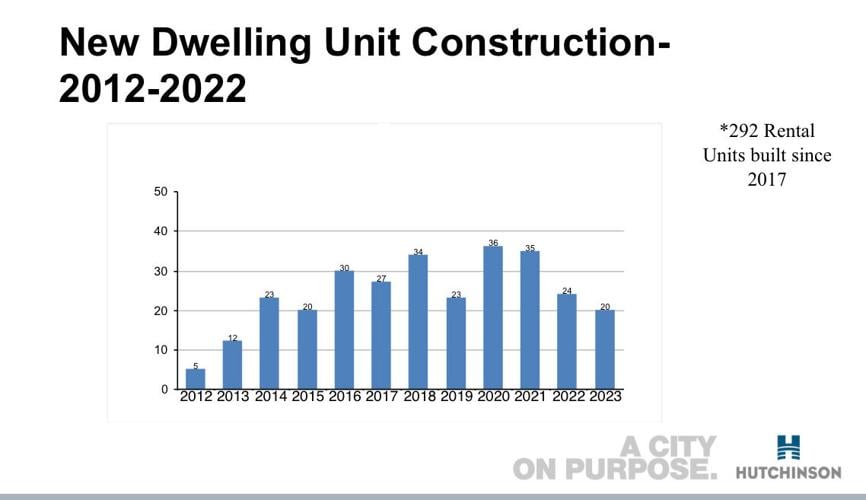
Data presented during the workshop revealed a stark reality. Over the past decade, Hutchinson has seen a modest increase in new home construction, with an average of 24 homes built per year since 2012. However, this rate falls short of meeting the projected household growth in the area.
Since 2012, there have been 289 homes built, and 292 rental units built since 2017, yet Hutchinson remains behind the demand for new housing, as evidenced by vacancy rate.
“We’ve been historically in that 1% to 2% (rental vacancy rate); we talk about a healthy rate is 5%,” City Administrator Matt Jaunich said at last week’s City Council workshop.
Hutchinson’s rental vacancy rate is 3.6%, but Jaunich noted that the city did not get responses to a survey from managers of 300 units.
“I’m thinking that inflated that number a little bit, but we’re still low below that healthy market rate of 5%,” he said.
One of the primary factors contributing to the housing shortage is the widening gap between the cost of existing homes and the cost of new construction. While existing homes have seen a steady increase in median sales prices over the years, the cost of building new homes has skyrocketed, primarily due to rising construction and infrastructure expenses. This disparity has made it increasingly difficult for residents, especially first-time homebuyers.
“It’s the younger people that have to deal with the interest rates and escalating prices that’s harder for them to get in,” Director of Building, Planning and Zoning Dan Jochum said. “It’s more of a barrier for them, than people that already have equity.”
Limited availability land for development within city limits adds another layer of complexity to the issue. While there are parcels of land suitable for housing development, the costs associated with infrastructure upgrades and land acquisition present significant barriers for developers.
Infrastructure for a city block containing four to five homes costs approximately $500,000, according to Jaunich. The new Ravenwood Addition, which has 35 lots, would cost $1.2 million for the street, water, sewer and garbage.
“That’s about $33,000 to $35,000 a lot,” Jaunich said. “That doesn’t include the cost the developer had in buying the land. It doesn’t include any of the costs that it may take to develop plans …. This is just the street cost. I think realistically you’re looking at $50,000, $60,000, $70,000 a lot.”
Hutchinson currently holds 88 vacant lots, with approximately 15 earmarked for other purposes. Of these, 50 are owned by builders or developers, and 23 by individuals with uncertain intentions. A recent approval for an additional 13 lots near Northwoods Park offers some potential relief, according to Jochum.
“It appears to be about a three-year supply of lots left in town,” he said.
Jaunich urged City Council members and staff to think outside the box for housing solutions. Ultimately the council decided to revisit the topic again at a later date to allow time to discuss the matter with constituents and reach out to developers.
Last year, the city incorporated a seventh core value, housing, into its principles. Under this core value, the city will prioritize advocating for safe and affordable housing while fostering collaboration with other agencies and the private sector to address the community’s housing needs.