The year was 1898. It was fall, and it was time to clear land for the spring planting. On a small 40-acre farm in central Minnesota, Olof Ohman and his two sons, Olof Jr., age 11, and Edward, age 10, were clearing land with the intention of making a new field. Olof’s land was still “virgin” in the sense that tall poplar trees towered over the ground. When he bought the land in 1890, there was just barely enough space to allow for a homesite and a small field. Each year he would clear the land little by little and by 1898 had cleared enough wooded area to have farmable land within a few hundred feet of his neighbor, Nils Flaaten.
Clearing the land of trees was hard work. Most farmers would first down the tree, then hitch a team to the stump and “yank” it from the ground like a loose tooth. Olof, however, had developed a more efficient method. He began by digging around the base of the tree, cutting the roots, then using a large winch to topple the tree with the stump intact.
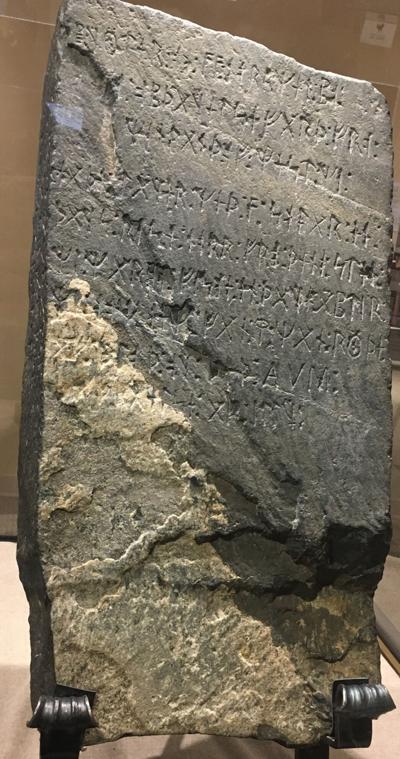
As it neared lunchtime, Olof’s youngest son, Edward, brought his father’s lunch to him while he watched him struggle to pull a tree from the ground. The tree had a large stone tangled in its roots. This wasn’t too uncommon as every farmer knows that rocks often “grow” in a field and, just like modern times, those rocks needed to be taken out. Unlike most field stones that are smooth and round, this stone was long, rectangular, and rough — a sort of sandstone that resembled a tombstone. With the help of his two boys, Olof freed the stone from the roots and set it aside — it looked as though it would make a great “doorstep” to be placed in front of their home’s entrance, and Olof intended to place it there later.
Olof’s 10-year-old son noticed something odd about the stone — there appeared to be some sort of etching into the stone, a carving. Nils Flaaten, the neighbor, was working within earshot of the Ohmans and was beckoned to come take a look. Dirt was brushed away from the stone to reveal more markings, strange markings that neither man had ever seen before.
The stone was removed from the field and brought over to the Ohman farmyard where it could be further inspected. It was first cleaned; then, as legend has it, Olof Ohman took a nail to the etchings to clean the dirt and grime from the carvings. After it was cleaned, it was clear that the etchings were some sort of ancient writing.
Neither Olof nor Nils could read the etchings, but they were certain that they had something of significance, so Olof brought the stone slab into the closest town, Kensington. There, the stone was put on display at the bank where onlookers could come and view this strange marker.
The stone certainly was an attraction. One local man, curious to what the message translated to, made an inscription and sent it to Professor George Curme at Northwestern University in Illinois with the hopes of translating the inscription. In February of 1899, the translation was published in the Minneapolis Journal. It read: Eight Goths and twenty two Norwegians on an expedition of discovery from Vineland to the west. We had a camp with two boats a day’s journey from this stone. We went out fishing one day. After we came home we found ten men red with blood and dead. Ave Maria, save from evil. There are 10 men by the inland sea to look after our ships fourteen days journey from this peninsula. Year 1362.
The Legend of the Kensington Runestone had begun ... to be continued.
— Brian Haines is executive director of the McLeod County Historical Society and Museum, 380 School Road N.W., Hutchinson. Do you have a historical anecdote to share? Haines can be reached at 320-587-2109, or by email at director@mcleodhistory.org.