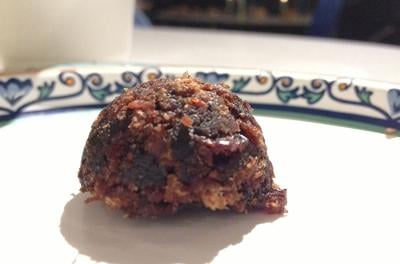
In Minnesota, decades before statehood, the area to become McLeod County was a desolate place. Around the time of European colonization of eastern North America, Minnesota was primarily inhabited by Ojibwa and Dakota natives who were migrating westward (around 1650-1700). The economy of these tribes was primarily hunter-gatherer. While it wouldn’t be accurate to say these early residents “thrived” in a hunter-gatherer society, they certainly gained a sense of expertise in North Country survival.
Food was often plentiful in the warm weather months, but through winter or during long periods of travel, those living in Minnesota needed a food source that could be preserved for many months. Some methods of preservation were to dry meat or edible plants. A method to preserve meat was to smoke it. One of the most popular ways for early Minnesotans to preserve food, however, was to make pemmican — the food of the north.
Making pemmican is a process that’s been nearly lost to history. It was typically made in summer or fall, after hunts, and while plant life was growing and fruits were ripe. Its chief ingredient was buffalo meat.
After a kill, the leanest meat of the bison was cut away from the carcass and boiled down until it was tender, then it was shredded to the point of being “mush.” Next, a sack was made from the buffalo skin with the hair left on the outside. The skin had to be large enough to hold large amounts of meat that was packed in tight — so tight that no more could fit. Berries and other wild edibles were added to the batch. Meanwhile, fat from the buffalo was rendered by boiling it down. Once it was converted to liquid form, the fat was poured into the sack of meat until the meat was permeated. While the fat cooled and returned to a solid, it sealed the meat and preserved it for up to a year.
Pemmican never needed to be cooked and was ready to eat anytime. It was high in nutrients and calories. It was also portable, as very little was needed to receive the required daily nutrients — a key aspect of the food as plants and wild game could be scarce on the frontier at certain times of the year. In winter, pemmican could be used to feed dogs that were pulling sleds and was even used to start fires.
For thousands of years, pemmican was processed and eaten by Native Americans. When Europeans began venturing west, it was quickly adapted by fur traders and explorers. In Minnesota, or what would become Minnesota, the Metiz people, fur traders with mixed French and Native American ancestry who drove the Red River ox carts, had diets that consisted primarily of pemmican. Even the early white settlers in Minnesota, who came in the 1850s, found pemmican to be a necessary source of food while trying to survive on the frontier.
By the 1860s, changes in transportation on the frontier had improved greatly. Better roads and the growth of the railroad meant that freighters, stagecoaches and trains could deliver better foodstuffs to frontier settlements than just a decade prior. With better supplies, and dry goods being more readily accessible, the processing and consuming of pemmican dropped off sharply. By the 1870s, its use was nearly non-existent. Today, the food is still made as a novelty item for 19th century reenactments, but one has to assume that it tastes little like the pemmican on the frontier.
— Brian Haines is executive director of the McLeod County Historical Society and Museum, 380 School Road N.W., Hutchinson. Do you have a historical anecdote to share? Haines can be reached at 320-587-2109, or by email at director@mcleodhistory.org.