

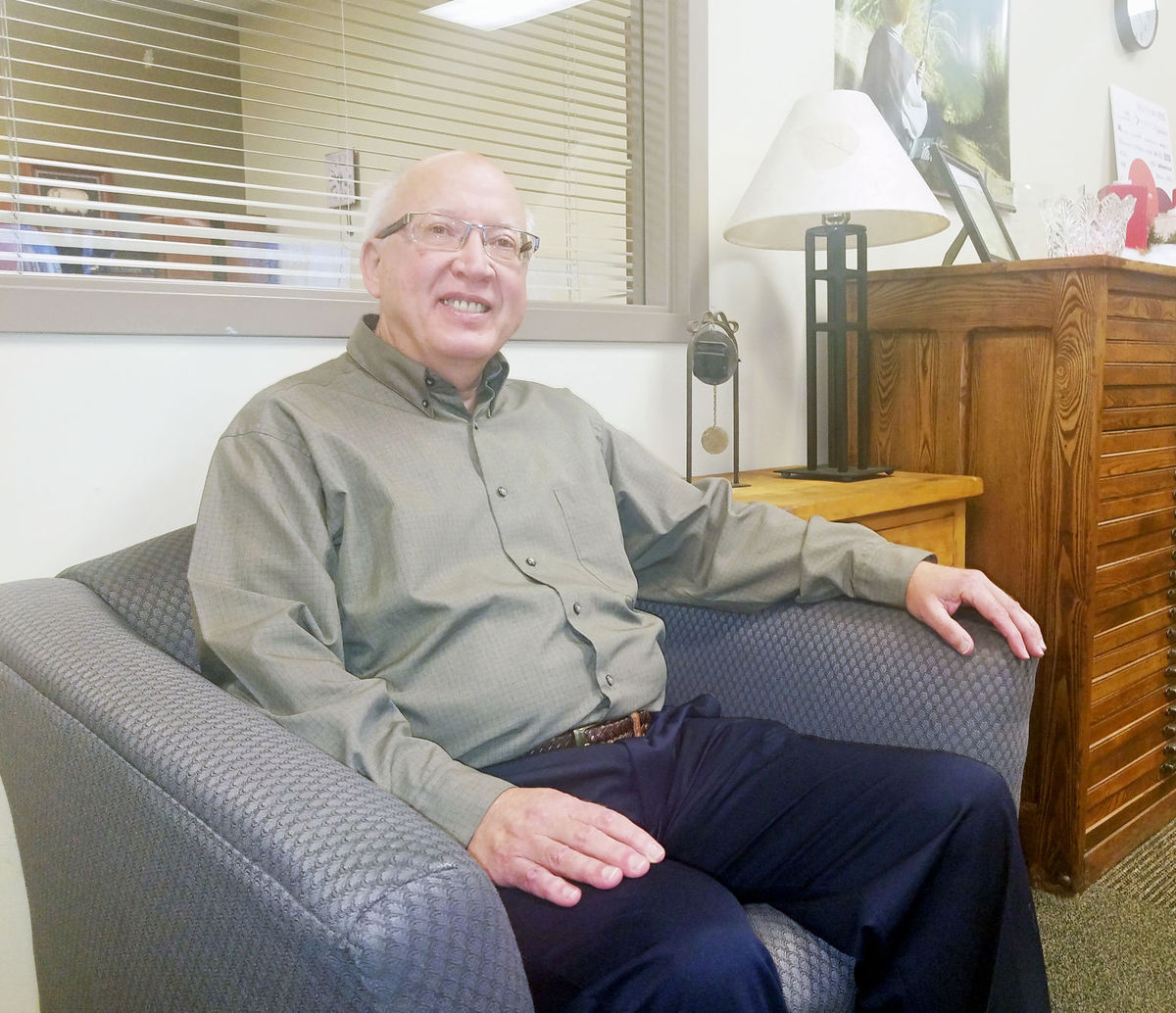
If Terry Sandquist had his way, he’d continue work as a probation officer for McLeod County at least two more years.
“Originally, I had thought even longer,” he said.
But after 10 years battling Parkinson’s disease, his doctor told him it was time to get off the job and rest. Parkinson’s is a neurological disorder that leads to progressive deterioration of motor function.
“I originally had intended to work until 2020, but the 60-year warranty on this body of mine seems to have expired,” Sandquist said. “First a hip was replaced during March, then a loss of balance in April contributed to a fall that alarmed my office manager.”
Two bailiffs, a deputy and an EMT stepped in to help him out, but that’s when the doctor said the writing was on the wall. He stopped working earlier this year, his departure from co-workers and clients coming abruptly.
“On a Friday afternoon in April, he said I shouldn’t go back,” Sandquist said.
By the end of the year, he’ll be officially off the job. He had hoped things would work out differently.
“A year ago, my neurosurgeon had implanted a 4-inch electrode deep into the center of my brain. As hoped, this surgery was very successful in reducing tremors, but not my other symptoms,” Sandquist said.
His career as a probation officer actually goes back 35 years, as he got his start in the Ozarks of Missouri, but his connection to the field started much earlier in an experience that helped shape his approach to the job.
“One of my older brothers ended up convicted (of forgery) and going to prison when I was 12,” he said. “I remember visiting him in Stillwater State Prison. Nowadays, a first-time forgery charge would not get you prison.”
Sandquist later would pursue the path of a conservation officer, but found his chemistry and physics skills weren’t up to it, so he instead went for a bachelor’s degree in law enforcement, and a master’s in counseling.
“That put me into the position where a probation officer was an ideal job,” he said.
Work in the field started in 1980, and his move to Minnesota came in 1989. He expected to stay in McLeod County only two years and then move to the Northwoods.
“The cornfields of McLeod County didn’t hold a strong appeal, or so I thought,” Sandquist said. “Yet it didn’t take long before I took a liking to the slower-paced, common sensical, rural community values found in this area.”
His original caseload included clients age 10 to 88, but he went on to specialize in adults, with an expertise for clients convicted of domestic abuse or repeat drunk driving.
“To err is human, but you can’t make the same mistake twice. The second time you make it, it becomes a choice,” Sandquist said.
During his career, Sandquist created a restitution program, which didn’t use tax dollars, to immediately pay victims for any crime-related costs not covered by insurance. Prior to the current law requiring imbedded breathalyzers in the vehicles of some repeat driving-while-impaired offenders, Sandquist helped launch a program offering enhanced supervision, which included breath testing at home during nights and weekends, for offenders with a long history of failed efforts to drive sober.
In addition to supervising clients and holding them accountable during their probation terms, over the years Sandquist said he has written about 1,500 detailed background reports to aid judges in determining the best sentence to reduce recidivism.
“As much as I believe in the benefits of probation, occasionally I would find myself recommending just incarceration and no probation. Sometimes, albeit rarely, public safety was best served by simply locking up an individual,” he said.
But far more often, he found a mix of incarceration, treatment and supervision was most effective.
Recently, he’s found his Parkinson’s started to get in the way of work. A few years ago, his ability to type became severely impaired, making those hundreds of background reports a real challenge.
“My dexterity is reduced so much that the state had to accommodate my disability and arranged for a software program,” he said.
The program translates his voice to text.
“I’ve had that for a decade and it has been really helpful,” Sandquist said.
His sense of smell has also faded, a problematic loss in his profession.
“My ability to detect odors is limited. For example, my once dependable nose is no longer able to detect the odor of alcohol or marijuana on a client,” he said. “I was speaking with a prosecuting attorney and she pulled me aside and said ‘Are you going to test him for alcohol?” And I said ‘Why?’ And she said ‘Can’t you smell his breath?’ And indeed he was over the legal limit.”
After nearly three decades walking the steps to his second-floor office at the McLeod County Courthouse in Glencoe, Sandquist found it was a shock to suddenly end his routine.
“What I had never realized was the huge amount of stress produced by this job,” he said. “Once the decision to stop working was made, there was a tsunami of relief that swept over me.”
In retirement, he hopes to spend more time with his photography.
“With the tremors, it’s not an ideal (hobby),” he said. “But with new cameras with image stabilizing, it’s kept from becoming a foregone pastime. The other interest I have is a large vegetable garden in the backyard.”
He’s also become a soccer dad, and enjoys taking photos for his son’s team.
Sandquist has considered whether he could return in some part-time capacity, perhaps writing reports, but thinks it is unlikely.
“A wise old proverb says: ‘You can’t turn the wind, so turn the sail,’” he said.


