

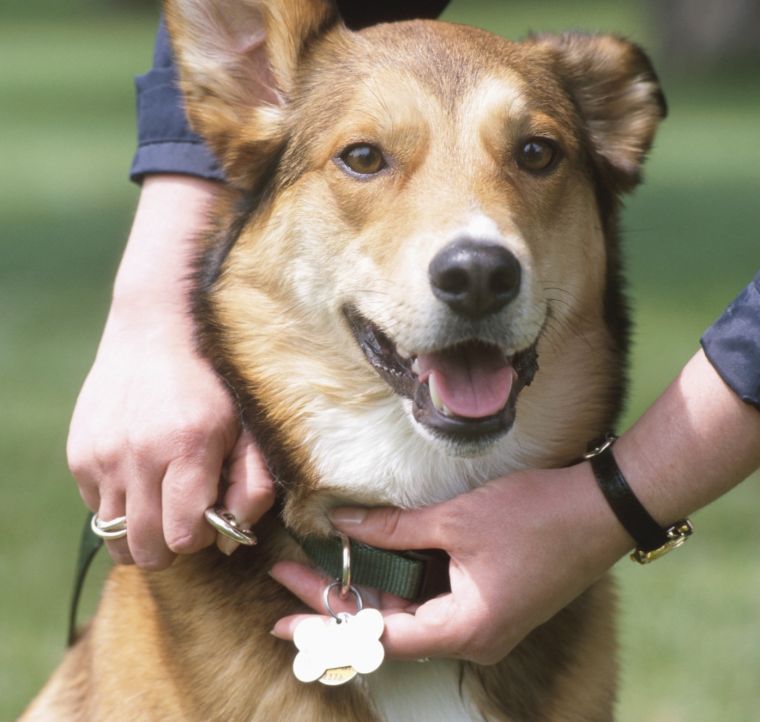
With the official dedication of the new dog park at East River Park in Hutchinson this past Thursday, pet owners may be excited to pack up their furry friends and check out the new 1.3-acre space that includes separate fenced-in areas for large and small dogs.
Before you load Fido into the car, though, it’s good to remember there are rules for using the park. Among them is one that requires dogs to wear a city of Hutchinson pet license tag if they live in town.
According to city code, “It is unlawful for the owner of any animal, six months of age or more, to fail to obtain a license therefor from the city’s Police Department .” Those licenses must be renewed annually, too.
Does that mean every pet dog and cat in Hutchinson is licensed? Far from it.
The Hutchinson Police Department’s 2017 pet license records, to date, list 442 animals — 393 dogs and 49 cats — as licensed. According to a 2012 study by the American Veterinary Medical Foundation, however, the estimated total number of pets in a city with Hutchinson’s population is more like 7,274, or about 3,475 dogs and 3,799 cats. And that’s using population numbers from the 2010 census.
Clearly there are thousands of pet owners around town in violation of the city ordinance, whether they know it or not. What they may also not realize is that city ordinance says any animal without a license tag can be impounded. Owners with unlicensed animals could potentially be cited with an ordinance violation and fined $125 to $135. And that doesn’t include the impounding fees.
Lt. Tom Gifferson of the HPD said that when unlicensed animals are picked up they are brought to Animal Medical Center on Crow River. The center is responsible for holding the animals and trying to locate their owners. While the animals are held, they can rack up a hefty bill for which owners are responsible.
The first-day, intake fee is $35. That helps cover any medical attention needed after it is assessed. For each day after the first, the cost of impounding a cat is $11 per day and a dog is $16 per day.
But licensing your pet isn’t just about avoiding fines and fees. It’s primarily about taking care of the animal and making sure that if it does get loose, it will find its way home again.
When an animal with a license tag is picked up by police, Gifferson said most of the time they will try to find the owners and return the dog without any fines.
Dr. John Froning, owner and senior clinician at Animal Medical Center on Crow River, said most, if not all animals that arrive with tags are returned to their owners.
“If they arrive with a collar on and that city tag on or a rabies tag, or anything like that, we’re able to identify most of those without too much problem,” Froning said. “The other thing that would be really nice is if people had their pets microchipped. That way, if they lose their collar I can still find (the owners).”
When an unlicensed, unchipped animal is brought to the center, finding the owner is much more difficult. And if the owner can’t be found within a week, the animal is placed in a new home.
“What we work off of is, when an animal is brought in, of course we have a pretty extensive network through our clients and Facebook, trying to get animals back to their homes,” Froning said. “If they’re not claimed within seven days, then we place them (with a new owner).”
Froning said while most dogs are returned to their homes, fewer cats make it back because they are less likely to be chipped. That follows the same trend in the HPD’s licensing records that show cats are less likely to be licensed than dogs. Froning estimated a couple hundred animals are impounded per year, and of those about half are returned to their owners.
Heart of Minnesota Animal Shelter in Hutchinson echoed Froning’s support of getting pets licensed with the city.
“The shelter supports and encourages people to license pets,” Heart of Minnesota president Roberta Yates said. “When we have an adoption, the adoption counselors are instructed to inform adopters of the city ordinance. There is also information posted in the shelter (about licensing). It’s just another option to locate your pet if it’s lost.”
To add even more incentive for people to license their pets, the $10 fee is waived if the owner provides proof the animal is neutered or microchipped. That means for most people all it would cost is a drive to the police department to apply for the license.
So if you’re planning a trip to East River Park with your four-legged companions, or even if you’re not, swing over to the police department first and get your pet licensed.
“It really is a no-brainer,” Froning said. “They should just do it.”


