


When it comes to the things that make Hutchinson a nice town to live in, most residents would agree the city’s parks and rec system is at the top of the list.
It’s often said there is “much in Hutch,” and that is largely thanks to the many city-run facilities that keep people, young and old, active throughout the year. From amenities such as the senior center and aquatic center, to the city’s 37 parks, it seems there is always something happening.
What people may not agree with, or may not even realize, is that most city-run facilities come with a cost. And in most cases, a good chunk of that cost is covered by the taxpayers.
At the Dec. 12 City Council meeting, City Administrator Matt Jaunich gave a report on the Hutchinson Family Aquatic Center’s first-year finances. It showed that at the end of the season the pool ended up with a net loss of $76,987, which was covered by the city.
Furthermore, Jaunich showed how much other city facilities are being subsidized by taxpayers. Facilities such as the library, event center, senior center, civic arena and rec center all require property tax dollars to keep their doors open and programs running.
Following the report, people on social media had questions such as, “Is it normal for communities to subsidize these types of facilities?” and, “How much are Hutchinson residents paying compared to other communities?”
To answer the first question, yes, it is common for tax dollars to go toward funding these types of facilities.
“Without painting a broad brush, I can say it is extremely difficult for me to find some of these facilities that make money,” Jaunich said.
“If the goal is for each and every one of those facilities to make money, then we probably shouldn’t have them,” he added. “But I don’t think that’s what the community wants.”
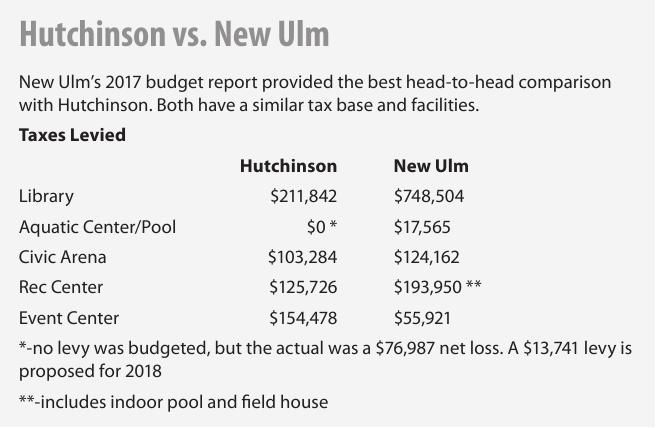
While most of these community amenities are not moneymakers, there are things the city can and does do to help reduce the burden for taxpayers.
As was reported last week, the price to visit the aquatic center is going up next summer to help reduce some of that taxpayer burden. With those fee changes, the proposed 2018 budget projected a $13,741 levy to operate the pool, less than one-fifth what it cost in 2017.
But while the city can do things such as increase the costs to use certain facilities, Jaunich said it’s a balancing act between charging the taxpayers and charging the users.
“Would I like each of those facilities to break even or make money? Yes. That’s what we strive for as staff,” he said. “Part of what we have to take into account is, if you charge the fees to do that, what would happen to the usage then? If it’s $20 every time to go to the pool, how many people are going to pay that?”
Jaunich also pointed out there are other financial benefits these facilities provide, similar to loss leaders in the world of business. While the city pays to operate them, the hope is that they also bring business to the community.
Businesses such as hotels, gas stations, restaurants and more benefit from the influx of people in town for a hockey tournament at the ice arena, or volleyball at the rec center. New families and businesses may also choose to move to Hutchinson, increasing the city’s tax base, because of what is available.
“The alternative (to subsidizing) is, you don’t have a library, you don’t have an ice arena, you don’t have an event center. You don’t have these amenities to the community,” Jaunich said. “One of the biggest comments we get from our business base is that we need an attractive community for people to move here and live here.”
“When it comes to looking at the community as a whole and trying to make it an attractive place for families to move here, for businesses to move here … that’s part of the decisions (council members) make as elected officials,” he added.


