



Thanks to the efforts of people such as Jennifer Huebscher, curator of photography and moving images, and Wendy Guerra, digital initiatives archivist, the Minnesota Historical Society is digitizing its collection of 350 photo albums.
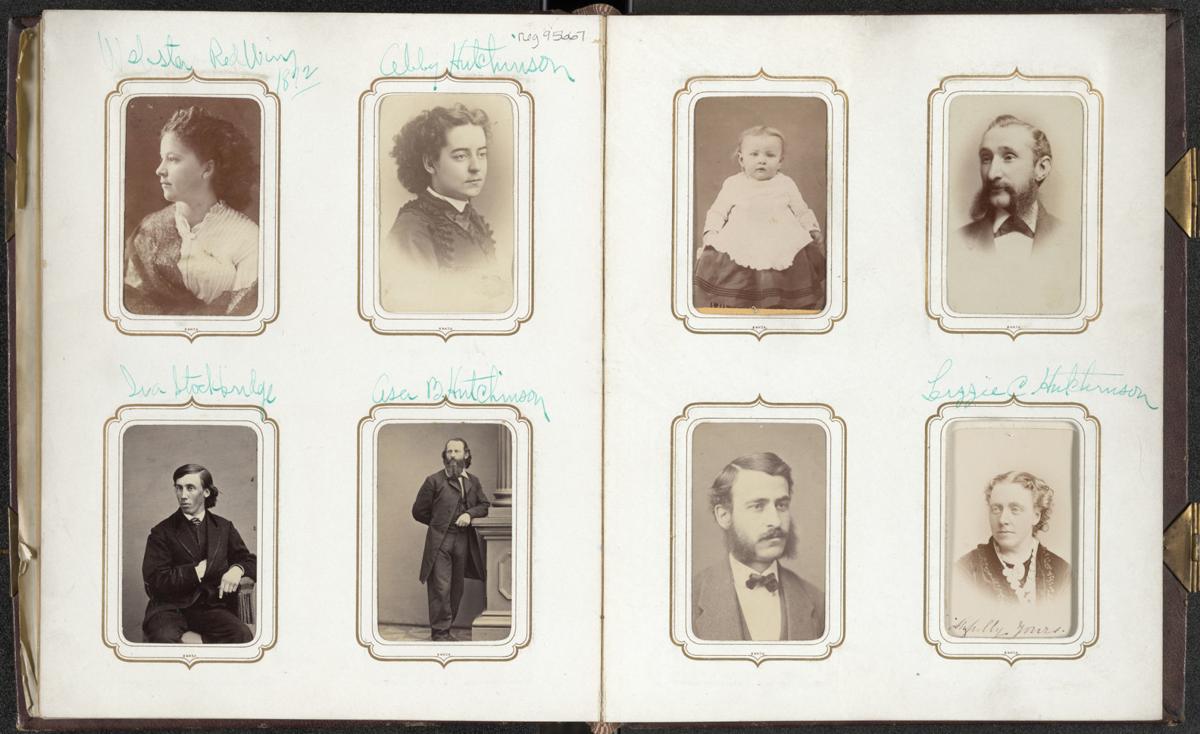
So far, 186 albums have been photographed, with No. 64 of local interest. It's the 1860s-1870s album featuring portraits of the Asa B. Hutchinson family. Asa was a member of the Singing Hutchinson Brothers and a founder of our namesake community. His bronze statue with brothers John and Judson can be seen in Library Square, and his tombstone may be viewed at Oakland Cemetery.
It's Huebscher's job to acquire still images and moving images for the Historic Society's collection. This means she works with donors and occasionally purchases items at auctions or through sellers. The goal is to build the visual history of Minnesota.
The Asa Hutchinson portrait album was donated to the Minnesota Historical Society in the late 1930s by O.D. Hutchinson and his daughter, Elizabeth Hutchinson Fournier. They donated a manuscript collection, scrapbooks, clothing, some jewelry and the photo album. Until now, it was mostly accessible on site, meaning you would have to visit the Minnesota Historical Society in St. Paul to view the items.
The advantage of digitizing the Asa Hutchinson family album is access and preservation.
"I work at the reference desk once a week," Huebscher said. "I've gotten the occasional request for materials. They (the Hutchinson family) were integral to the founding of Hutchinson and larger McLeod County."
Digitizing the Asa Hutchinson family album makes it accessible. Anyone with an internet connection can see the album. Digitization also allows it to be picked up by Google. For instance, if someone wanted to know more about the Hutchinson Family Singers and what happened to them, a search would reveal the album information and they would be able to access it.
Now that high-resolution digital copies exist, albums such as the Asa Hutchinson family album can be put in low-humidity storage, which helps stabilize plastics and dyes found in photographs and decreases deterioration. While the physical albums will still be accessible to researchers with a curator's permission, decreased handling will also help prevent damage over time.
INQUIRIES ARE STEADY
The curator said she receives inquiries every day from people interested in donating items to the Historical Society.
"This week I've had a couple offers for single items, glass plate negatives," she said. "It's a hodgepodge. It picks up around the holidays as families start to talking about family history. I anticipate it will be busier over the next couple of months."
Among her greatest finds: A set of family photo albums put together by Willard Handsaker, a draftsman for the railroad.
"In addition to photographing family, family vacations, neighborhood and things for work, he used beautiful fonts to describe things," she said. "Each year he did an album. They were phenomenal."
Huebscher said the best part of her job is the surprises.
"What's next? What's on this roll of film? What photos am I going to be offered?" she said. "It's great. I have to wonder what's going to happen to my photographs. Will my children think of donating them?"
DIGITIZING THE ALBUMS
While Huebscher collects the images for the Minnesota Historical Society, Wendy Guerra coordinates the digitization of the whole collection and oversees the technicians who do the work.
"Jen brings in the item," Guerra said. "The cataloging staff writes the description of the item. I bring it all together and deliver it online."
So far, her staff has photographed 186 albums. Typically, you can probably do a couple in a day. Photographs are taken with an overhead camera. From there the images are edited.
"We have some pretty awesome equipment," she said. "It's pretty snappy."
Although they don't have a deadline to complete the project, Guerra hopes to have it done by March.
"We have other projects," she said. "The photo albums are one of our collecting areas. We're digitizing the state government records and manuscripts and personal papers."
When it came to photographing the Asa Hutchinson album, Guerra said it was very straightforward.
"It was in the second batch," she said. "We've gotten into a rhythm. In looking at the material, it was in good condition with metal clasps. Physically that's a pretty stable artifact to photograph. This was a beautiful album."
The Hutchinson Family Singers and their various offshoots performed for President Abraham Lincoln and Union troops during the American Civil War.
The Asa Hutchinson photo album was a gift to the Hutchinson family. The inscription reads: "Presented to the Hutchinson Family by Lt. Col. John S. Bishop and Major Andrew Krause on behalf of the officers and men of the U.S. 108th Regt. U.S. C.I. (United States Colored Infantry), Rock Island Barracks, Ill, December 6, 1864."
Just so you know, when you're looking at the Hutchinson photos, it's close to the originals.
"We don't do too much photo editing," Guerra said. "It's the most realistic version, as if the person was looking at it in person. We don't mess too much with the color."
If you're wondering how Guerra prioritizes what gets digitized and when, she uses a scoring system.
"I have a whole spreadsheet recommended for digitization," she said. "It give (each item) a score based on popularity. I consider any copyright restrictions, privacy restrictions. What strategic priority does it provide. I do a risk assessment. After all that, I give it a score and based on the score, it gets prioritized and that is how it is ranked."
Sometimes things will jump the list. For example, the Minnesota Historical Society is hosting the exhibit "She Voted: Her Fight, Our Right" in September 2020. As a result, Guerra is digitizing collections that would support that exhibit.
LOCAL DIGITIZATION
If you think digitizing museum collections is only for the big guns such as the Minnesota Historical Society, you would be wrong. As early as 2014, the McLeod County Historical Society was creating a searchable online records database.
Lori Pikell-Stangel, the museum director at that time, advocated for the project because it makes history accessible.
"It was my dream to unleash the huge store of historical McLeod County information for the public," she said in 2014.
To date, Brian Haines, the director of the local Historical Society, estimated it has digitized about 30,000 items. Guerra estimated the Minnesota Historical Society has 236,000-237,000 items that have been digitized and accessible online.
To access these online collections, all you need is an internet connection. No matter what kind of device you use — laptop, desktop, tablet or smartphone — research is just a click away.

