

It’s no mystery. Someone somewhere knows the answer.
Being new to McLeod County, I find myself doing a large bit of learning, especially when I write these columns. Each week is a new adventure, a chance to discover something I never knew before about a place I’m getting to know now. I guess you could say it’s one of the fringe benefits of working at a history museum.
This week while looking for something to write about, I was told a story about Campbell Lake, or rather how Campbell Lake received its name. The problem is, no one I talked to, nor any source I searched, could verify the information I received. So I thought this week you could help me find the information I’m looking for on the history, or maybe “the mystery,” of Campbell Lake.
The story goes as follows:
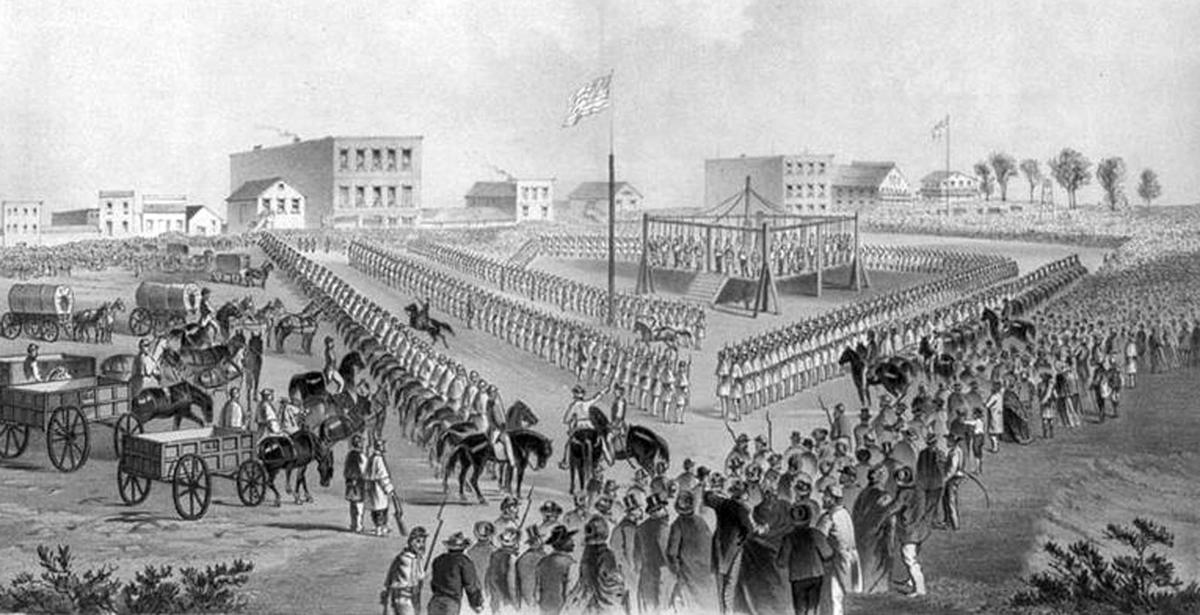
His name was John Baptiste Campbell, son of the famous Sioux translator Antoine Scott Campbell, and one of the 38 Dakota men hanged in Mankato on the fateful morning of Dec. 26, 1862. John’s father was a white man of French descent, and like many early Minnesota residents, his mother was a Dakota woman. He was born at Fort Snelling in 1838, where his father worked as an interpreter (and farmer) for Indian Agent Maj. Lawrence Taliaferro.
For most of his youth, John farmed alongside his father, but when Antoine Scott Campbell died, John moved to the Upper Sioux Reservation near Granite Falls, Minnesota, where he worked as a merchant trader with the Indians.
In 1857, trouble began brewing. Under the leadership of Inkpaduta, 40 white settlers were killed by a band of 14 Dakota men at Spirit Lake. The winter of ‘57 was hard on Inkpaduta’s band, and his grandson succumbed to starvation. The attack at Spirit Lake was his way of retaliating. He avoided capture by the military, and his band was never caught. In a last-ditch attempt to rally support for his cause, Inkpaduta sought out Little Crow, leader of the Mdewakanton band of Dakota for help. However, Little Crow had another plan in mind.
Prompted by the U.S. government withholding money owed to the Dakota if Inkpaduta was not turned in by his own people, Little Crow rallied a party of warriors to seek out the renegade and bring him into custody. Though they were unsuccessful in bringing Inkpaduta in, Little Crow’s warriors were able to capture some of the renegades.
Of the warriors in Little Crow’s party was the “mixed blood” John Campbell. Campbell would go on to create a bond with Little Crow, and with his mother being of the Mdewakantons, it became a kinship bond. As their relationship grew, Campbell became a sort of “secretary” to Little Crow, conducting much of the chief’s correspondence between himself and the government.
In 1862, Little Crow was prompted to lead a large faction of his followers in what would become known as the U.S.-Dakota War of 1862, or more traditionally, the Sioux Uprising. Though Campbell would later go on to say he was forced to, he stayed by the side of Little Crow and took part in the killing of white settlers in Minnesota.
Upon being captured by the United States Army in 1862, Campbell testified that he was told, “If you don’t help kill some white men, you should be killed … I went to the Big Woods on a war party. They had a fight with the soldiers. Crow (Little Crow) was along. The soldiers and Indians ran so fast that I couldn’t keep up with them. We went above the town (unnamed, possibly Hutchinson) and heard firing. Crow asked us to go toward the town. When we got close, there were too many white men and we left.”
Though he denied killing any white settlers, others testified that he did, and he was sentenced to hang with 303 other Dakota men.
Shortly before the executions were to take place, President Abraham Lincoln pardoned all but 38 of them. Campbell was one of the 38. In the moments before the condemned men were sent to hang, a Jesuit priest was brought in to pray with the Dakota, some of whom were Christian. As the priest ministered with the Indians, Campbell translated his words to Dakota. Moments later he would go down in history as one of “38.” It remains the largest government ordered execution to date in United States History.
As far as there being “More to the Story,” I was told that the northern portion of Otter Lake was later re-named in Campbell’s honor, but as I stated, I cannot find the information to verify the story. If you know, shoot me an email at director@mcleodhistory.org.

