

Nothing makes the work day drag like a night of poor sleep. Now think how much worse it could be hurdling through space on a multi-billion dollar space station.
"There are lights and noise, no gravity. It doesn't feel normal," said Bhavya Jalla, a fifth-grader on the Park Elementary Lego League team, the Tigerbots.
In addition to designing, building and programming a robot designed to complete various challenges on a theme playing board, each year the teams are tasked with a research project. This year, the theme is space and orbit, which means the Lego robot must be capable of collecting prop samples, tipping panels and other tasks to complete missions based on space exploration.
Meanwhile, the 10-person team is fine-tuning its solution to a good night's sleep in space. Judges at the Dec. 8 Minnesota Regional Tournament in Eden Prairie were so impressed they granted the Hutchinson team the tournament's Project Award, placing it ahead of 31 competitors at the event.
"We presented our idea, the Star Bed," Jalla said.

Lily Harbarth shows the Star Bed and its controller. The design reflects an idea for a product intended to make it easier for astronauts to sleep in space.
Everyone on the team played a part in the skit, which featured astronauts, NASA experts, a host, a doctor and a rocket man on the television speaking to two astronauts about a new product.
"It was an infomercial about the Star Bed," Jalla said.
"We were trying to sell the Star Bed to NASA," said fourth-grade Dalen Loncorich.
The Star Bed prototype the team built looks similar to a sleeping bag. The design calls for air pockets on the back and sides that can be expanded to apply pressure where the user desires, thus replicating the feeling of pressing that comes with sleeping on your back or side. The bed also creates warm or cold air, depending on preference.
"It's a good idea, considering no one else thought of it," said fifth-grader Alison Lauinger, fifth grade. "It would really work if we had all the equipment in space. I think it would really help astronauts to be more energetic during the day."
Judges told the team they liked the use of expert opinions — that of a doctor and a nurse — in the presentation, and the amount of research the team had used to prepare it. They encouraged the team to try and share information from a wider variety of experts, which the students are planning to follow through on.
Thanks to the Tigerbots' success, they are one of 140 teams out of 600 to advance to the sectional tournament Jan. 12 in St. Paul. The state tournament is in February.
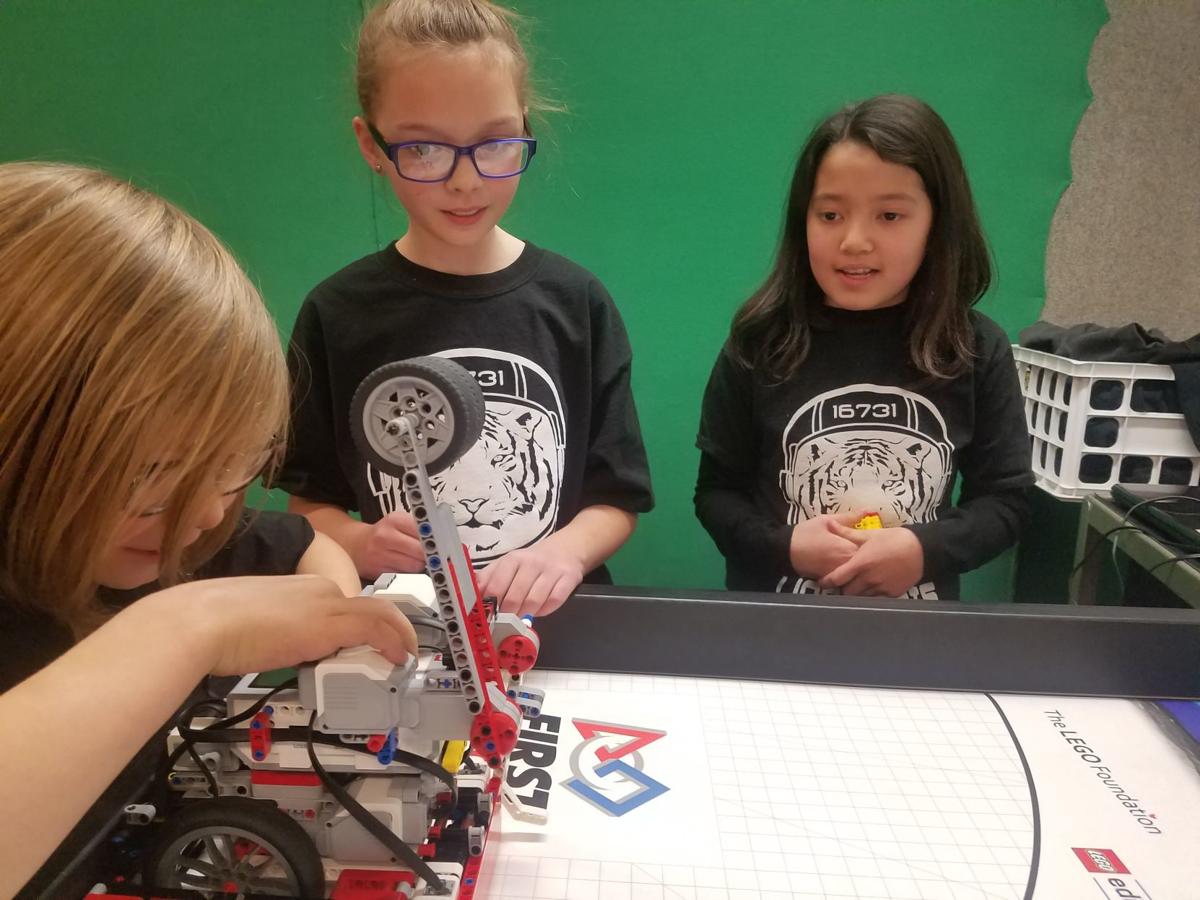
On the robot end of the competition, the team earned 72 points out of a possible 382 spread across 15 missions with numerous challenges within each. Part of Lego League is figuring out the best robot to build to complete the most tasks, but also figuring out the most efficient way to gain points from the many tasks available. The score earned the team second place in its division of 16. Fifth-grader Carson Gonzalez said one of the robot's best features is its lift arm, which was built with a simple design that gets the job done and saves time.

Matson Alvey readies the treads for the Lego robot during practice.
"The lift arm we use for a lot of missions," he said. "We have an attachment specifically for it. ... We can attach it whenever we want."
The robot is programmed by the team to move certain distances and respond to certain objects on the play board. Isaac Scott, a fifth-grade student, said he learned the basics of coding before he joined Lego League by using websites to practice.
"It's a challenge to understand some things, but it's also fun," he said. "I like it."
Successfully completing a mission requires a lot of moving parts to come together, but it's all worth it in the end.
"At tournaments when they work," said fourth-grader Dalen Loncorich, "everyone just goes crazy,"

