
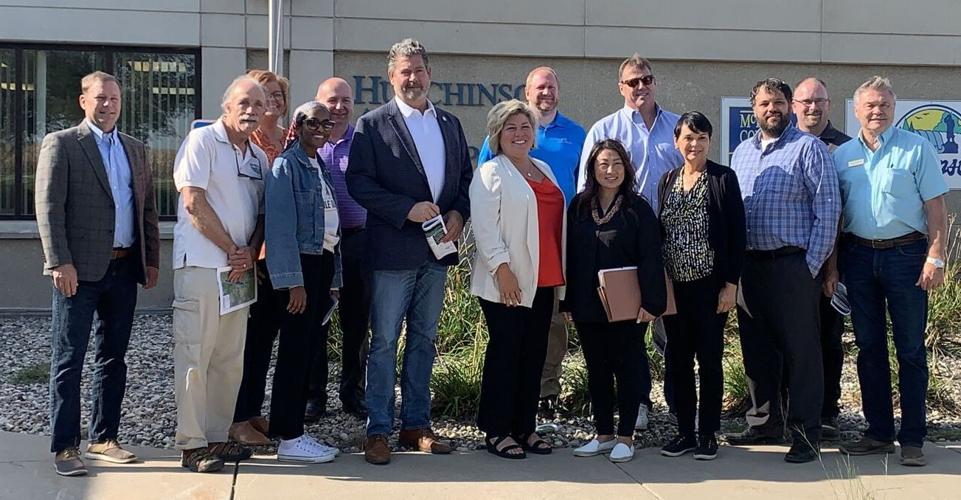


Members of the Minnesota Senate’s Capital Investment Committee visited Hutchinson last week as part of their statewide tour of sites seeking capital improvement funds.
Hutchinson has requested $9.9 million in state funds as part of Minnesota’s 2024 preliminary capital budget. If approved, $6.4 million would be allocated to Hutchinson Area Transportation Services to construct a tempered vehicle and equipment storage building and to replace and modernize the fueling station at HATS. The remaining $3.5 million would go toward a restoration project at Campbell and Otter lakes.
“There’s nothing like seeing projects in person, whether it’s a wastewater treatment plant that needs to be redone or a community center or a lot of sewer projects,” Capital Investment Committee Chairman Sandy Pappas said. “We look at road projects; we just looked at a maintenance facility. So we really get a chance to kind of taste and feel and smell in many cases what the projects are.”
According to McLeod County Public Works Director Andrew Engel, the HATS project is expected to cost $10.3 million and is split between the City of Hutchinson, McLeod County and Minnesota Department of Transportation.
“We are proposing to contribute $700,000 of HATS operating and reserve funds for a local match and are requesting the remaining $9.6 million — $3.2 million for each agency — from the Legislature,” Engel said.
MnDOT is unable to receive General Obligation Bond funds for its portion of the project, but has requested money from the state trunk highway fund to cover its portion.
The HATS facility is a multi-purpose complex, housing various agencies in the region.
“Since the facility was constructed in 1996, staffing and operations have changed. Equipment has become larger, more complex and computerized, requiring longer down time for diagnostics, repair and more mechanic space,” Engel said.
This transition has put increased strain on the original fuel system, which was installed in 1995, according to Engel. That nearly 30-year-old fuel system is now beyond its useful life and constantly requires repairs. Due to the system being out-of-date, finding replacement parts has become a burdensome task, causing prolonged operational disruptions, often stretching for weeks.
Another issue is the facility’s proximity to the Crow River, resulting in a high water table at the site. To address the problem, the project proposes the installation of above-ground tanks. The tight confines around the existing system’s location make this an impractical approach. Instead the plan is to relocate the fuel system near the new tempered vehicle and equipment storage building.
“Above ground tanks for a replacement system is the most responsible route,” Engel said.
Engel emphasized that the project is not just about fixing the fuel system. It’s a comprehensive effort to modernize the facility and cater to the changing needs of the transportation hub that serves McLeod County, city of Hutchinson and MnDOT.
“This project will address the space needs of the mechanics and improve the fueling system, making operations more efficient for the areas transportation system maintenance work,” Engel said.
OTHER AREA PROJECTS
Capital Investment Committee members also listened to a presentation on the restoration project for Campbell, which is in phase 2 and requested $3.5 million in General Obligation Bond funds. These funds will be used to address sediment inflow from the large contributing watershed beyond city boundaries, the South Fork of the Crow River.
During phase 1, the city of Hutchinson invested in storm water treatment infrastructure, spending $2.5 million to improve water quality to Campbell and Otter lakes from city drainage and to restore fish passage from the Crow River into the lakes.
“This project has been going on for a long time,” Project Environmental Regulatory Manager John Paulson said. “It’s been something that the city’s been interested in doing since back into the ’90s. Cleaning up the river, improving the recreational and habitat benefits for the river itself is something the city’s been working on for a long time.”
Funding has been coming together with a significant boost received from the 2020 legislative session, which allocated $3.1 million for the project.
“We’ve finally gotten to the point where we can start moving the ball forward,” Paulson said.
The funding, along with previous contributions, has laid the groundwork for a comprehensive project estimated at a total cost of $19.8 million, according to Paulson.
Enhancing habitats, reviving the lake, ensuring it supports fish year-round, addressing various aspects of this project comes with extensive costs. While the city may not have the primary responsibility for these tasks, there is strong community support and interest in revitalizing the lake’s depth, functionality and fish habitat among other goals, he said.
One key aspect of the project is sediment management, with a focus on diverting sediment-laden floodwaters away from the lake and river. This strategy includes measures like sediment traps on farmlands, restoration of eroded stream banks and the creation of sediment basins outside of water bodies to safeguard future investments and protect downstream water systems.
“We know we can’t do it all at once,” Paulson said. “It’s just a huge project … We’re not just building a building. We’re talking about habitat improvements, recreational improvements, restoration activities, fish and wildlife improvements as well. It’s a broad project, lots of moving parts to it.”
The committee also heard later in the day about a Ridgewater College request for $8.2 million to help with construction, health care, student services and classroom renovation.


