Coach Jeff Smith chats with Jon Evenson, Noah Nadeau and Cole Rahne about adjustments the robot may need based on data collected during practice Monday morning.
President's Day provided many students with a day off, but members of the Hutchinson High School robotics team had other plans for the short break.
"Right now I'm having kids put things together with different motors," said Jeff Smith, one of the team's coaches. "We are trying to analyze via programming and mechanics the best combination of motors and programming to get the best opportunity to score. You can run the numbers and then when you actually put things together they don't do what you think they're going to do."
The 35-member team known as the Tigerbots designs, programs and builds a robot and all of its parts in a technical education wing in the heart of Hutchinson High School. Ultimately the robot must be able to carry out a series of tasks on a head-to-head game arena against other robots.
The competition's aesthetic has a new theme every year. This year the theme is inspired by a team up with Star Wars, Lucasfilm and its parent company, Disney. The arena includes structures with a spot to shoot a ball and a spot to place a ball. Inside the shooting target is a second, smaller target for extra points. There is also a color wheel the robot can align to the right color for points.
"In the center of the field is a big scale where we have our robot climb up and balance," said DJ Scheele, an 11th-grader whose role on the team mostly focuses on programming.
Usually this part of the First Robotics season is one of the most stressful times for the team as it races to finish work on the robot and put it away in time for "bag day," when it can no longer be worked on until competition begins. But this year that restriction was removed. While the change lowers the competition's stress level, it raises the stakes as well.
This year the Hutchinson High School robotics team only needs to build one robot. DJ Scheele and Cole Rahne were among the students working on the robot Monday.
"Normally we've built two robots so that after we bag the competition one we can continue to program and stuff (on a second)," Smith said. "That worked out well for us in the past but that was always difficult because those two robots were not exactly the same. We could program for the practice bot and get to the competition and it wouldn't do what we'd think it should do."
Now every team attending the Northern Lights state competition March 4-6 will have had the opportunity to work on their competition robot right up to the first matchup.
"So they'll have bugs worked out before they get there," Smith said. "Theoretically, everyone should be able to step their game up and show up to the competition with a better robot, which should make for better competition.”
Freshman Carter Drey joins the Tigerbots after one year in the middle school program. His brother, Tyler Drey, was one of 11 outgoing seniors who left the team at the end of the last school year. But Carter Drey is part of an equally sized group of newcomers.
"It should be a good group of students for a couple of years that have got some experience," Smith said, noting that the team has four seniors now. “Every year you lose a few key seniors and then you expect the underclassmen to realize … somebody has got to step up and do that job. It always impresses me how students realize what needs to get done and they step up and take care of business.”
As a drafter, Drey transitions 2D models into 3D. He's also a part-time machinist.
"If they need parts, I can machine (them)," he said.
Among Carter Drey’s projects for the team is a strategy board the team will use to plan its approach to competition. The strategy board from last year was built by his brother, Tyler Drey.
Parts can also be made on one of three 3D printers the team has access to.
The Tigerbots have competed successfully for the past several years, including in 2017 when they won both state-level tournaments they attended and earned a spot at nationals.
Last year, the team fell short of a top-eight ranking at the Northern Lights tournament when it was defeated in the playoffs. However, the final rounds call on the top eight teams to build alliances with other teams, and compete together. Hutchinson was invited to join an alliance and competed in the final rounds, but didn't win another national invitation. This year the team will take another shot at earning a spot.
"Nationals would always be great," Scheele said. "But it's always about improving upon what we did last year and doing the best we can."
Smith said one key to the team's success is its network of volunteer mentors. Former team members, parents and local engineers have helped the team over the years, including a group of eight this year.
"We have a nice group of people," Smith said. "And a good, hard-working group of students. ... The mentors come in from industry and bring a lot of knowledge we wouldn't have otherwise."
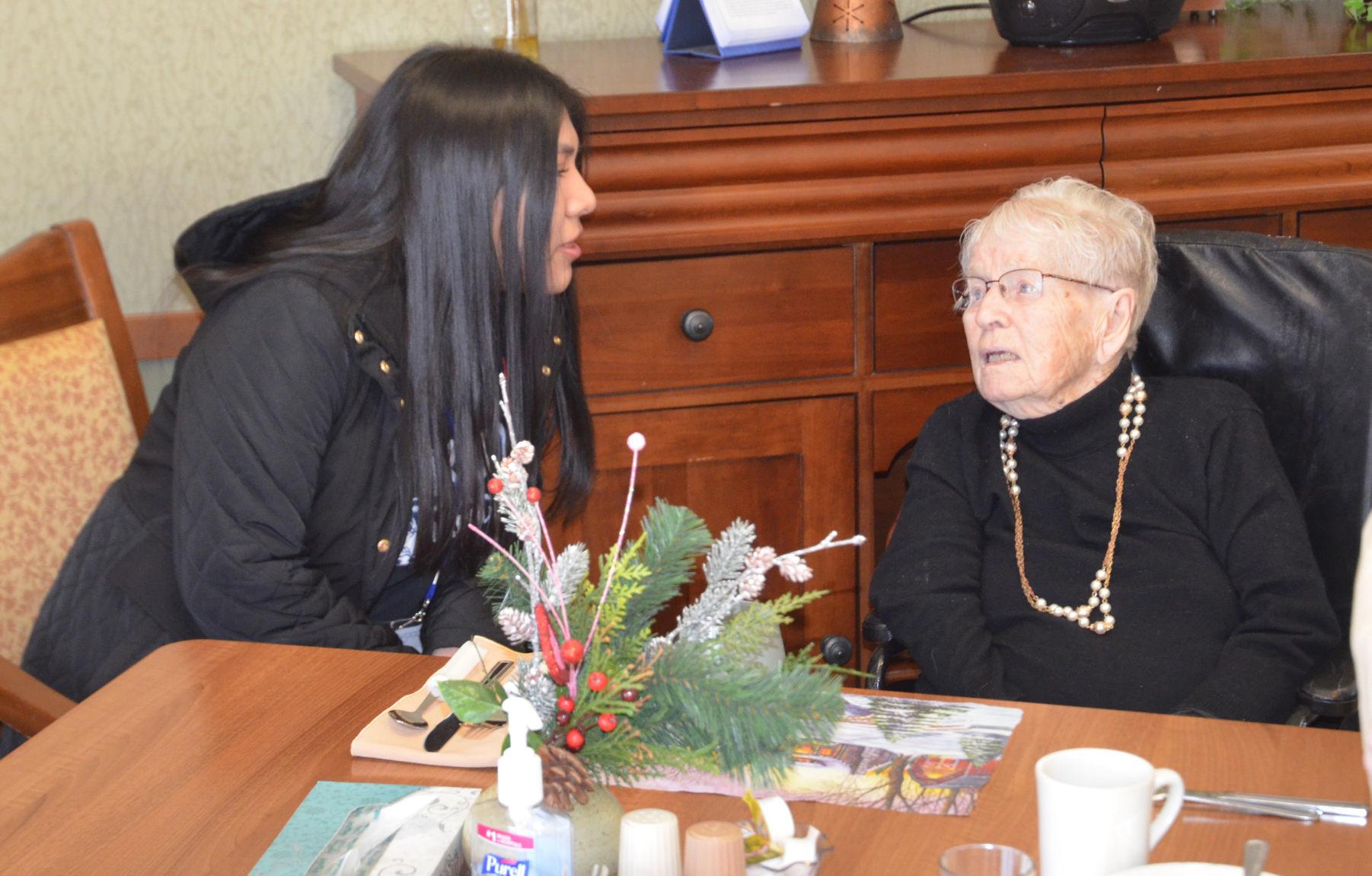
Jazmine Cazales and Margaret Alrick talk while waiting for breakfast at Harmony River Living Center.

The scope of federal and state jurisdiction of various waters continues to shift.
Minnesota will seek to exempt residents from federally issued permits for projects affecting wetlands, lakes, streams and other waters the state also regulates.
That’s one of several notes included in a program update sent from Ken Powell, Minnesota Board of Water and Soil Resources Wetland Conservation Act operations coordinator, to water conservation stakeholders across the state. In the email he discusses the conservation landscape following last month’s announcement of the Environmental Protection Agency’s new Navigable Waters Protection Rule in Section 404 of the Clean Water Act, and how it will impact Minnesota’s state-level programs. It is designed to replace the Waters of the United States Rule that was previously repealed from that section.
The change, effective 60 days after it is published, would limit federal jurisdiction to enforce restrictions to pollution and call for environmental protections pertaining to property owners by bodies of water. The change has not yet been published. The most noteworthy aspect of the new rule is a greater limit on what waters are defined as Waters of the United States. Such waters are subject to the jurisdiction of the Army Corps of Engineers and the EPA. Farmers and businesses said the former rule created an additional set of restrictions and permitting on top of local or state protections, which came with larger expenses. Critics of the new rule say it strips decades of protections.
“Minnesota’s regulation of wetlands is fairly comprehensive because of the Wetland Conservation Act and the (Department of Natural Resources) Public Waters Work Permit Program,” Powell wrote. “The new WOTUS rule will not reduce the scope of wetlands regulated by the major state wetland regulatory programs in Minnesota, nor will it substantially change the process and procedures for implementing state regulations. The rule may affect how the Minnesota Pollution Control Agency assures compliance with state water quality standards.”
The changes do not affect WCA implementation. There is no substantive effect on state jurisdiction of wetlands, Powell said, but federal jurisdiction may change. If Minnesota is successful in assuming administration of federal Section 404 requirements, duplicate oversight may shrink as well.
“A state can apply to the EPA to administer their own regulatory programs to meet Section 404 requirements, thereby eliminating the need for separate, federally issued permits,” Powell wrote. “Over the last several years, Minnesota has evaluated the feasibility of assumption of the federal 404 program.”
State agencies were directed by legislation to assemble materials for such an application. The BWSR has hired Lewis Brockette to manage the effort for Minnesota to assume 404 regulation in place of the federal government. Brockette recently served as the assistant state conservationist responsible for managing the Minnesota Natural Resources Conservation Service’s wetland compliance program.
“We have begun regular discussions with EPA on our regulatory programs and how they conform with assumption regulations,” Powell wrote.