Dr. Christopher Wallyn, left, works at a surgical microscope while Dave Salo assists during a past trip to Guatemala. Wallyn and Dr. Michael Merck of Regional Eye Center in Hutchinson have been visiting Guatemala since 1992 to provide eye care as part of their mission work with The Foundation for Saving Sight.
Dr. Christoper Wallyn stands with one of his patients during a past trip to Guatemala. He and Dr. Michael Merck will often see up to 120 patients per day during their visits, and as many as 40-45 of those patients may require surgery.
When someone asks where you plan on traveling this year, odds are good Guatemala is not on the itinerary. But for nearly three decades, that’s exactly what two local doctors have been doing, using their skills to help restore vision to people in need.
Dr. Christopher Wallyn and Dr. Michael Merck are ophthalmologists at Regional Eye Center in Hutchinson. They met while in training together at Rush-Presbyterian-St. Luke’s Medical Center in Chicago. Both were married with young families, and both were Catholic, so pairing them together as residents was a natural fit.
“Our faith really, they could tell, motivated much of how we looked at our lives,” Wallyn said.
It was also the doctors’ faith that led them to accept an offer that would change their lives. In the early 1990s, the Rev. Greg Schaffer, a priest for the Diocese of New Ulm, invited Wallyn and Merck to visit Guatemala, where Schaffer had worked at the mission parish in San Lucas Toliman since 1963.
“He invited us to come and see because both of us had said that we would like to do mission work,” Wallyn said. “That was one of our goals.”
“It was the personal invitation of the late Father Greg Schaffer that led to my commitment to begin the work of bringing surgical eye care to the area,” Merck said about the two doctors’ first trip to Guatemala. “He so generously offered to host me and my family. And he extended the kind of hospitality that made it impossible for us to refuse to make that initial trip.”
A desperate situation
On their first visit, Wallyn and Merck quickly realized how difficult the living situation was for the people of Guatemala. Most families lived in one-room homes with dirt floors and tin roofs. Malnutrition is also a serious threat for young children. With so many concerns, eye care was often neglected.
“People went blind and that was part of life,” Wallyn said.
But while life is tough in Guatemala, Wallyn and Merck were inspired by the culture and reverence for elderly people. Grandparents are an important part of a family and often live together with multiple generations. And while the older generations want to contribute to the family with tasks such as collecting fire wood, cooking and cleaning, they can’t do that if they can’t see.
“Coming from North America, coming from this country that has so much, learning what people lived under and trying to help where we could, which was really trying to help people with their eyes, from that point we decided that we were gonna try to address the needs of the people in this area,” Wallyn said.
From then on, Wallyn and Merck became regulars in Guatemala. Their trips started in 1992 and usually last 7-10 days. On average the doctors said they see about 120 patients per day, many often with cases of neglected cataracts requiring surgery.
“Some we can help by just giving them explanations,” Wallyn said, “some people by just giving them eye drops, some people by giving them the opportunity to have surgery.”
Now almost 30 years later, the doctors continue their trips, sometimes as many as two to three times per year. In 2000, the doctors established a nonprofit organization to help their mission called The Foundation For Saving Sight.
While the need for eye care remains, the conditions have somewhat improved. The doctors now have a full operating room with equipment that allows them to complete cataract and glaucoma surgery. They’ve also earned the trust of the locals.
“We've gone from people being very superstitious about eye surgery and superstitious about what we're all about to trusting us and understanding who we are and what we are there to do,” Wallyn said.
Their work has also attracted other eye care groups from St. Louis, Texas and Seattle that help with the mission.
“Here we are trying to address mature cataracts with modern-day surgery,” Wallyn said. “The end result is, a person goes from blindness to being able to see, which is dramatic, life changing.”
Just as dramatic as restoring a person’s vision, however, is giving patients the knowledge and understanding of an issue with which they’ve had to live.
“I've found it can be equally moving to be able help a patient who is plagued with the uncertainty and lack of understanding they have of their disabling eye condition,” Merck said. “to be able to answer for them the haunting questions that they and their loved ones have lived with for too long, not knowing whether they are neglecting or have neglected a treatable problem or not, and then witness their gracious acceptance of their difficult circumstances when they learn it is permanent and untreatable.”
Inspiring others
On Thursday, Wallyn departs for his latest trip to Guatemala and is scheduled to return Feb. 16. Merck’s next trip is scheduled for the fall.
While the two plan to continue their mission, they’ve inspired others to join them. Merck’s son, Joseph, started attending the trips with his father as a child. He is also a certified ophthalmologist now and helps perform surgeries and other procedures. Merck's three daughters, all nurses, also accompany the group to Guatemala and assist with the work.
Katie Wallyn also started her own project called LEAST, which stands for Loving the Elderly and Satisfying His Thirst and helps feed elderly people in San Lucas.
There are also plans to develop a mentorship program with the University of Minnesota to bring residents in training along to Guatemala so they may experience life on a mission trip.
If others are looking to donate either through money or service, they can visit through foundation.regeycenter.com for more information about the organization.
“It's wonderful to have people able to participate and be part of that process,” Wallyn said, “because we couldn't do it just by ourselves.”
It’s been 28 years since their first trip, and although the Rev. Greg Schaffer is gone — he died in 2012 — his work and love for Guatemala live on in Wallyn and Merck, and continues to spread down to new generations of missionaries.
“Part of my life, and Dr. Merck's the same way, is for us to never just consider that working in a medical practice in central Minnesota would be a sufficient answer to the gifts that we were given,” Wallyn said, “that there would be more to it than that.”
One of the interesting points Steve Chandler, owner and brand strategist at ChandlerThinks, tells the audience is how the branding story can be shared by local businesses. His example was Macon, Georgia. A local restaurant had an Allmann Brothers burger on the menu. The city also created “Soul Spots,” which identified important milestones in their history.

It was a full house Thursday night for the ChandlerThinks presentation on its findings about Hutchinson. Many of the people attending were early participants in the process.
The Allmann Brothers are to Macon, Georgia, what the Singing Hutchinson Brothers are to Hutchinson, Minnesota — a key element in each city's identity.
It's these building blocks of a city's story that ChandlerThinks, a Tennessee-based marketing and branding company, has sought to discover by asking citizens and out-of-towners their impressions of Hutchinson.
While it might sound like busywork, it's important for the city's marketing and branding effort, which will be used to attract new residents and young families along with prospective businesses and developers to Hutchinson.
The findings gathered through public meetings, focus groups, one-on-one sessions, surveys and the Facebook group "Branding Hutchinson" were presented Thursday night by Steve Chandler, owner and brand strategist, and Greg Fuson, research director, to a full house of interested residents at the Hutchinson Event Center.
"It's a pretty fun presentation to give," Chandler told the audience.
While some folks may think it's all about developing a logo, Chandler said it's more than that. It's about telling the story of Hutchinson.
"The logo takes on the meaning of all the stories," he said.
So, do people see value in actively creating and managing the city's reputation? You bet. A whopping 75 percent of participants said it was extremely important.
You might wonder what's wrong with the city's approach now. According to the brand diagnosis: The city of Hutchinson's presentation — its website, social media, logo and so on — does not reflect the professionalism and progressive energy of its programs and general community.
William "Bo" Young participated in the interview process and provided feedback.
"I believe we made a good choice in hiring ChandlerThinks," he said. "I am confident they will define our brand and provide strong direction on how to market Hutchinson."
David Wegscheid agreed.
"I thought ChandlerThinks approached the research for Hutchinson's story from a somewhat profound and unbiased perspective," he said. "By looking outside the box (Hutch) as well as deep into the box, they were able to reflect what I thought was a true and accurate mirrored reflection of Hutchinson."
According to Tim Burley, the feedback from the community was as expected.
"The point they made about people in our community being proud and very happy with our current direction was point on," he said. "Now the question is, how do you take that information and roll it up into a branding and marketing message and sell it with the goal of influencing people to move to Hutchinson?"
One of the findings Burley felt was ignored was that workforce- and college-age students feel there isn't enough to do.
"I have three sons in their 20s," he said. "When I asked them about Hutchinson, all three said it's boring. I speak with veterans from around the country, they are looking for adventure, people their own age and not having to live paycheck to paycheck. I said to them, 'The Twin Cities is an hour away with nightlife, sports, bars, dancing, movies, concerts, etc.' Their response was, then we have to live near there because a Hutchinson income won't make that lifestyle affordable. I said, 'Commute to work,' their response was then we get home later and we don't have a quality of life.'"
Like Young, Burley was involved in the beginning stages of the branding project.
The best thing he thought that came out of Thursday's meeting was Hutchinson's need for a communications/marketing director.
"Someone who is updating web and social media presence, marketing daily," he said. "Not just somebody that gets around to it. We have to use the visionary, educated and forward-moving ideas and keep and attract business and industry, or entrepreneurship to keep them here. We have a lot of retail. We have shift work, but these young people are in the digital age and technology is their passion. How do we tap into that?"
WHAT DO PEOPLE LIKE?
The answers aren't surprising: the Crow River and dam, Little Crow statue, Hutchinson football, Library Square, Les Kouba, parks, wildlife sanctuary, sunsets, lakes and trails.
"The sense of community came through," Fuson said.
When it comes to branding, the company has established six pillars it uses: personality, values, reputation, point of pride, point of different and overdelivery.
Like a person, a city has a personality. Hutchinson's characteristics include small-town rural, convenient location, natural beauty, blue collar, dedicated, clean and proud.
The Niche website, which connects people to their future schools, neighborhoods, and workplaces, gave Hutchinson an overall grade of B.
What are our values? Hard working, dedicated, collaborative, progressive, conservative, supportive, friendly and volunteerism.
So far, so good.
What do people love about Hutchinson? A feeling of pride, it's safe, a great place to raise a family, caring and giving, arts programs, Main Street and a manufacturing base.
What is it's reputation? Words that were mentioned were Much in Hutch, Minnesota's Manufacturing City, high school sports and TigerPath.
Outsiders see it as a small town, a place for shopping, good people, clean and nice.
An impressive 79 percent perceive Hutchinson in a positive light.
One of the findings that most impressed Chandler and Fuson was the culture of government, which was described as supportive, team, efficient, proud, cooperative, dedicated and futuristic.
It's something they don't see very often.
Points of pride include high school sports, downtown Hutchinson, it's close to the metro, trail system, the Crow River and history of Little Crow.
What do we do better than other cities? We're trailblazers and we are willing to step out and try something new.
When you boil all this information down, you have what is called brand truths. According to ChandlerThinks, Hutchinson's brand truths are:
- The personality, values and reputation of Hutchinson reflect that of a small, rural, blue-color town, honesty, hard working, friendly and supportive.
- From the formation of the town, to its successful TigerPath program, to selling its own compost, Hutchinson has a strong history of progressive collaboration that may juxtapose its conservative nature.
- Downtown Hutchinson, the Crow River, area parks and the trail system create an aesthetic that draws the community together.
- Hutchinson serves as a rural hub to other small towns in the area for jobs, dining, health care, shopping and social activity.
WHAT'S NEXT?
With all this information, the next step for ChandlerThinks is to develop a brand story, which it hopes to have by the end of March.
"The project should wrap up by April," Chandler said. "I will be back to present final overview and recommendations to the city manager, the branding task force, also the council."
So, what do you do with a brand story? It helps the city build a reputation with the goal of energizing residents and instilling a sense of pride within the community. The hope is to position Hutchinson as a desirable place for relocation, continued development and redevelopment to increase new resident attraction and economic growth.
Bottom line: More people, more businesses, fewer taxes for all of us.
Wegscheid is excited to move forward with what ChandlerThinks reveals at the end of its research.
"For me, I see their process and ideology to be well-rounded and I feel comfortable and confident with what they will have to offer Hutchinson with their findings," he said. "I believe it will be a very positive, beneficial and exciting time for Hutchinson's future moving forward."
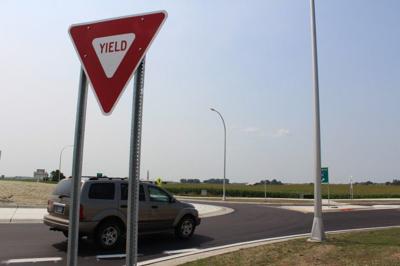
Truckers aren’t fond of the two roundabouts they must drive through to travel through Hutchinson on State Highway 15. An alternate route around the city would allow them to skip the intersections more easily.

Kent
Exner

John Brunkhorst
A plan to build a road that curves from State Highway 15 on Hutchinson's north side to State Highway 7 on Hutchinson's east side is taking shape.
Hutchinson City Council agreed last week to contribute to the second phase of a study to formulate the plan. The McLeod County Board agreed Tuesday morning to hire SRF Consulting Group of Minneapolis to conduct the study.
THE CONCEPT
The road plan is part of a ring road concept that directs incoming traffic around a city instead of through it. Directing traffic around Hutchinson from Highway 15 on the north to Highway 7 on the east — and vice versa — will also provide quick access to State Highway 22, which runs north and south beside Hutchinson on the east side.
"It's been talked about quite awhile," said McLeod County engineer John Brunkhorst. "It goes back to probably the '90s."
A similar ring road was constructed about 15 years ago along Vale Avenue and Airport Road to circle Hutchinson from Highway 7 on the west to Highway 15 on the south.
Brunkhorst said ring roads provide an alternate flow of traffic, as would be the case with the northeast proposal.
"I envision commercial vehicles using it more than, say, regular automobiles," he said.
"We hear from truckers," said Hutchinson city engineer Kent Exner. "There are a lot of traffic signals through town here in Hutchinson, and there is no debating it. And two roundabouts. The freight community is not a fan of that."
Construction of the northeast ring road was included among a list of potential projects discussed in a five- to 10-year plan when the county approved a 0.5 percent sales tax to fund road work. The tax went into effect this year. Other funding sources could have an impact on the timeline. The work is estimated to cost $5-8 million.
The City Council voted unanimously to support the study, but Council Member Chad Czmowski said he thought the route would have a marginal benefit for Hutchinson. He said large vehicles can take Adams Street to avoid the traffic lights on Main Street. Exner said it benefited the city to continue to develop travel options to keep the transportation system up to date.
WHAT'S BEEN DONE
A $17,270 study of the ring road's feasibility from a traffic perspective was completed by McLeod County last fall. The city pitched in $8,000 to help the county with the cost.
The study analyzed traffic along roads the ring road would impact and determined the ring road would be traveled by approximately 1,800 vehicles each day, 220 of which would be heavy commercial trucks such as semitractor-trailers, milk trucks and delivery trucks. It identified 10 routes along which to align the road.
"Ultimately the hope is to take those 10 alignments down to two or three," Exner said.
WHAT'S NEXT
The second phase of the study is expected to cost $59,005. In the resolution to hire SRF Consulting Group, the phase cost was capped at that amount. Hutchinson's decision last week came with a $15,000 contribution to that total. Exner said the city's contribution assured it had a seat at the table in project discussions.
The study will analyze soil quality, wetlands and other environmental factors any construction will need to take into account along various route alignments. These factors will impact the overall cost of road construction. SRF Consulting Group is also tasked with gathering input from the public. The study will have a steering committee and public open houses. When the phase is completed, the county should have what information it needs to decide whether to move forward.
"We need this information to make a decision," said Board Chair Joe Nagel. "The hard part is finding where there is value ... and who is benefiting from it."
He said he was happy Hutchinson had agreed to help fund the study.
Board Member Paul Wright said the study doesn't assure the road will be built.
"This is something to put on that long-range plan," he said.
He said keeping on top of such studies helps the county avoid mistakes such as allowing other construction where a preferred corridor would go.
"Those are very expensive mistakes that can happen if you don't have a plan," Wright said.