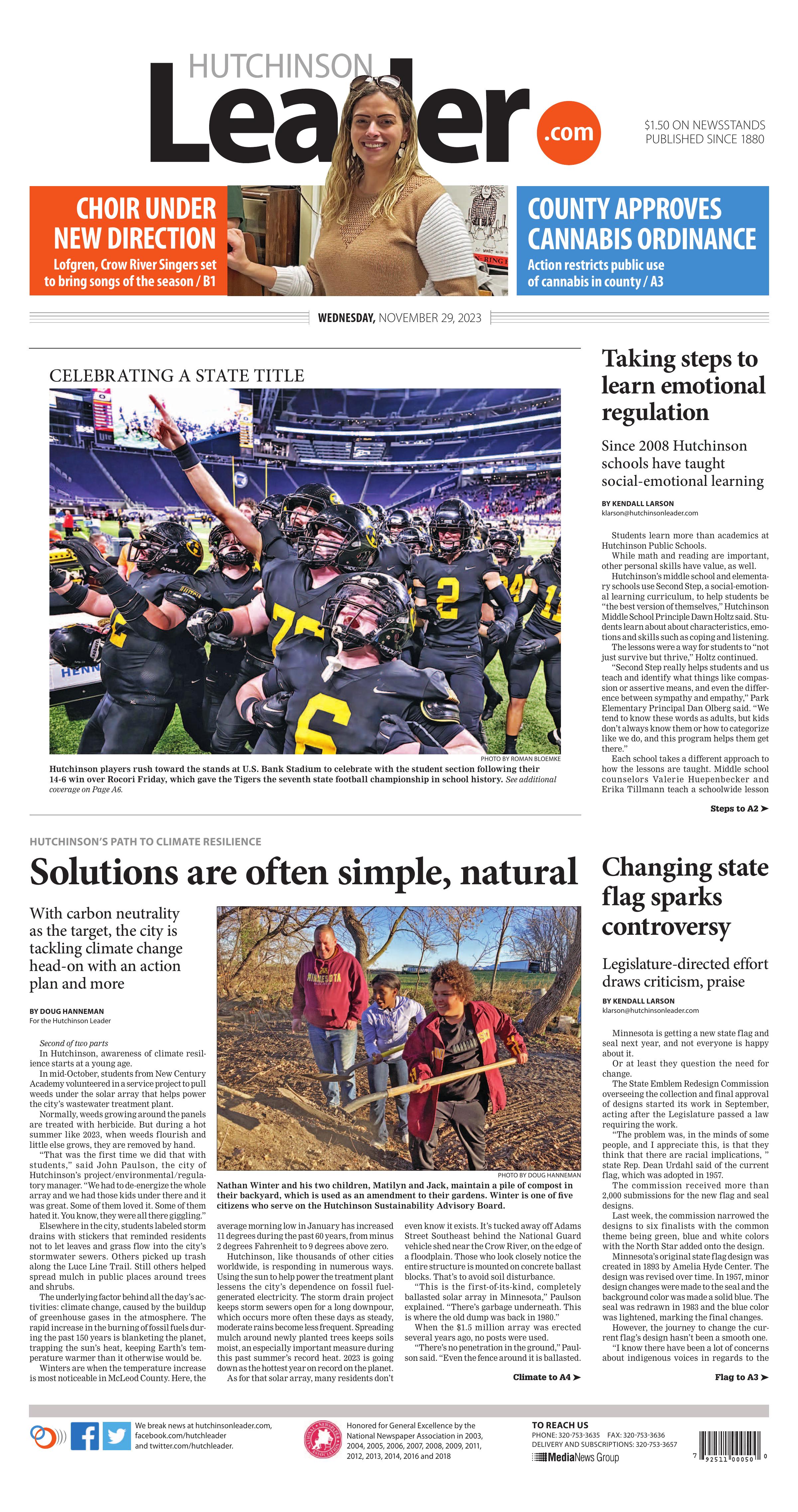
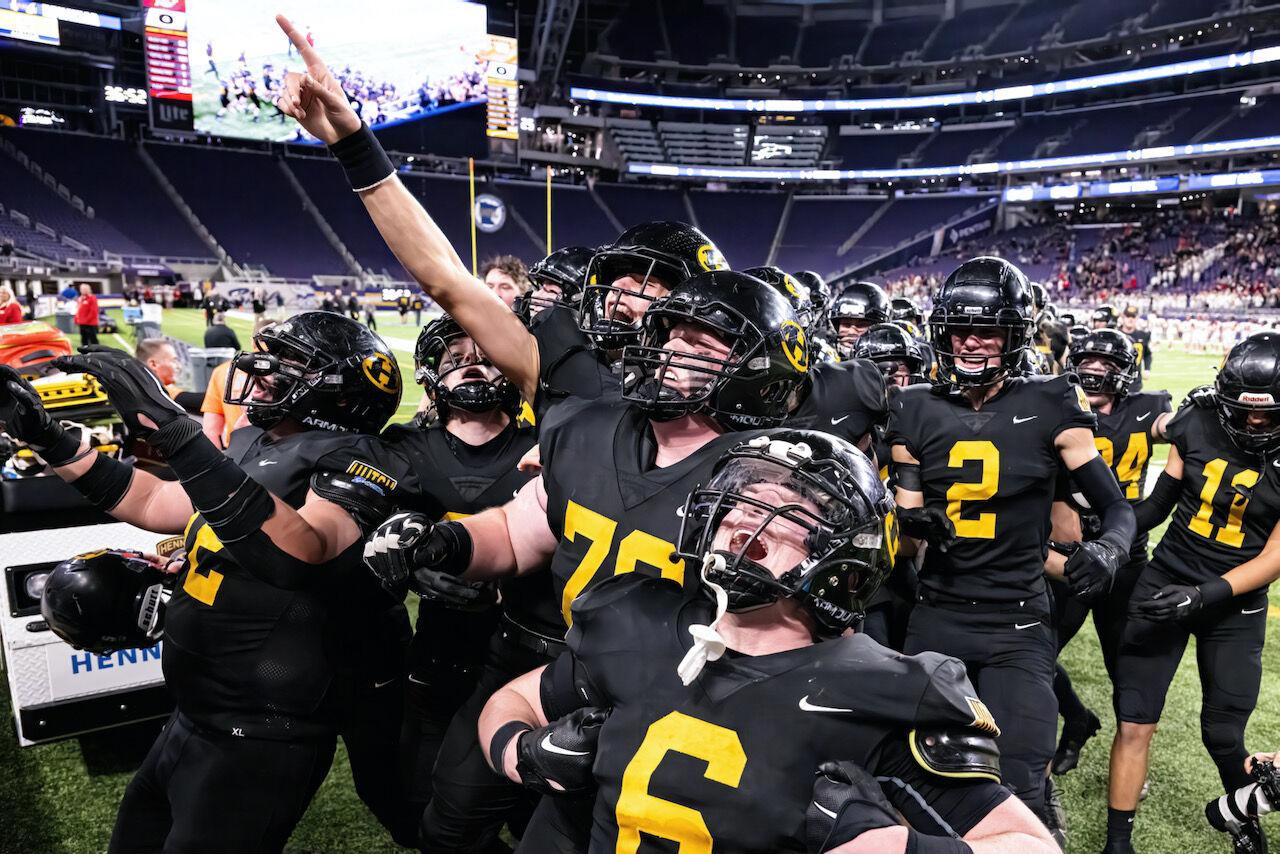
Hutchinson players rush toward the stands at U.S. Bank Stadium to celebrate with the student section following their 14-6 win over Rocori Friday, which gave the Tigers the seventh state football championship in school history. See additional coverage on Page A6.
CELEBRATING A STATE TITLE

Nathan Winter and his two children, Matilyn and Jack, maintain a pile of compost in their backyard, which is used as an amendment to their gardens. Winter is one of five citizens who serve on the Hutchinson Sustainability Advisory Board.
John Paulson, Hutchinson’s project/environmental/regulatory manager, stands above the city’s one-acre solar array that helps power the city’s wastewater treatment plant. The city received a $1 million grant from Xcel Energy to build the $1.5 million array, which was erected in the mid-2010s and will be paid off in about 12 years. “It’s power that’s being produced with very little long-term investment from the city,” Paulson said.
When Hutchinson rehabilitated a portion of the School Road bridge several months ago, it decided to install solar/battery-powered streetlights. Besides saving energy, the new fixtures eliminate the need to wire the lights from beneath the bridge.
Nathan Winter and his two children, Matilyn and Jack, maintain a pile of compost in their backyard, which is used as an amendment to their gardens. Winter is one of five citizens who serve on the Hutchinson Sustainability Advisory Board.
Second of two parts
In Hutchinson, awareness of climate resilience starts at a young age.
In mid-October, students from New Century Academy volunteered in a service project to pull weeds under the solar array that helps power the city’s wastewater treatment plant.
Normally, weeds growing around the panels are treated with herbicide. But during a hot summer like 2023, when weeds flourish and little else grows, they are removed by hand.
“That was the first time we did that with students,” said John Paulson, the city of Hutchinson’s project/environmental/regulatory manager. “We had to de-energize the whole array and we had those kids under there and it was great. Some of them loved it. Some of them hated it. You know, they were all there giggling.”
Elsewhere in the city, students labeled storm drains with stickers that reminded residents not to let leaves and grass flow into the city’s stormwater sewers. Others picked up trash along the Luce Line Trail. Still others helped spread mulch in public places around trees and shrubs.
The underlying factor behind all the day’s activities: climate change, caused by the buildup of greenhouse gases in the atmosphere. The rapid increase in the burning of fossil fuels during the past 150 years is blanketing the planet, trapping the sun’s heat, keeping Earth’s temperature warmer than it otherwise would be.
Winters are when the temperature increase is most noticeable in McLeod County. Here, the average morning low in January has increased 11 degrees during the past 60 years, from minus 2 degrees Fahrenheit to 9 degrees above zero.
Hutchinson, like thousands of other cities worldwide, is responding in numerous ways. Using the sun to help power the treatment plant lessens the city’s dependence on fossil fuel-generated electricity. The storm drain project keeps storm sewers open for a long downpour, which occurs more often these days as steady, moderate rains become less frequent. Spreading mulch around newly planted trees keeps soils moist, an especially important measure during this past summer’s record heat. 2023 is going down as the hottest year on record on the planet.
As for that solar array, many residents don’t even know it exists. It’s tucked away off Adams Street Southeast behind the National Guard vehicle shed near the Crow River, on the edge of a floodplain. Those who look closely notice the entire structure is mounted on concrete ballast blocks. That’s to avoid soil disturbance.
“This is the first-of-its-kind, completely ballasted solar array in Minnesota,” Paulson explained. “There’s garbage underneath. This is where the old dump was back in 1980.”
When the $1.5 million array was erected several years ago, no posts were used.
“There’s no penetration in the ground,” Paulson said. “Even the fence around it is ballasted. Since there’s underlying waste, we didn’t want any penetrations into the garbage.”
Engineers and environmentalists describe the site as a “brownfield to brightfield” transformation.
The past few decades have taught scientists a great deal about soil and water pollution, and how to prevent it. Today, the focus is increasingly directed toward keeping greenhouse gases out of the atmosphere. Paulson and the city’s five-member Sustainability Advisory Board are an integral part of the effort.
It shows up everywhere in the city, from the new solar-powered streetlights on the School Road Bridge to the energy-efficient water heaters at the city’s Aquatic Center to the city’s annual spring sale of rain barrels. To date, more than 1,000 rain barrels have been sold. For every barrel of water collected off a rooftop, one less barrel of water is used from the city’s water treatment plant.
Solutions to improve the city’s environmental stewardship are constantly being explored. Some, such as Creekside Soils – the city’s revenue-producing compost and mulch factory – have been thriving for almost 20 years.
“It makes sense,” Paulson said. “Why would we want to take our food scraps and put them in a landfill? We have the facility to process it.”
Meanwhile, the city’s adoption of LED lights at all its facilities has saved thousands of dollars.
Attention is also being directed toward savings at the city’s largest energy users – the wastewater treatment plant (the solar array provides about 10% of its power) and the water department.
Industrial and residential water usage is fairly predictable. Reservoirs are filled and demand is generally steady.
The wastewater treatment plant is another matter. “It’s more static, more inconsistent,” Paulson said. “We’ll see increasing flows due to rain events and inflow and infiltration. There’s water always flowing. It never stops. And you just have to deal with those fluctuations as they come.”
The city’s lush tree canopy is yet another part of the community’s infrastructure that demands attention.
“We have a lot of infrastructure in the community, and I don’t just mean pipes and roads,” Paulson said. “We have boulevard trees and parkland and prairies, and that might be natural but it’s infrastructure nonetheless, things the city is responsible to maintain. The tree canopy is something to be very proud of, and it’s also very helpful for air conditioning and other things.”
Keeping the city cool during increasingly hot summers is a priority. Shade trees are a natural solution that the city can promote through thoughtful investment. City parks and green space are a big part of that solution.
“We’ve learned time and time again that if we take a more natural approach, or use a more natural design to things, it certainly is much more environmentally friendly,” Paulson said. “We try to incorporate those ideas into all we do.”
Implementing
climate solutions
But perhaps the greatest challenge to the city’s – and Minnesota’s – sustainability is yet to come. With rising threats to life and property from heat, floods, wildfires and droughts, the Minnesota Legislature’s new Climate Action Plan sets a goal of 45% reduction in greenhouse gases by 2030. Paulson said the state is soon expected to present cities with a framework for achieving climate solutions.
The Climate Action Plan’s Framework is centered around six goals:
1. Clean transportation: Connect and serve all people through a safe, equitable, and sustainable transportation system.
2. Climate-smart natural and working lands: Enhance climate benefits by absorbing and storing carbon, reducing emissions, and sustaining resilient landscapes.
3. Resilient communities: Provide each Minnesota community with tools to plan for and become resilient to its unique climate impacts.
4. Clean energy and efficient buildings: Expand the use of carbon-free energy and create healthy, comfortable buildings that are cheaper to operate and pollute less.
5. Healthy lives and communities: Protect the health and wellbeing of all Minnesotans in the face of climate change.
6. Clean economy: Build a thriving carbon-neutral economy that produces goods and services with environmental benefit and equitably provides family-sustaining job opportunities.
State and federal funds are expected to help communities achieve their goals.
The framework, according to Paulson, “is basically creating a tool so that communities can align their localized priorities and desires with a menu of different climate action practices that can be implemented in their community.”
Balanced, pragmatic approach
In a world increasingly turning to carbon budgets and climate solutions, Nathan Winter, a member of Hutchinson’s Sustainability Advisory Board, is like many Minnesotans. He is a pragmatist.
Because he’s conservation-minded, he composts the leaves that fall in his yard. In Hutchinson, he notes, “People can have free recycling receptacles so they can downsize their garbage. And then there’s leaf pickup days.”
He recycles whatever he can. “I’ve always done that,” Winter said. “I learned about recycling in 4-H in Nobles County when I was 10, 12 years old. I grew up collecting milk jugs before there was a recycling program.”
He’s energy conscious. “When we do a remodel of our garage or any other electrical remodel,” he predicted, “I have found that we’re going to want to invest in upgrading our electrical service to make sure we’re in a position to have charging capability.”
And while he and his wife Kelly have no immediate plans to buy an electric vehicle, he said having an EV to drive his two kids to destinations around town will be more convenient if it can be charged at home overnight. “Yeah, I’m going to plug it in at home,” he said.
Winter, an educator by profession, says serving as a member of Hutchinson’s Sustainability Advisory Board has made him more aware of the things he can do to live in a way that meets his family’s needs without compromising future generations’ ability to meet their needs.
“I really appreciate that we’re all trying to figure out … as we move from combustible engines to electric vehicles,” he said. “And I think what I’m learning is that the city is trying to figure out where some of those things are going, and it’s trying to be proactive in being sustainable.”
Hutchinson, he asserts, is a leader when it comes to recycling, composting, managing a fuel-efficient vehicle fleet, conducting energy audits of city facilities, and using new technologies like its one-acre solar array to power the city’s wastewater treatment plant.
“It’s not normal what we have here,” Winter said. “I appreciate the city’s balanced approach in looking at the data and the costs and using that to make decisions.”
That approach not only applies to the city, but also to how the city helps citizens make wise energy decisions as the climate continues to change.
“I know that things are going to change a lot,” he noted, “and I think giving people the right information to make the best decisions is what people want.”
In making those decisions, Winter emphasizes balance and efficiencies when discussing solutions to climate change.
Using resources more wisely, he said, “is not only the right thing to do for the environment, it’s also a smart thing to do for your finances. We need to think of it as win-win.”
Storm capacity
to be studied
As extreme storms grow in frequency, Hutchinson is preparing to evaluate its storm sewer capacity. The reason? “We’re seeing more flooding,” environmentalist Paulson said.
The first study, which will examine the capacity of the city’s northern half, will be funded by the Minnesota Pollution Control Agency.
“We’re going to be kicking it off in the course of the winter,” Paulson said.
Residents will be invited to contribute stories about localized flooding and other factors involved in dealing with water during and after a storm.
“They’ll be able to tell us, ‘Hey, this is a picture that we took, and here are the issues we’re dealing with,’” Paulson said. Long-term remedies might include new or higher-capacity storm sewers and stormwater ponds, similar to those built near the Hutchinson Recreation Center several years ago.
After that study is completed, the city will examine the southern half of the community.
Meanwhile, the city will continue working on its new Climate Action Plan. It will include benchmarks that haven’t existed until now. And it may even prompt the city to investigate solutions it hasn’t considered before.
While the city might come up with all sorts of new programs, Paulson said environmental stewardship starts with every citizen’s decisions in their own home. It means making sure all your light bulbs are LEDs. It means replacing a tired gas furnace and air conditioner with a heat pump. It means replacing that old gas-powered lawn mower with an electric one.
“Some people do more to reduce their carbon footprint than others,” Paulson said. “But this is all fairly simple. What incentive more than saving money do you need to turn off the lights and drive less? Be present. Be aware there are opportunities out there.”

Park Elementary counselor Larissa Rohlik teaches a lesson on respecting similarities and differences through the school social-emotional learning curriculum, Second Step.
Students learn more than academics at Hutchinson Public Schools.
While math and reading are important, other personal skills have value, as well.
Hutchinson’s middle school and elementary schools use Second Step, a social-emotional learning curriculum, to help students be “the best version of themselves,” Hutchinson Middle School Principle Dawn Holtz said. Students learn about about characteristics, emotions and skills such as coping and listening.
The lessons were a way for students to “not just survive but thrive,” Holtz continued.
“Second Step really helps students and us teach and identify what things like compassion or assertive means, and even the difference between sympathy and empathy,” Park Elementary Principal Dan Olberg said. “We tend to know these words as adults, but kids don’t always know them or how to categorize like we do, and this program helps them get there.”
Each school takes a different approach to how the lessons are taught. Middle school counselors Valerie Huepenbecker and Erika Tillmann teach a schoolwide lesson via Google Meet each Wednesday, while elementary school counselors Larissa Rohlik, Jill Bridge and Jessica Bouta teach bi-weekly or weekly lessons for each grade.
“Generalization is important,” Holtz said. “Students can use it in all situations at home, with their friends, really no matter where they go.”
Bridge, counselor at Tiger Elementary, echoed Holtz’s words.
“The program is nice and consistent,” she said. “It uses common language that anybody can follow.”
Second Step is foundational – it builds as the students grow.
Bouta, counselor at West Elementary, said school staff starts with teaching kids the “West Five.” Students learn to have “eyes watching, ears listening, voices quiet, bodies still and brains thinking.” This model gives students a foundation for the rest of the lessons to come.
Every member of the staff participates in the system. For example, staff members raise their hand with all five fingers to get students’ attention.
“Being consistent is important,” West Elementary Principal Bailey Rettmann said. “The staff are all trained to respond the same, so students get used to it. Having the visual aspect is really important.”
But beyond teaching students skills for learning, Bouta offers lessons on community.
“Every week we spend 20 minutes together learning about managing emotion and self-regulation,” she said. “We build a classroom community around that. We teach kids that big, strong feelings are normal, but that we need to learn to regulate them.”
Students at Tiger Elementary learn how to read body language through images.
“I had a lesson on perspective and empathy with students this week,” Bridge said. “I have images and little cards with stories on them. I showed two students working on a project with a worm. Tiana was very interested in the worm and Brandon looked very disgusted. They have different perspectives about this worm. So if we have to have empathy, or in the story, if Tiana has empathy for Brandon, she might think he doesn’t want to touch the worm.”
Bridge works with students to make a strategy that allows the two to work together to complete their project. Plenty of questions and discussions arise about how the two characters could solve their problem, but the key is learning about different perspectives and how students can accept and work with them. This lesson will follow the students as they work together in projects of their own.
Rohlik follows a similar model with students at Park Elementary.
“We watch videos of other fourth- and fifth-graders experiencing something similar to the topic,” she said. “We do a lot of discussion questions, projects, activities and lots of partner work, so students can really practice the skills that are being taught. That’s the most important thing about social-emotional learning — practicing the skills that you’re being taught.”
Olberg said, there is a lot of role play in the classroom so students get a chance to model the behavior before they use it.
“They practice situations and emotions in the classroom, so when they get on the playground and something happens they have a system,” he said. “It’s really about teaching the kids problem-solving skills so they can resolve problems without an adult.”
Huepenbecker and Tillmann have taken a different approach to Second Step. They do lessons virtually on Wednesdays and try to make them as approachable as they can.
“Student engagement is important to us,” Huepenbecker said. “We’ve started doing fun music videos for the kids. We started it, but the kids actually handle a lot of the song writing now.”
The music videos take popular tunes and change the wording to talk about topics in counseling and social-emotional learning.
“The songs are ones people would know,” Tillmann said. “We did an introduction song to ‘Ice Ice Baby’ and did one to ‘Barbie Girl’ and ‘Lucid Dreams’ that students wrote for us. The songs can be surprisingly deep and meaningful.”
Beyond the music video performances, the Hutchinson Middle School counselors do 20-minute lessons that offer information, discussions and activities for the students. By using classroom representatives and the chat, the two counselors have found a system that works for their student population.
“It’s about building relationships with the students and engaging with them,” Holtz said.
And in the 15 years the schools have used Second Step, each member involved in the program said the students and parents react positively to the lessons.
“The kids love it,” Rohlik said. “They know when I walk into the room we’re going to be talking about something different. We do a song to get them up and moving, and we do lots of partner work, which the students normally love. I really try to incorporate more discussion as I want it to be more of a conversation rather than me preaching at them.”
Rohlik said she noticed a difference in students from the start of the school year to the end.
“Students are figuring out how to label their emotions,” she said. “They realize that, ‘Oh, I’m really worried about this thing,’ which is coming out as anger. They can identify that inside it is really worry and it helps them rationalize.”
Social-emotional learning has become a key part in the education of Hutchinson students and will continue to be.
“Success in school is not just about reading and math,” Bridge said. “It’s knowing how to learn and how to get along with others.”

One of six flag design finalists for Minnesota's new state flag.

One of the six flags chosen by the state emblems redesign committee.

One of the six designs chosen to potentially become Minnesota's new state flag.

One of the six flags that the state emblems redesign committee chose to potentially become Minnesota's new state flag.

One of the six flags that the state emblems redesign committee chose to potentially become Minnesota's new state flag.

One of the six flags that the state emblems redesign committee chose to potentially become Minnesota's new state flag.
Minnesota is getting a new state flag and seal next year, and not everyone is happy about it.
Or at least they question the need for change.
The State Emblem Redesign Commission overseeing the collection and final approval of designs started its work in September, acting after the Legislature passed a law requiring the work.
“The problem was, in the minds of some people, and I appreciate this, is that they think that there are racial implications, ” state Rep. Dean Urdahl said of the current flag, which was adopted in 1957.
The commission received more than 2,000 submissions for the new flag and seal designs.
Last week, the commission narrowed the designs to six finalists with the common theme being green, blue and white colors with the North Star added onto the design.
Minnesota's original state flag design was created in 1893 by Amelia Hyde Center. The design was revised over time. In 1957, minor design changes were made to the seal and the background color was made a solid blue. The seal was redrawn in 1983 and the blue color was lightened, marking the final changes.
However, the journey to change the current flag’s design hasn’t been a smooth one.
“I know there have been a lot of concerns about indigenous voices in regards to the artwork that's portrayed on the (current) flag,” New Century Academy teacher Kelsey Dolge said. “I know there is a lot more color than what you'll find in most typical state flags. And I know I read about this: There are five keys to a decent flag or whatever, and I think the Minnesota state flag, in the study that I read, violated all five of them.”
The North American Vexillological Society, a source listed by the state commission, lists five elements of a good flag design, including:
- keep it simple,
- use meaningful symbolism,
- use only two or three basic colors,
- do not use lettering or seals,
- and be distinctive or related.
But effort to change the flag and seal has created division.
“In general, I am opposed to tearing down artifacts of state or national history to avoid offending the sensibilities of modern society,” Litchfield High School teacher Adam Hayes said. “It does not benefit us to censor our history and suppress it. Shameful atrocities were committed in American history between the indigenous peoples of the United States and settlers of Minnesota. The danger of modern society ripping up statues and symbols and forgetting its history – warts and all – outweighs the benefits of pacifying an unappeasable activist class.”
Urdahl said he didn’t see racial implications in the current flag and didn’t support changing its design.
“I do recognize that a bill was passed to create a commission to change the state flag, and it's going to happen,” he said. “So with that in mind, I have accepted the fact we're going to have a different state flag. All I encourage is that some of the basic tenets of our current flag remain, like the color and you got to have something in the circle, like the North Star.”
While Urdahl and Hayes oppose the changes, New Century Academy teachers Chris Smith and Dolge favor the change.
“Everything needs a fresh perspective,” Smith said. “We're constantly growing and evolving and changing. I think a new state flag is a great idea.”
“I would want our flag to be something that is easy to recognize and a little less congested, and any voices that are being included should actually be from those communities,” Dolge said.
Brian Beffert a government teacher at Hutchinson High School said he is neutral about the process.
“I'm not for or against, it's just what the state wants to do,” he said. “And if that's what the majority of state legislature votes for and they have a fair process, then that's one thing that they decide to do. So, obviously, they've decided that they want the flag updated. And their job is to listen to both sides and take a vote.”
The new flag will fly May 11, 2024, on Statehood Day unless the Legislature rejects the commission's decision.