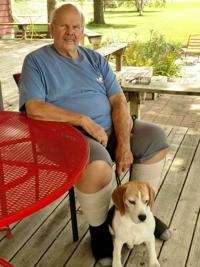
Months after being discharged from the hospital Steve Soeffker of Biscay is still recovering from COVID-19. He’s found the disease leaves behind ongoing health issues. He’s pictured with his “day care provider,” Clue.
Steve Soeffker of rural Biscay was released from Abbott Northwestern Hospital in mid-May after recovering from COVID-19, but since then it hasn't been all smooth sailing.
"About a week after I was discharged, on Memorial Day evening, I had some leg cramps and my legs were real tight," said Soeffker, 69. "I had blood clots in both lower legs and that was COVID related."
Soeffker, a retired McLeod County sheriff's deputy, is among thousands reporting ongoing complications following recovery from COVID-19. Ongoing research suggests the disease impacts numerous systems in the body, and patients have reported ongoing muscle pain, brain fog, breathlessness and more. For Soeffker, ongoing issues brought him back to the hospital, and he spent another week at Glencoe Regional Health.
"The oxygen levels are another concern," he said. "When I went to the Glencoe ER, my oxygen had dropped into the 60s. Reports indicate brain damage can occur if the O2 levels drop below 70. Now my levels are back in the upper 90s."
While in the hospital, Soeffker was discovered to have an irregular heartbeat. The symptom was an oddity, as he was suffering no shortage of breath or chest pains.
"It's going to be an ongoing issue the way it sounds," he said. "I talked to a cardiologist. We're going to meet end of July, and maybe put me under to stop the heart and restart it."
He's also concerned about damage to kidney function. Upon arrival to Abbot, his major organs were shutting down.
"I was in dialysis three or four times before the kidney would work. Happily, the kidneys are functioning as they were before COVID," Soeffker said.
Because his original hospital stay had him on a ventilator for 15 days, he had a tube down his throat for that long.
"I am having issues with my voice, almost like a gravel voice that may or may not clear up," he said. "They gave me a time frame of four to six months (to clear up)."
He's also on the lookout for loss of smell, extended pain, high fever and a loss of mobility.
THE LOWEST POINT
Soeffker's memory of April 2 is fuzzy. That's the day his symptoms first presented in dramatic fashion. His wife, Linda, found him laying on the ground gasping for air and called an ambulance. After that, he walked into the kitchen but doesn't remember doing so. He does have memories of telling the ambulance crew he'd walk outside so they could load him onto the stretcher. Soeffker stands at 6 feet, 5 inches and imagines it would have been a challenge to get him through the narrow front door. He made it outside but doesn't remember having done so.
He also doesn't remember the ambulance ride, or even speaking to a doctor with whom he had a conversation. Ultimately he ended up at Abbot Northwestern Hospital after he was taken to Glencoe Regional Health. Though he can't recall his lowest points, he knows Linda does. She received a call from a doctor working on her husband at Abbot Northwestern.
"He called her and asked if (I) wanted to be worked on and saved, or let go," Soeffker said. "She made the right decision."
His gap in memory extends for several days after.
"I remember nothing until I saw the calendar that said April 23," Soeffker said. "I basically lost 21 days in there somewhere. And I had no Easter dinner. I missed out on the ham."
REFLECTIONS ON COVID
Since his release from Abbot Northwestern, Soeffker has had a lot of time to reflect. One of his major takeaways during his recovery time has been how much has yet to be learned about COVID-19. Doctors frequently sat down to talk to him while he was in the hospital, asking about his symptoms, dreams, and wondering if he had hallucinations.
"(The lead doctor) would spend his whole dinner hour talking to me, trying to get information," he said. "(He) said I had come in with the worst condition they had seen, recovered the quickest and left in the best condition they'd seen. But why me?"
Nearly 70, Soeffker supposes he should have had a hard time getting enough strength to leave the hospital after 43 days. But he knows people younger who are having a harder time.
Ultimately, he thinks, the best thing for anyone to do is to follow the advice of medical professionals while they learn all they can.
"There's too much politics involved," Soeffker said. "There are too many unanswered questions with COVID."
The debate over masks, too, seems to have become political.
"People don't want to wear masks," he said. "I wear a mask. The doctors don't think I'll be susceptible to get it again, but they don't know for sure. They are learning on a daily basis."
He encourages everyone to follow health guidelines.
"It might not be the coolest thing around to wear a mask, but when your spouse has to answer the phone call asking, 'Should we pull the plug?' ... Well, that's a phone call they could get," he said. "Wearing a mask is something that could prevent that phone call. It's a cheap precaution."
As for himself, Soeffker hopes to have his strength back by August or September, if the rule of three days for recovery for every day in the hospital holds true.
"The summer is pretty much gone by September," he lamented.
He can walk around the lawn, but it's a much quieter life than he's used to.
"People can come over and visit," Soeffker said. "But people are afraid to spend time around me. That's sad for me. I've always been a people person, a public person. ... I was in law enforcement for 25 years, and I did volunteer driving. I can't do any of that."

The Cervin family, from left — Gary, Kathy, Cade, Kalle, Carson, Kris and Corey — will be recognized as Meeker County Family Family of the Year by the University of Minnesota during a virtual ceremony Thursday, Aug. 6.
Cervin family
The Cervin family of Darwin has been named Meeker County’s 2020 Farm Family of the Year by the University of Minnesota.
The Cervin farmstead was purchased in 1947 by Corey Cervin’s grandfather, Harlan. The farm is where Corey’s father, Gary, grew up. Gary started farming with his father full time right out of high school and continues to farm full time today. Over the years, the farm has raised cattle and hogs as well as corn, soybeans, small grains and canning crops.
Corey has helped on the farm since childhood. After graduating from North Dakota State University with a crop and weed science degree, Corey worked as an agronomist and helped on the farm as much as possible. In 2006, he started to become more involved in the family operation. Corey expanded the farm’s land base and in 2014 he left his off-farm employment and joined the farming business full time.
Currently, the Cervin farm raises corn and soybeans and feeds out 50 to 60 head of dairy steers annually. The farm is also home to a variety of 4-H animals. The Cervins are committed to being good stewards of the land by using the latest, as well as time-tested, technology.
Corey’s wife, Kris, is an oncology pharmacist and helps on the farm when time permits. The couple has three children: Cade, Carson and Kalle. Gary’s wife, Kathy, is a retired nurse and assists the operation when needed.
Corey is a director on the Central Counties Co-op board, a member of the AgCountry nominating committee and a member of his church council. He also maintains his Certified Crop Advisor certification. Kris is a member of several professional organizations related to her career. She is also a volunteer at her church and with 4-H. Gary is a past director on several co-op boards, and Kathy volunteers at the local hospital, an assisted living community, and her church.
Though COVID-19 has forced cancellation of the annual Minnesota Farmfest, where the awards are presented each August, this year’s honorees will be celebrated in an online video tribute. The recognition, led by University of Minnesota President Joan Gabel, will be available at 1 p.m. Thursday, Aug. 6, at mnfarmfamilies.cfans.umn.edu.
Honored families are chosen, one per county, by local University of Minnesota Extension committees based on their demonstrated commitment to their communities and to enhancing and supporting agriculture.
“We’ll miss the face-to-face ceremony for the 2020 Farm Families of the Year, but nothing diminishes the pride we take in celebrating their accomplishments,” said Extension Dean Bev Durgan. “These families represent the best in agriculture. They’re innovative and dedicated to their communities; they are stewards of the land.”
A complete list of the 2020 Farm Families of the Year is available at mnfarmfamilies.CFANS.umn.edu.
Along with Farmfest, University units sponsoring the recognition event include University of Minnesota Extension, Minnesota Agricultural Experiment Station, the College of Food, Agricultural and Natural Resource Sciences, and the College of Veterinary Medicine.

The city of Hutchinson must decide how to use $1.07 million in federal CARES funding to respond to the COVID-19 pandemic.
The money — $853 million — was distributed to Minnesota cities, counties, food shelves and food banks by an executive order from Gov. Tim Walz. Hutchinson's share, which it applied for, is based on $75 per capita. Now it must determine where that money can best be used. City Administrator Matt Jaunich said about $200,000 can be used to help the city recover expenses such as leave pay for staff that was higher than usual, unemployment costs and safety upgrades in city facilities. But that leaves $875,000 to be spent.
Some small, miscellaneous costs at Hutchinson Utilities and the Economic Development Authority could qualify, and money could be used to hire consultants for COVID-related purposes, but during a July 14 discussion, City Council members seemed most interested in providing assistance to local businesses. Money that is not used will be sent to the county. If the county doesn't spend the money, it will return to the state and, ultimately, the federal government if not used.
"This funding comes with some pretty strict requirements of how we use it," Hutchinson Finance Director Andy Reid said.
Funds must be for expenditures made necessary due to the public health emergency. Expenditures must not be budgeted expenses and they must have been incurred from March 1 to Dec. 30, 2020. If money is given to businesses, the city is responsible for making sure it is used correctly.
"If we do utilize these (funds) for small businesses, it can't be for revenue shortage," Reid said. "It has to be used for expenditures such as their mortgage or rent payments. It can be used for unemployment costs. Really, any cost they would have incurred due to the pandemic."
Property taxes would not qualify, for example. Costs from COVID-19 incurred by homeowners and renters would qualify, as would delinquent rent during the emergency period. The only utility that would qualify for payment would be electricity.
"Eight hundred grand seems like a lot of money, but it's not going to go very far," said Council Member Chad Czmowski.
He suggested using the money for loans earmarked to be used for certain purposes in order to help as many businesses as possible. The CARES money cannot be used for any purpose that already received federal funding earlier in the year. But Czmowski suggested rent assistance could still play in if a business received prior assistance, as new assistance could still go to later rent payments.
Council members discussed potentially using the funds for businesses hit the hardest, and able to do the least work, such as restaurants and salons.
"Small businesses — they need the help," said Council Member Mary Christensen.
City staff will use the council's input to create a plan for review at an upcoming meeting.

Bart Roepke, right, is with Daniela Montoy at a qualifying race in Mexico early in the season. Montoy’s parents approached Roepke to help coach her after previously coaching the local club team.
For many, running for fun sounds like torture. A lot of people do it to get in shape, but for others running is a competition and a way of life. For Bart Roepke, running has helped him see the world.
It all began for him in the early 1970s when he first arrived at Hutchinson High School. That's where he was introduced to track and field, and cross-country. He joined both teams his sophomore year. Now the 64-year-old is a distance runner in both sports and it took him a little bit to find his footing.
“I was OK, but I didn't have a lot of great success,” Roepke said. “I never went to the state meet in either one. So I did decide after I graduated that I wanted to continue running if I went to college.”
Roepke graduated in 1974 and took a gap year to work, while trying to determine if he wanted to go to college. If he could do track and cross country, he was willing. Bemidji State University allowed him to do just that, and it's where his love and passion for running began to blossom. He worked twice as hard as before to make sure that he made the team.
“My coach told me when I first talked to him, the very first time ... 'With your times, it's going to be difficult,'" Roepke recalled. "But he said nothing's impossible. People have done it before.”
The work paid off, and during his junior and senior year, Roepke was named a captain. After graduation, Roepke continued to work on his running while working at a shoe store and living in Minneapolis.
“I became a better runner because of all of that,” he said. “That's when I began running marathons.”
Roepke ran a total of five marathons, with his last one in 1983 in Arizona. Shortly after, he began to think about the next step in his running career — coaching.
“The first opportunity I had was in Hutchinson with (Len) Lasley, and I think it was 1984 or '85," he said. "There was no funding for an extra assistant track coach in those years, so Lasley said, 'You can come and coach the distance runners, but we can't pay you.'”
Roepke coached one season at Hutchinson, but from there he bounced around, taking coaching jobs at Robbinsdale and Pequot Lakes, but they never lasted more than a year, and there was often a decade or more of time between jobs.
Then a teaching job sent him to China, and after eight years he left and returned back to Hutchinson for another one-year coaching stint in Hutchinson. Roepke decided he wanted to do some traveling next and find a place where he could retire and live out the rest of his life. He spent six months in Nicaragua, three months in Columbia and a month in Panama before settling in Mexico last September. That's when his next coaching opportunity arrived.
“When I first went down to Puerto Vallarta ... I had been there like six or eight weeks and I was down at the local track where a lot of people just run for exercise, and there were these young people running," Roepke said. "They looked like they were doing track workouts. I went over to the one guy who looked like the coach and I said, 'So, what is this?' He said, 'It's our track club.' Then he said, 'Are you interested?' I told him I coached track in the U.S. and he invited me to come to a couple of practices.”
Roepke worked for free with the club's distance runners for about three months before he was contacted by a runner's parents who asked if he could to help coach their daughter, Daniela Montoy. Roepke believes the 15-year-old girl has a lot of potential to make it to a top finish at the Mexico national meet.
“She ran about a 2.16 800 (km)," he said. "Now a 2.16 800 on our Minnesota State High School meet would place in the top six in the state, and she's 15.”
Montoy has already qualified for the national meet, but it was postponed due to COVID-19 and may be rescheduled for January 2021. Going eight months between meets is tough, but Roepke said, "She is such a hard worker. She does everything I tell her to do without ever complaining.”
RETIRING FROM RUNNING
While he plans to continue coaching, Roepke believes his running career will be coming full circle to retirement soon. It started in Hutchinson, and it may end in Hutchinson as he plans to run his final race in the Hutchinson cross-country alumni meet later this fall.
“I'm just doing it because it's an interesting way to end it all,” he said. “Run my final 5k in a competition here in my hometown. It's my swan song.”
When he goes back home to Mexico, he plans on focusing a lot more time on coaching. He has never coached a champion before, but with Montoy, he sees that possibility.
"She's 15. By the time she's 20, she could be an international-caliber runner," Roepke said. "I have a chance to take this girl in the next two, three or four years and see if I can coach a champion before I'm done. I want to see how far I can go with her.”