




“Is there a drug problem here?”
Ask the question in many rural communities and you may hear that drugs are a problem in bigger cities, or that the local problem is bigger than other places. The two answers may even be heard in the same place. But what's the reality in McLeod County?
“Are drugs a problem here? Yes,” said Hutchinson Police Chief Dan Hatten. “Are they worse than any other city in America? Absolutely not.”
“One thing I think would surprise a lot of people is it's everywhere, and it's as bad anywhere as it is anywhere else,” said Matt Wyatt, an investigator with the McLeod County Sheriff's Office.
Hatten said struggles with the sale, abuse of and addiction to illegal drugs doesn't fit one mold. The impact isn't relegated to one corner of a community.
“It's youth, adults, even in some cases our seniors,” he said. “It's a broad spectrum. It certainly doesn't have any economic borders.”
Roger Stearns, a lifelong Hutchinson resident, knows the truth of Hatten's words firsthand. Many locals will recognize the 70-year-old former Stearnswood president's name from lists of volunteers and public servants during the past 40 years of the city's history.
“There were two different faces for Roger,” Stearns said. “I could wear a suit and a coat with the best of 'em. But addiction is an equal-opportunity disease. … I've gone from shaking hands with George Bush to shaking hands with a drug dealer.”
Stearns started his drug use in the 1960s, and behaviors he describes as “addict behaviors” — such as the desire for instant gratification and anger for no reason — started before college.
As a student at Gustavus Adolphus College he used marijuana, with much of it tied to an adventurous lifestyle steeped in the activism popular during the era.
“And (I used) everything else that was available. Everything but meth,” said Stearns, who now is clean “just for today” — a sentiment any addict knows.
He stopped using after college, largely at the insistence of his first wife. But it took three years for him to start up again. By the 1980s, Stearns was using cocaine. He can't remember how he started, but guesses it may have come from a marijuana dealer, or he may have tried it at a concert or with a group of friends in the drug scene.
“It was probably easiest for me to find it in the metro area,” he said. “That's just a matter of connecting with someone you know who also uses drugs. So maybe it's through them, instead of going to a dealer. … I could still do that in Hutch here.”
At the same time, he was leading another life as a businessman, as an active, recognized member of the Republican Party and as a volunteer.
“In 1989, I was honored by being the Jaycees Distinguished Service Award winner,” he said. “The same year I was introduced to Narcotics Anonymous.”
It’s his knowledge of cocaine that caused a 2018 police report to catch Stearns's eye. During the May 1 execution of a search warrant on Juul Road Southwest by Hutchinson police, the Southwest Metro Drug Task Force, the CEE-VI Drug Task Force and the Minnesota Bureau of Criminal Apprehension, 160.9 grams of a white, powdery rock substance was found. It tested positive for cocaine.
“When I looked at that, I thought, 'Well, this is a person dealing to a more 'sophisticated' clientele,” Stearns said. “They are not dealing with guys on the street who are destitute.”
The bust reinforced that drug use has no socioeconomic ties.
WHAT DRUGS ARE HERE?
Jason Arras, commander of the Southwest Metro Drug Task Force, wasn't surprised by the discovery of cocaine.
In 2017, his team — which covers Carver, Scott and McLeod counties and a portion of Hennepin County — seized:
- 829.16 grams of heroin,
- 15,970.98 grams of methamphetamine,
- 50,438 grams of marijuana, and
- 128.63 grams of cocaine.
In 2016, his team seized:
- 71.78 grams of heroin,
- 2,074.2 grams of methamphetamine,
- 4,272.46 grams of marijuana, and
- 286.9 grams of cocaine.
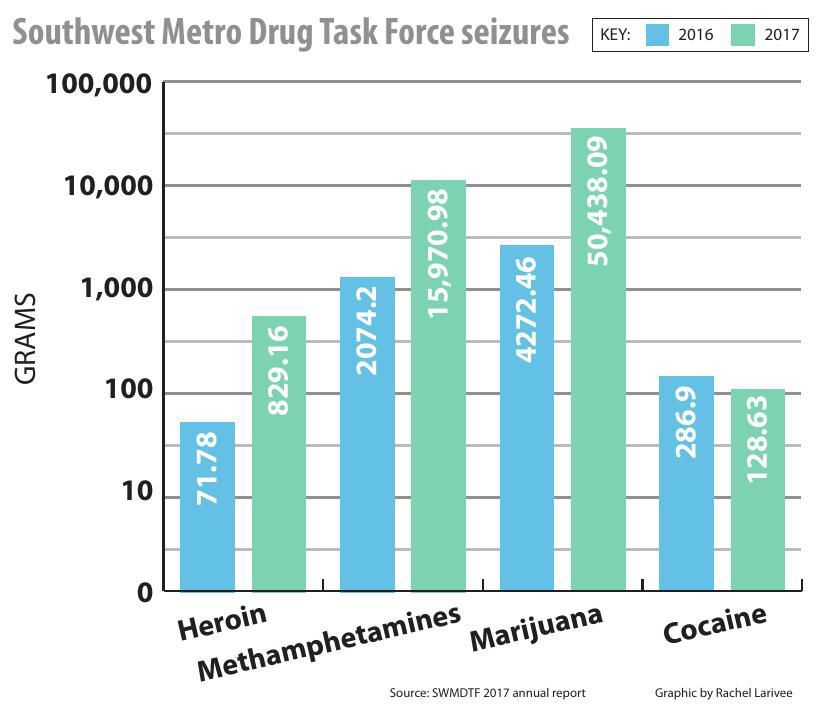
While more heroin, meth and marijuana were seized compared to the previous year, conversations with other task forces led Arras to suspect cocaine would see a return in 2018. The 160.9 grams found in the May 1 search alone is more than was found in 2017.
The uptick in heroin, methamphetamine and marijuana seizures by the task force from 2016 to 2017 matches statewide numbers as well, which show relatively similar numbers from 2013 to 2016, and a jump in 2017.
Hatten said his officers most often discover prescription drug abuse.
Arras noted the increase in seized heroin, meth and cocaine may lend credibility to a recent theory. With marijuana use legal in more states, some law enforcement agencies worry other drugs will be pushed more aggressively by cartels.
“They won't give up that money,” Arras said. “So they pump more of it (drugs) out here. They are going to make up that money.”
He said a growing number of successful busts have also inflated the number of seized drugs.
“There is never a rest. It never stops,” he told a reporter.
A moment later, his phone rang. During a two-hour interview, work calls and texts were frequent. Two calls forced him to pause the conversation for a few minutes.
“There are 30 balls in the air,” he said.
The task force handled 291 cases in 2017, and 120 of those cases were in McLeod County. At first glance, the numbers suggest the problem is much bigger here. Arras said that is not the case.
“We have two agents working their tail off,” he said.
The task force has one commander and six agents spread across its region, representing its member law enforcement agencies. McLeod County is unique in that it has two agents working together in an area with a population smaller relative to the rest of the mostly metro jurisdiction.
“I'm very encouraged by how hard those agents are working in their communities,” Arras said. “It shows a solid communication between the sheriff's office and the Hutchinson Police Department, and all communication within McLeod County. People are giving information to those agents.”
Information given by the public to law enforcement is a crucial part of the process, Arras said.
He credited the success of enforcement in McLeod County to organizations such as McLeod Education and Drug Awareness, and individuals such as school resource officers, school counselors, concerned neighbors and family members.
“Please, give us more tips. Fighting drugs is a team sport,” he said. “We're emptying the ocean with a teaspoon.”
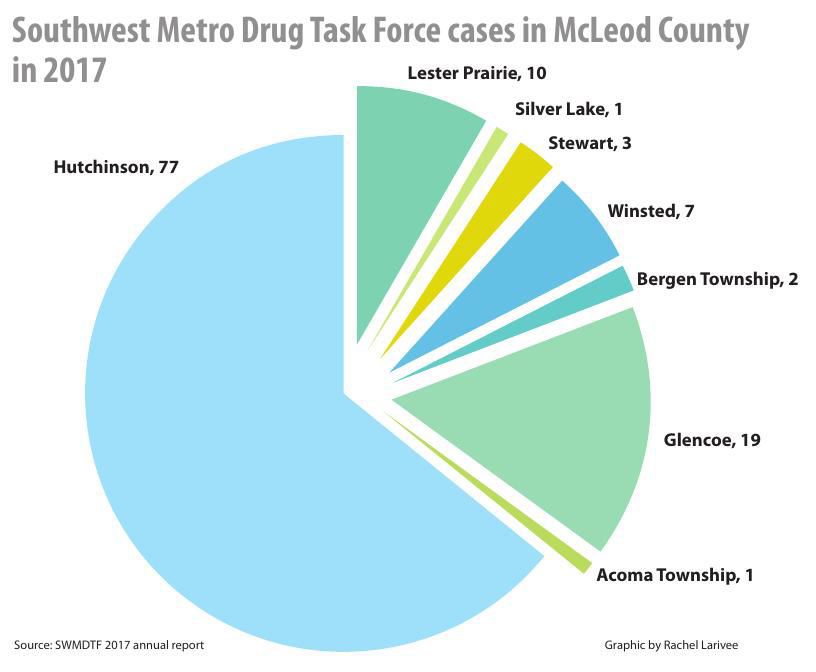
“If we had two more people in McLeod County doing nothing but drug cases, I think this number may very well double,” said McLeod County Attorney Michael Junge.
He said he thinks the high number of cases reflects the officers' dedication.
“They are willing to ... do the dirty work to get the leads, to do the search warrants to get in the places they know drugs are going down,” he said. “That's how it's happening.”
Junge noted that about one-third to one-half of his drug cases come from the task force. Most of the rest come from cops on traffic enforcement. It is also common for concerned citizens to provide tips, or turn in paraphernalia they find.
Arras sees the 120 cases as a success, and not a cause for alarm.
“I see 120 potential families that are going to get help. People don't want to be addicts,” Arras said. “I have a family member that is a heroin addict and I love them the same.”
Arras said cases in the metro area tend to involve longer investigations, and lead to larger busts.
“It's so hard to predict the drug world,” he said. “(Drugs) don't have a scan bar to say where it was going.”
Wyatt, an investigator with the sheriff's office, said McLeod County's central location serves as a nexus through which many drugs pass through on their way to other parts of the state. That's one reason for the arrest rate here.
“They're not being produced in the county to any huge degree,” he said. “A huge chunk of our drugs come from the metro. ... The supplier could be anywhere from Duluth to Chicago, but mostly the Twin Cities/metro area.”
Last year, Fernando Rangel, 42, of Minneapolis was sentenced to 93 months in jail for first-degree possession of a controlled substance. He had agreed to meet with a Minnesota Bureau of Criminal Apprehension special agent — who had posed as a buyer — in Hutchinson to deliver 12 pounds of methamphetamine for a price between $50,000 and $60,000.
Arras said many drugs sent to the state stop in the metro area, and are then shipped to other cities. But others are delivered to residences in the mail.
Many drugs that end up in Minnesota are produced in Mexico, Wyatt said, as it is cheaper to do so there. Many THC concentrates — tinctures, wax, candies and other methods of delivering cannabinoids in a stronger form — are shipped from states where those products are legal. Many opiates, such as fentanyl, are often shipped from China.
THE HUMAN COST
The drug fentanyl may ring a bell for many because of its mention in recent stories about the opioid crisis, and because it was found in Prince's body after his death.
“If a heroin user is purchasing what they believe to be heroin, but it is actually fentanyl or carfentanil cut with it, they can very easily overdose, and lethally,” Wyatt said.
“Opioids have a central brain sedating effect,” said Brian Pollmann, chief medical officer at Hutchinson Health. “Everything slows down. You become more tired and lethargic, ultimately becoming unconscious. Your breathing slows down, you can stop breathing. ... People with a severe overdose die because they just stop breathing. That's probably the biggest one. Unless someone is there to recognize that, or give a reversal agent, that's how they pass away.”
The cost hits close to home as well. In 2017, a 64-year-old man died due to a heroin and methamphetamine overdose in McLeod County. A 44-year-old woman overdosed from prescribed morphine and lorazepam.
Near the McLeod County border, between Hutchinson and Litchfield, a Waverly resident who formerly lived in Hutchinson was found dead beside the road. The Midwest Medical Examiner found Shawn Medley had died due to an overdose of methamphetamine and mitragynine. His vehicle was found abandoned in Litchfield, and authorities don't know when Medley died.
“The bottom line is we know he didn’t die where he was found,” said Meeker County Sheriff Brian Cruze. “Someone put him there. We know there is someone out there that knows some information. That is someone we really need to have come forward to talk to us.”
DRUG USERS AND RELATIONSHIPS
Stearns has had medical complications in his life that may have been connected to drug use, starting in 1989 when a pacemaker was implanted.
“I don't have good stories about being destitute. I was practically born with a silver spoon,” Stearns said. “Being born the son of one of the owners of Stearnswood, I had things pretty darn good.”
In 2002, Stearns' father died.
“He had always been kinda the boundary for me,” he said. “He created the fences. I respected him so much that I did my best not to screw things up.”
In his father's absence, Stearns started drinking much more, and using marijuana more heavily. In 2005, he was arrested for driving while impaired, and arrested for the same crime a month later.
“Both were from alcohol. Did I have pot with me? Sure,” Stearns said. “The first time that happened I was president of the Hutchinson Community Foundation.”
Stearns lost his license and was sent to jail for 30 days.
“Before they sent me to jail, I put myself in Hazelton (Addiction Treatment Center),” Stearns said. “I thought I'd better get serious about this (recovery).”
Stearns relapsed with marijuana in 2013.
“That kept me down for about five, six weeks. I was spaced out and happy until I realized what the hell I was doing,” Stearns said. “I stopped again, and not on my own. I had to have help from the group, and that's really the secret: the fellowship and the love you get from these groups.”
But remaining clean is a daily challenge.
“Oh, I had plenty (of regrets),” Stearns said. “Lots of guilt. Lots of shame, especially for what I did to my family. I've been married three times. In both (divorces), drugs had something to do with that."
“As soon as you start (using drugs), you stop maturing. It's really crazy," Stearns added. "That's why so many drug addicts have problems with relationships, it's probably why people divorced me. It's the drugs. You don't develop the capacity to have a good relationship. You think about yourself all the time. You can’t sustain a relationship if you only think about yourself.”
The Southwest Metro Drug Task Force sees drug use break down other relationships as well, including those where the user has a responsibility, and replace them with a new focus.
“(Drug abuse) has a culture. It's an addict society,” task force commander Arras said. “I don't know when a person is going to be introduced to the network, but once you are in the network, you are in the network. It will isolate you from your family, your friends. It will isolate you from who you were. You begin to lose your identity, but I can never give up hope on them.”
Adam Ament, a Hutchinson police sergeant, has seen the damage drugs have caused firsthand. He recalls speaking to a mother on a case who couldn't tell him what day it was.
“And the children's needs aren't met on the nutrition side of things, or the structure,” he said. “We see it's never taken care of.”
Ament recalls carpets that have never been vacuumed in homes with children.
“We have seen bath tubs … they will throw pots and pans, and they are stacked to waist level with rotten food,” he said.
Wyatt recalled one case where he went into a home on a search warrant, and found three children younger than age 10.
“There was no running water, barely any food in the house, the house is a mess,” Wyatt said. “The parents were both very much under the influence when we got there. … What you actually see first hand, that kind of damage and neglect, it's very hard to imagine.”
“Sadly, contrary to many parents' statements that they don't do drugs around the children, it is often proven to be false,” said Gary Sprynczynatyk, McLeod County Human Services Director.
Human service workers find traces of drugs in the hair of children of drug users.
“I don't believe there are any cases where parents are intentionally screwing up their kids,” Junge said.
In 2017, his office handled 41 Child in Need of Protective Services cases involving 87 kids. Twenty of those CHIPS cases were drug related, involving 49 kids. Of the 46 kids tested, 22 tested positive for THC or meth in their system. Junge said it can happen because kids accidentally get into the stash, or because of secondhand smoke.
“It tells you the parents are high and their infant children are high. That is the tragedy of what I want to nail home,” Junge said. “There are little toddlers, and they are crawling around and everything goes into a toddler's mouth.”
Hatten said there are also cases where elders are abused due to drug use, as it bleeds into cases of financial exploitation.
“It can't help but be that way,” he said.
“The issue that is always at hand when a child is doing that … they make it seem like they're not stealing and their parents are receiving some kind of asset, or they give a story that they are down on their luck,” Ament said. “The parents don't always see they are being victimized by their own child.”
The cost of drug use reaches beyond the individual, and beyond their family as well.
“A good portion of violent crime out there is never reported,” Wyatt said. “It's drug-related, part of the drug trade, and the victims don't report it.”
The majority of crime is directly or indirectly caused by drugs or the drug trade, he added.
“The reality is it is fed by people's illness and addiction,” Wyatt said. “They are addicted and preyed upon by people who sell it to them, who traffic it.”
Ament said many instances of theft, burglary and criminal sexual conduct can be traced back to drugs.
“I'm surprised how many people are caught for drug offenses because they did something like shoplifting,” Junge said.
There is a lot to take in when considering the impact of drugs on a community as a whole.
“It’s a huge mechanism,” Wyatt said.


