

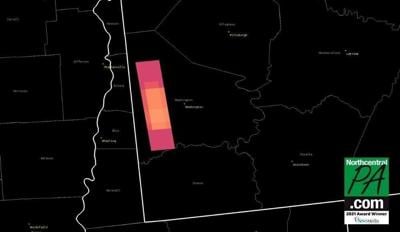
Washington County, Pa. -- The much speculated New Year's Day meteor over Pittsburgh has now been confirmed by NASA. The meteor has been estimated as stretching one yard in diameter, traveling 45,000 miles per hour, and weighing one-half ton.
Cloudy skies prevented a visible sighting of the meteor, which was estimated to be 100 times the brightness of the full moon, according to NASA.
Here is the final update on the New Year's Day meteor from NASA. pic.twitter.com/ePwD2SDhdt
— NWS Pittsburgh (@NWSPittsburgh) January 3, 2022
Residents across the state presented theories about the large boom erupting over the Pittsburgh area on January 1, while the National Weather Service (NWS) offered one most likely conclusion: "A meteor exploded at some level above the ground," as posted on the NWS Facebook page.
People in Pennsylvania and neighboring Ohio expressed on Facebook their observations and hypotheses that evening. A range of sounds were reported, with some hearing the sound of thunder, others hearing fireworks, and many hearing a very loud boom that rattled windows.
The range of sound experiences varied depending upon relative location to the source—a select portion of Washington County detected through a satellite's Geostationary Lightning Mapper function.
The sounds were not associated with a lightning storm, according to the National Weather Service. However, meteors can create sounds of thunder if they travel low enough to the ground, according to research by astronomer C. C. Wylie published in the NASA Astrophysics Data System.
Typically, according to the study, following an initial eruption, a "rumble or roar" noise will cascade along the path of a meteor. Those nearest to the site of eruption will experience the most intense sounds, ones "violent enough to shake windows," wrote Wylie.
Then, according to Wylie, people often report repeated booms, a result of the meteor rumble traveling outward from the eruption point. Echoes from buildings and landscapes likely contribute to rumbling sounds, explains Wylie.
When an explosion is especially intense, the sound can travel large distances.
A 1930m an Arkansas meteor fall received similar public feedback to the January 1 occurrence, with residents as far as 70 miles away reporting sounds of explosion, as noted in Wylie's research. These sounds, receding from the main eruption, may resemble a "hum," and are often mistaken for an airplane in transit, notes Wylie.
If a meteor erupts atmospherically, dividing into many smaller pieces, the resulting sounds could also resemble "firecrackers" or "machine gun fire," explains Wylie, similarly to the recent reports of "fireworks."
NASA reports that the meteor broke apart during descent. Precisely where and when the meteor broke has not been confirmed publicly.


