

As temperatures continue to drop in Wisconsin, 25-year-old Arzo Yousofzai has been spending most of her time at Fort McCoy either inside the barracks where she’s staying or teaching English classes indoors.
Nearly two months after arriving at the military base from Afghanistan, Yousofzai still hasn’t received winter clothes from personnel on base. She got a warm coat for the first time Wednesday — but not from Fort McCoy staff. Another Afghan woman gave her a coat some American friends sent in from the outside.
With hours-long lines to get food, Yousofzai said she would usually skip breakfast and dinner because she didn’t want to wait outside in 40- and 50-degree weather wearing only sandals, pants and a T-shirt.
“It’s really cold,” she said, adding she would usually eat lunch at the school where she is bused to each day to teach English to both Pashto and Persian speakers. “I skipped my meals. Because of the weather, I could not stand in the (cafeteria) line for four or five hours, and I didn’t have any (warm) clothes to wear.”
Many Afghan evacuees at Fort McCoy are still waiting for winter coats due to a shortage at the base, though figures on the extent of the shortage vary.
On Saturday, a spokesperson for the Department of Homeland Security, which is leading the government’s handling of the refugees, said the shortage was fewer than 600.
Others have put different figures on the shortage.
Team Rubicon, the volunteer group tasked by the Department of Defense with providing clothes to the base, was told to fill a shortfall of 3,000 coats earlier this month. The Wisconsin State Journal reviewed an email earlier this week from a staffer for U.S. Sen. Tammy Baldwin saying they were told by a liaison from the base that there was a shortage of 4,000 coats.
The shortage is the most recent snag in the push to clothe the nearly 13,000 refugees who have lived at Fort McCoy since fleeing Afghanistan in August.
Watch now: A tiny Madison nonprofit hopes to bring refugees to safety
Refugees waited weeks before getting fresh clothing upon their arrival, the Wisconsin State Journal found. Base policy prohibits bypassing official channels and giving clothes directly to evacuees, though many have done so anyway. Mailing in clothes is also allowed.
The State Journal spoke with four Afghan women who said not only had they gone weeks without a winter coat, but that the distribution of clothes at Fort McCoy is often chaotic, with little time to go through disorganized piles of clothes that might not even fit.
“I just expected to have a warm coat and also to have good sneakers, thick pants,” said Yousufi, a 23-year-old Afghan woman who asked to be identified only by her last name to protect family members still in Afghanistan. While she also received a coat in recent days thanks to outside help, Yousufi said she spent weeks outside with clothing no heavier than sports shorts and traditional South Asian dresses.
“Most of the time I work in the workshops for legal advice,” she said. “Sometimes I am volunteering in front of the clinic. We are outside so we need warm clothes.”
The shortage of coats is not from a lack of inventory or donations.
Clothing drives
In late September, base officials said they had more than enough winter coats for everyone after clothing drives led by Team Rubicon. But as coats were distributed to the more than 250 barracks-style housing units on the base, many of the coats did not fit the refugees, said John Stuhlmacher, a senior operations associate for Team Rubicon.
With volunteers only learning of the shortage last week, Team Rubicon put out a request for 3,000 winter coats to the Wisconsin Voluntary Organizations Active in Disaster, which will source coats from partners such as the American Red Cross, Salvation Army, Goodwill, Lands’ End and St. Vincent de Paul. Community members interested in donating can drop off new or gently used, freshly laundered clothes at Goodwill locations in southeastern Wisconsin or purchase items from an Amazon wishlist for refugees, updated daily, at go.madison.com/afghan-aid.
Base personnel have been recording the sizes for refugees who still don’t have coats, and all the refugees the State Journal spoke with have had their size taken.
Some 8,000 winter weather kits, including coats, boots, mittens and scarves, will arrive at the base in mid-November, said Cheryl Phillips, a spokesperson for the Department of Homeland Security’s task force.
Military deploys 'gender advisors' for Afghans at Fort McCoy
“Today, each guest at a minimum has winter layers and we continue to add layers for winter,” Phillips wrote in an email. “Each guest has been provided at least two blankets. Additionally, each person will be provided an extra fleece blanket in the coming days.”
But Team Rubicon’s Stuhlmacher declined to put a timeline on how long it will take to get a proper winter coat to every Afghan at the base.
“We’re starting to fill the shortfall,” Stuhlmacher said. “It’s one of those things that there could be a donation that fulfills all of it tomorrow. We just don’t know.”
Chaotic store
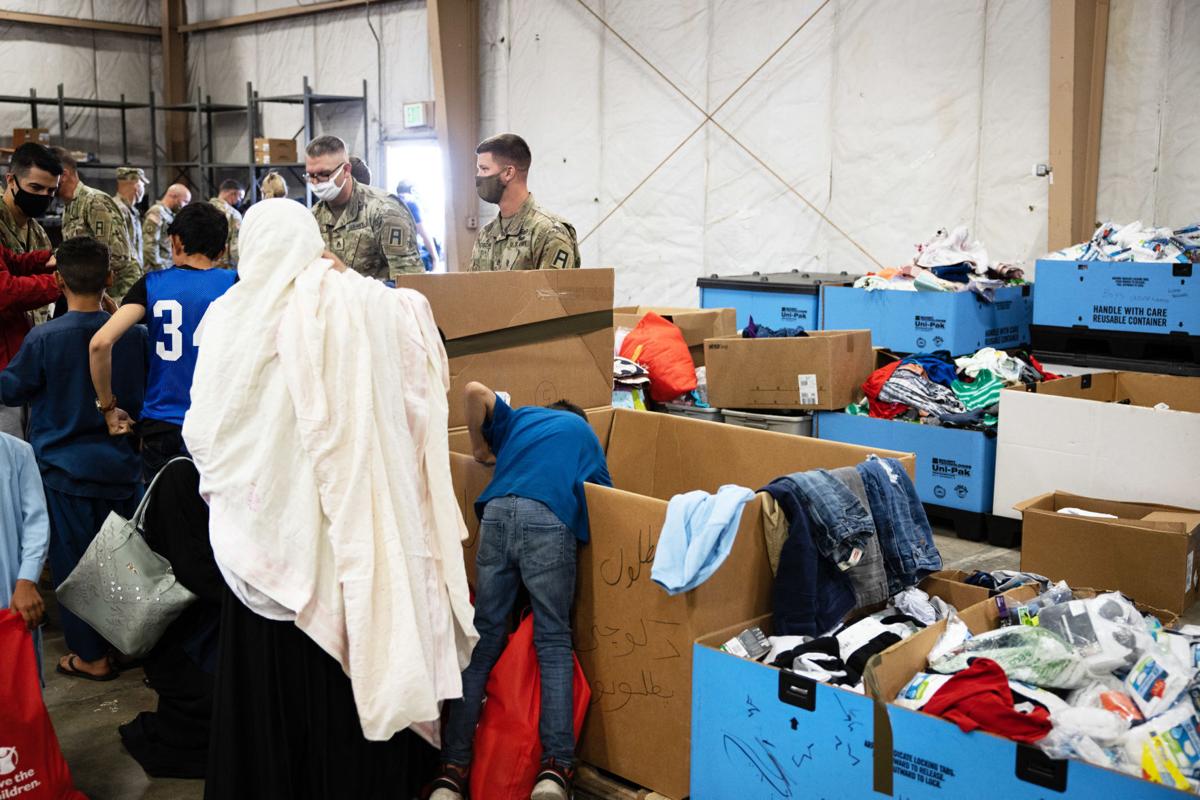
Yousofzai has had two chances to go to what those on base call “the store,” a large warehouse full of cardboard boxes that Afghans can sift through to pick out around 10 free clothing items for themselves. But both times she said the clothes were picked over, and she could only find warmer clothes in sizes large or extra large.
“We went there (to the store), but there was not any clothes for winter,” Yousofzai said. “My size is small. ... I didn’t find any small things for winter.”
In her two trips to the store, Yousufi saw a frenzied rush for the clothes and base personnel trying to get refugees through the warehouse as quickly as possible.
“We don’t know what to do during the picking of the clothes because they’re announcing every five minutes, ‘Time is over. Time is over. Be quick. Be quick,’” Yousufi said. “Sometimes the (girls) who are really small, they’re younger, they cannot pick up even pants for themselves because they are too small and cannot push the other girls.”
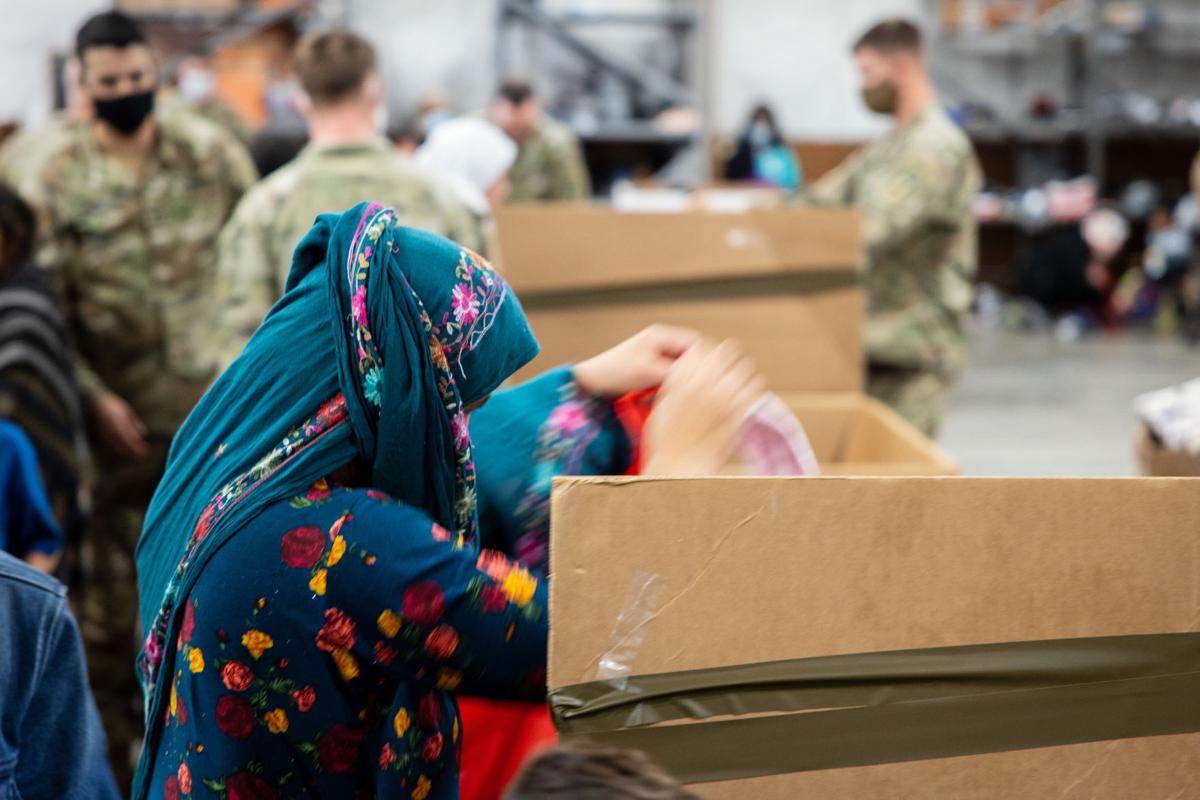
An Afghan women sifts through clothes inside the distribution center at Fort McCoy in late September.
But even after two trips to the store, Yousufi said she and others are still going without other basic items. The 23-year-old said she loans out sandals to other girls to wear in the shower.
“Most of the girls come to me and say, ‘Give me your sandals because I cannot take a shower with sneakers,’” Yousufi said.
A 25-year-old refugee, who also declined to give her name to protect family still in Afghanistan, seconded the difficulty in finding clothes that fit.
“I got shoes I just wore today,” she said. “But I may not be able to use it for the future days because it is like not fitting me and it is really difficult.”
Walking everywhere
Every Afghan on base has gotten at least one chance to go through the store, and many have gotten to go a second time, according to Afghans and base officials. Phillips said Fort McCoy personnel are going block by block to hand out coats individually.
Some have already left the base to get resettled into permanent homes across the country. Fort McCoy officials will not confirm how many have been resettled, only that Afghans are leaving “on a daily basis.”
Military deploys 'gender advisors' for Afghans at Fort McCoy
At 60,000 acres, Fort McCoy is sprawling. Roughly 13,000 Afghans have been staying in one section of the base with rows and rows of more than 250 barracks-style, two-story buildings with white siding and red roofs.
From the barracks to the medical clinic, the laundry building to the cafeteria, Afghans have to walk almost everywhere they go. All of the facilities are in separate buildings across eight neighborhoods.
There are heated tents for when Afghans have to wait outside to get into the cafeteria for food. But despite officials saying in early September that problems with food distribution were addressed, the hours-long lines for food have returned, some said.
On Oct. 3, the 25-year-old Afghan woman said she and another group of young women went to get in line at the cafeteria at 5:30 p.m. and didn’t get food until 9 p.m. Last week, she said the lines were still the same: Usually about two hours to get food, but sometimes three, four or even five hours.
‘Ineffective system’
Though it supplies the base with clothes, the veteran-led Team Rubicon did not have prior experience working with clothing donations when it was brought on by the military, Stuhlmacher said. There is no formal contract between the nonprofit and the government either. Instead, Team Rubicon and the commanders at six U.S. military installations housing refugees came to a “handshake deal” for distributing the clothes.
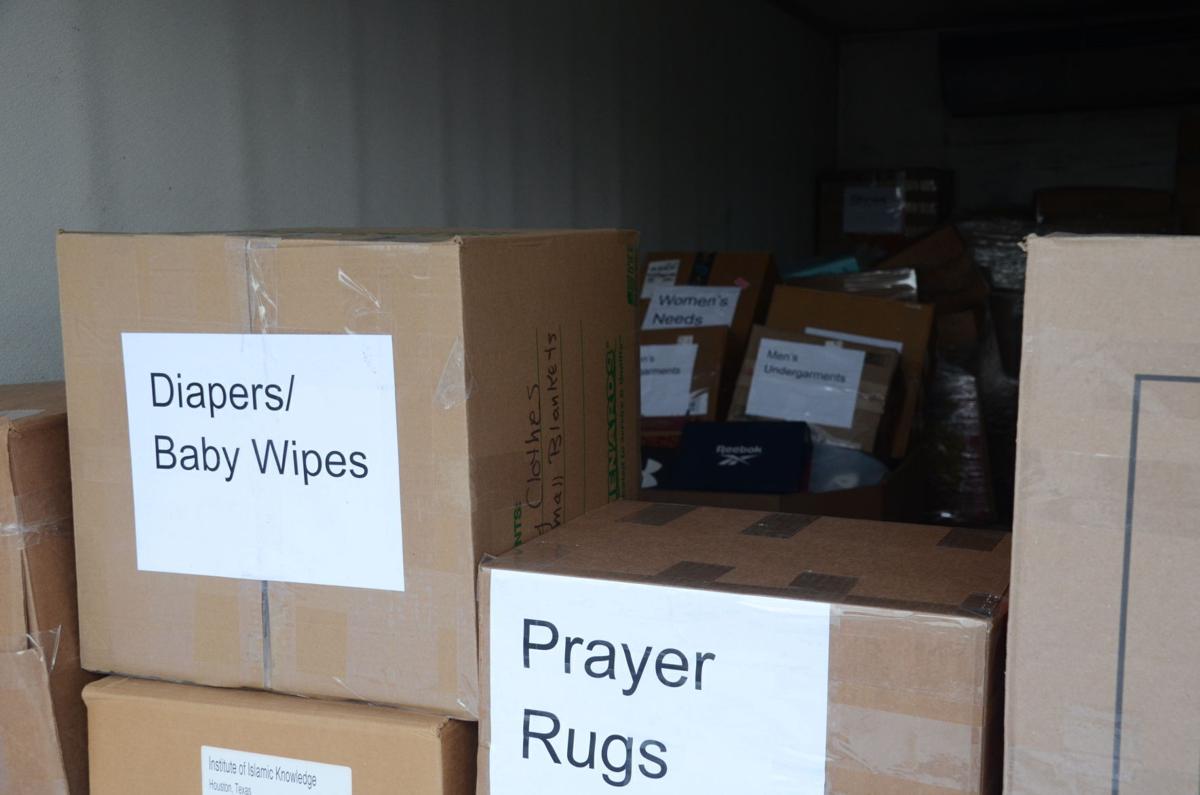
Nearly two months removed from a mass evacuation from Afghanistan, some organizations and individuals who have worked to donate clothes to the base have grown frustrated. The Milwaukee Muslim Women’s Coalition has sent truckloads of clothes to evacuees, yet the base-led distribution of those clothes remains disappointing, said president Janan Najeeb.
“Is it there’s this big bureaucracy and that’s why it’s taking so long, or is the government not really providing the adequate funding?” Najeeb said. “This is an ineffective system. I’m still quite concerned that people have been there this long and there’s still not an infrastructure set up.”
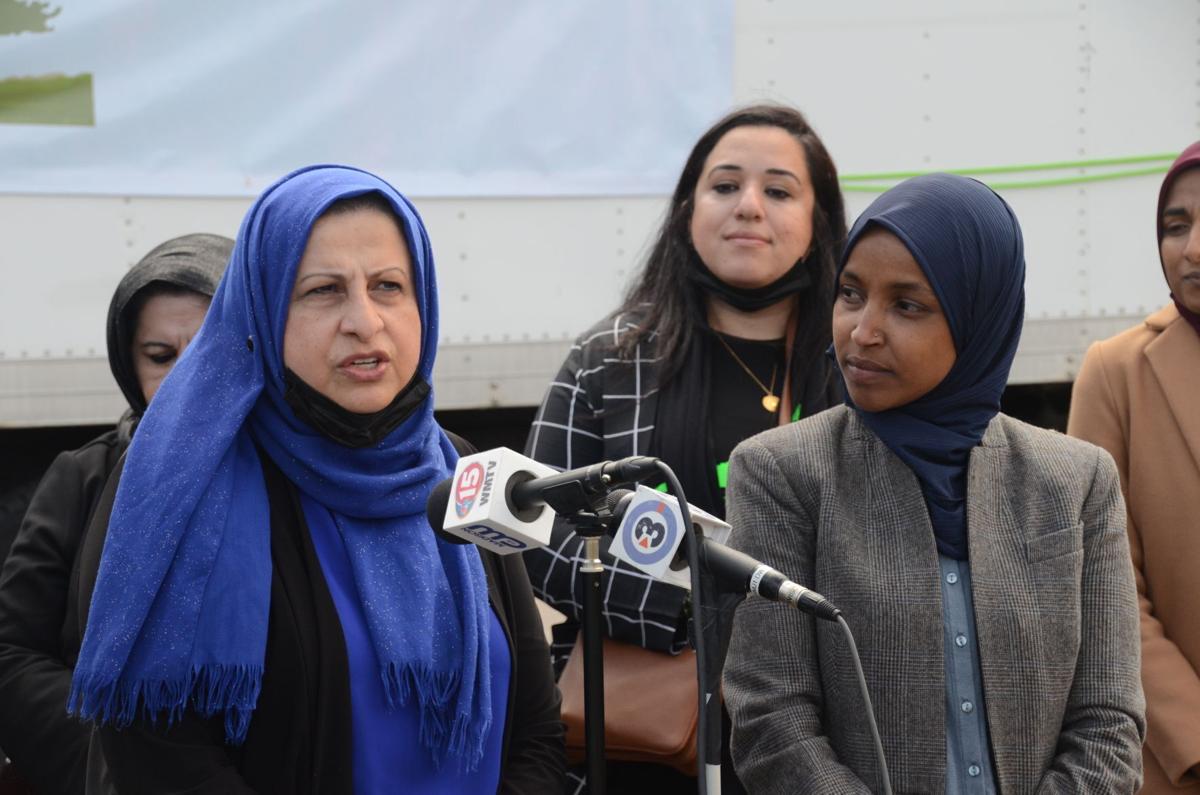
Janan Najeeb of the Milwaukee Muslim Women's Coalition speaks alongside U.S. Rep. Ilhan Omar, D-Minn., in front of a truck of supplies donated to Fort McCoy in September.
Ilene Henderson, a former counterintelligence agent for the U.S. Army who served in Afghanistan, said it’s been a struggle to get clothing directly to evacuees. She also believes the distribution of clothes at Fort McCoy hasn’t taken into account Afghan culture or the trauma the refugees experienced fleeing the country.
“You say, ‘Hey, pick out six items,’ and it’s a totally overwhelming situation,” Henderson said. “They’re not used to getting clothes in such a large environment. They’re not used to our sizes, and they’re just absolutely mentally and emotionally traumatized.”
For its part, the Department of Homeland Security task force overseeing the refugees said it has prepared the population for the winter, erecting heated tents, expanding indoor activities and adding more transportation options on base besides just walking.
“There is no greater priority of the personnel at Fort McCoy than the safety and health of our Afghan guests as we prepare them for resettlement in the United States,” said Phillips, the task force’s spokesperson.
Grateful still
Despite her lack of warm clothes and a severe cavity that she’s trying to get treated, Yousofzai said she’s happy to be in the U.S. and grateful to those who helped her get here.
“It’s better than living in Afghanistan,” she said.
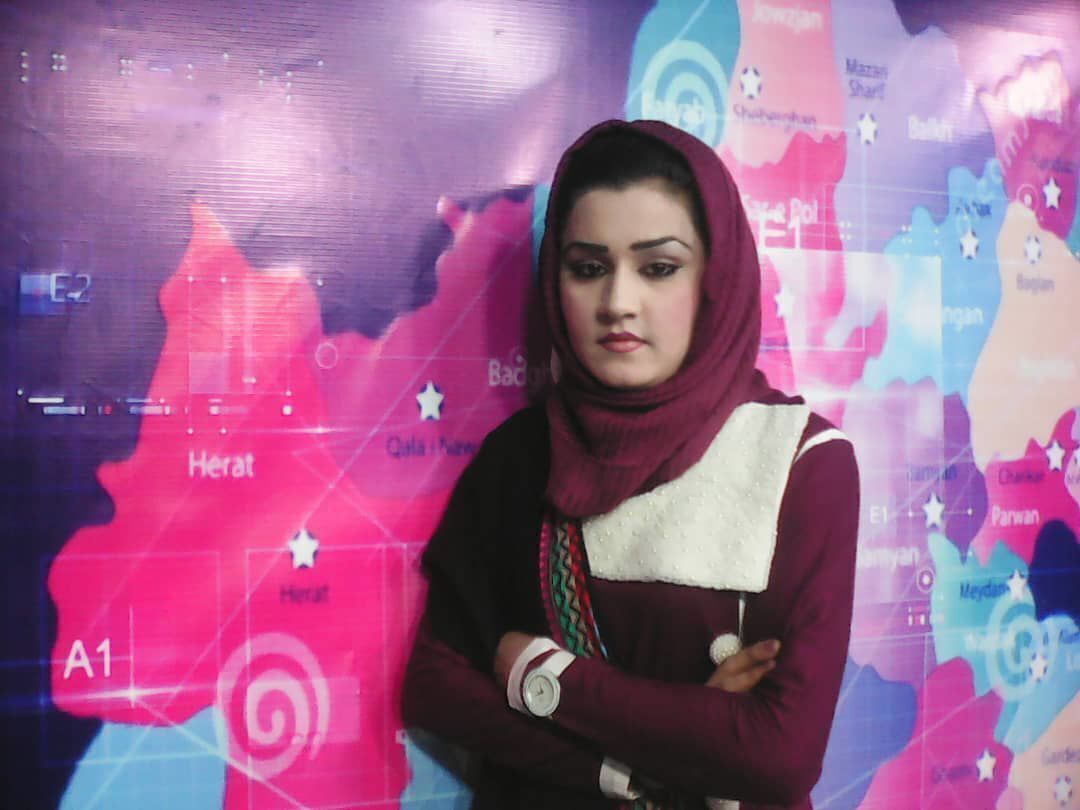
Yousofzai was a TV journalist living in Nangarhar Province before fleeing to the U.S. Directly to the east of Kabul, the province was one of the most austere areas in the country for women’s rights even before the Taliban’s takeover, she said.

Arzo Yousofzai, 25, was a TV journalist in Afghanistan. She said the Taliban attacked and killed her co-workers. She is among Afghans staying at Fort McCoy.
The Taliban attacked and killed some of her co-workers, including a close friend. Yousofzai said it then took three days to escape Afghanistan out of the Kabul airport, watching men and women die around her in the chaos.
For Yousofzai, being alive in the U.S. is a relief. She’s excited to soon go to college at Arizona State University, where she hopes to be reunited with her husband, an Afghan who is currently in France.
“I’m really happy to come here,” she said. “I’m thankful to God to give me a big chance to come out from all of the problems and all of the risks.”
Photos: Afghan refugees at Wisconsin's Fort McCoy receive clothing donations
Fort McCoy donations
Updated
Three Afghan evacuees look thorough women’s pants at a donation facility run by U.S. Soldiers and civilians at Fort McCoy, Wisconsin, Sept. 7, 2021. Led by Team Rubicon, several local nonprofits are accepting clothing and other donations for the refugees. Many evacuees have arrived with only one set of clothing.
Fort McCoy donations
Updated
An Afghan evacuee holds up a pair of donated children’s pants to see if they will fit her child at a donation facility at Fort McCoy in Wisconsin Sept. 7, 2021. Fort McCoy is one of eight U.S. military bases that will temporarily house vulnerable Afghans who have fled Afghanistan after the recent collapse of the government to the Taliban.
Fort McCoy donations
Updated
Afghan evacuees look through shoes at a donation facility run by U.S. Soldiers and civilians at Fort McCoy in Wisconsin Sept. 7, 2021. Led by Team Rubicon, several local nonprofits are accepting clothing and other donations for the refugees. Many evacuees have arrived with only one set of clothing.
Fort McCoy donations
Updated
An Afghan evacuee examines a piece of clothing covered with butterflies and trees at a donation facility run by U.S. Soldiers and civilians at Fort McCoy in Wisconsin Sept. 7, 2021. The Department of Defense is providing transportation, temporary housing, medical screening, and general support for at least 50,000 Afghan refugees fleeing from Afghanistan after the collapse of the country's government to the Taliban.
Fort McCoy donations
Updated
U.S. Army Sgt. Brandon Boriboun folds clothing for Afghan evacuees at a donation facility run by U.S. Soldiers and civilians at Fort McCoy, Wisconsin, Sept. 7, 2021. Led by Team Rubicon, several local nonprofits are accepting clothing and other donations for the refugees. Many evacuees have arrived with only one set of clothing.
Fort McCoy donations
Updated
An Afghan evacuee child is given a new backpack and coloring book during the reception process at Fort McCoy in Wisconsin Sept. 3, 2021. The Department of Defense is providing support for at least 50,000 Afghan evacuees who have fled from Afghanistan after the recent collapse of the country's government to the Taliban.


