Years ago, my friend, Katherine, and I talked about writing a book on manners. We worked together at Continental Cablevision, the company that brought cable television to St. Paul. The first two years of a cable-build are relentlessly fast paced. Katherine and I were both managers with major work loads. We were in meetings together but we were not friends outside of work.
When I left Continental Cablevision to work at William Mitchell College of Law, Katherine invited me to lunch. As we ate in the restaurant at the Union Depot building, we learned about one another on a personal level. She gave me the book “Absalom, Absalom” by William Faulkner with a lovely inscription. We decided to meet for breakfast at Bread & Chocolate on Grand Avenue soon and became good lifelong friends.
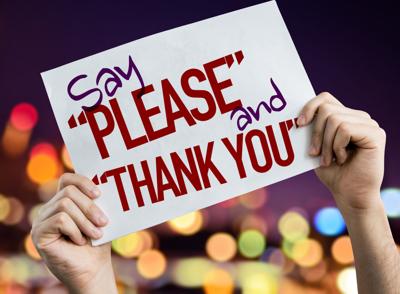
Our friendship was born because Katherine has good manners. She took the time to take me out to lunch and gave me a book to honor our shared work history. Hence, our conversations about manners began.
Katherine and I share an affinity for etiquette and spotting examples of good manners. We do not catalog poor manners because it is too easy. Instead, we note manners we want to emulate. We look for manners that are over-the-top in graciousness, manners that leave us saying “Wow — classy manners!”
Often, when we think of etiquette and manners, we think of table settings. We may know a fish fork from an oyster fork and prefer cloth napkins. We can know proper etiquette and still miss the boat on having good manners. Sometimes, good manners means we set the table simply so guests are not overwhelmed by an extensive set of silverware.
Manners guide us in our interactions with one another. Unfortunately, our society-at-large seems to be relying on social media as our manners guide. Social media has given us an explosive amount of permission to comment on anything and everything. Social media also has given us a broader range of topics we think are acceptable fodder for humor. We are losing our social filters.
Having strong social filters goes beyond etiquette and manners. Effectively using social filters is part of having good mental and emotional health. Our social filters refer to our ability to decide which of our thoughts we can verbalize effectively and kindly and which thoughts we should keep to ourselves. Healthy social filters mean we take responsibility for choosing appropriate verbalizations regardless of the situation.
Amazingly, we can reach adulthood without realizing that we are not supposed to say everything we think. Often, if we have hyper-critical or hyper-competitive parents, we grow up with poor social filters. Sometimes, we were bullies as children and do not recognize that our bullying behavior is continuing into our adult life. The result of poor social filters is saying things that are condescending, rude or unkind.
Frequently, when we have poor social filters, we think commenting on anything and everything is our conversational right — that we are just stating our observations. Or, we believe our unfiltered comments reflect our sense of humor — that we are just teasing. We struggle to understand that even if our observations are accurate or funny, such comments may be inappropriate to say out loud. Poor social filters are indicative of poor self-awareness, low self-growth and a lack of appropriate social boundaries.
We help children learn social filters. “Think it or Say it?” learning materials for children are available. I am not aware of such materials for adults but I think someone could make a fortune by developing a product for adults. Certainly, therapy helps us gain self-awareness, self-growth and appropriate social boundaries. Therapy is a gift we give ourselves that challenges us to strengthen our mental and emotional health.
We often tell children “If you do not have anything nice to say, do not say it.” This piece of wisdom works for adults too. Seeing the negative in situations is a chronic behavior from biblical days onward. We all need to be mindful of when we are caught up in a whirlwind of negativity. And, we need to understand the contagious effect of interacting with people who engage in negative commentary and humor highlighting how others are different from the accepted standard.
However, what I am concerned about today is our society’s addiction to commenting on anything and everything. I am leery of the thumbs up and thumbs down aspects of social media. We now make pronouncements stating whether we like or do not like anything and everything — even when that is not the point of the conversation. Spend some time out and about publicly and we routinely hear people say “I hate ...” or “I do not like ...” I do it too and, tongue in cheek, I hate it when I do it!
Compliments today often are coupled with a critique of what could have been better. I think it is a carryover from social media. Compliments and criticism, even if it is corrective feedback, are two different conversations. When we criticize along with our compliments, the compliments disappear into thin air.
The never ending commentary on anything and everything is a bad habit, especially if we are unaware we are doing it and clueless to overstepping healthy boundaries. Commenting negatively on personal appearance, eating habits, disabilities, social status, finances, another culture, gossip and other such topics without using any social filters to determine appropriateness, even when there is no ill intent, is not healthy conversation.
Is good conversation a lost art? We practice writing and public speaking in schools, churches and other community organizations. But, today most of us do not receive much, if any training, in how to hold up our end of a good conversation. Yet, we know when we have had a good conversation with someone. Good manners, social filters and conversation skills increase the potential for engaging in great conversations.
As adults in 2022, given the societal divisiveness we have created, we, individually and collectively, are called to examine our manners, social filters and communication skills. Imagine if we spent a quarter of our social media time learning about manners, social filters and communication skills. The world would change if we all committed to steadily and continually improving these life enhancing skills.