
Editor's note: Terry Shaw is a sort of unofficial recorder of Litchfield history, having researched and written two books — Terry Tales" and "Terry Tales II" — of his remembrances of growing up here. In recent years, Shaw has made daily posts on the Old Litchfield & Meeker County Facebook page. This new feature includes snippets of history from both his books and Facebook posts.
- The Minnesota Homestead Act became a law effective on Jan. 1, 1863, meaning future Litchfield residents could buy land here for $1.25 per acre for homesteading.
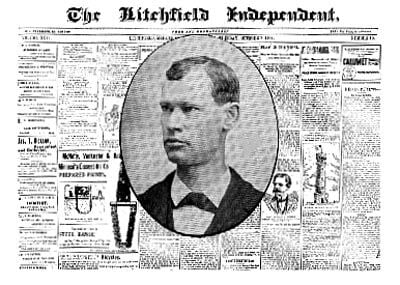
- Next to the corner lot at Marshall North and Depot Street East, heading north, was a building where Henry G. Rising published the Litchfield Republican newspaper starting Jan. 24, 1871. He discontinued the paper the following autumn. The Litchfield Saturday Review newspaper was bought by John T. Mullen, who sold it to Charles W. “Hans” Wagner on Jan. 1, 1898. It later combined with the Litchfield Independent to for the Independent Review. Vernon Madson bought Raymond Lenhard’s interest in the Independent Review in January 1971. Stan Roeser bought an interest in January 1973. John Harmon sold his interest to Madson and Roeser in January 1979.
- Charles W. “Hans” Wagner, the guy the elementary school was named after, bought the Litchfield Saturday Review newspaper on Jan. 1, 1898.
- In January of 1900, Litchfield’s Women’s Christian Temperance Union installed a ladies’ “Rest Room” in the building at 134 North Sibley (Sandgren’s Shoes) where women could come and “rest,” have conversation, and probably use the facilities, while shopping in downtown Litchfield. Ironically, Kellgren’s saloon was right around the corner in the building to the rear.
- The old Litchfield wooden depot was replaced by the grand brick Great Northern station, that we all knew and loved, in August 1901. It was built with sandstone and dedicated on Jan. 9, 1902. It was 32 feet wide by 187 feet long. Sadly, that depot was torn down in October 1985. The movie theater at 104-106 North Sibley, owned by United Theatres, was sold to David T. Hobson in January of 1918. Hobson changed the name to the Hobson Theatre, but it later became The Unique. The city of Litchfield bought land from Bengt Hanson by Lake Ripley for a Memorial Park in January 1922. That following summer, W.P.A. workers built mounds in the park in the shapes of things like ships and hearts. People remember playing as kids on the “ship” mound at the north end of the park.
- Minar Ford was Litchfield’s oldest lasting dealership. It was first called Larson-Minar Ford. In January 1923, Horace and his brother Cushman K. Davis Minar bought out Larson. Minar was west of the hotel on Depot Street when I was growing up. John H. Miller bought the business in January 1959, and it became Miller Motor, but lots of people continued calling it Minar for years. It became Bernie’s Fairway in January 1970. Robert L. and A. K. McDonald got a car dealership business in January 1927 and called it Litchfield Motors Inc. They mostly sold Chevrolets. They started on Depot Street, moved to the Kopplin garage on the northwest corner of Second Street and Ramsey Avenue in January 1928, and opened their new garage, where Fenton’s and Brock’s ended up at 627 Sibley Ave. N. in November 1930. The Chevy business was sold to Karl Augustus Danielson Jr., son of Dr. Karl Augustus Danielson, in January 1932.
- Fifty-six-year-old Carl Wilhelm Wickstrom and his 13-year-old daughter, Lilah Mae, left church early on the south side of town on Jan. 20, 1946, because they had to get to the drugstore in time to pick up a prescription before the store closed at noon. This closing time was common back then on Sundays. The drug stores took turns being open on Sunday mornings. Anyway, the church service had run long that cold January morning. As fate would have it, when they got to the now closed Miller Avenue railroad crossing, a westbound mail train was coming. Carl gunned his ’38 Chevy, trying to beat the train and still make it to the drugstore in time. Maybe there was ice on the approach because he didn’t move as fast as he anticipated and both he and his daughter were killed instantly.
- Twenty-year-old Ralph Christoph Carlson, son of Louie, got in trouble in January 1949 when he assaulted bank teller Clarice Ditlerson on her way home from work and made off with her purse. He was caught the next day and confessed. He was sent to prison for about five years, of which he only served a couple.
- Across from the Litchfield Produce at 104 Second St. W. was a café named the Lunch Time Inn, which was owned by Catherine “Kate” Pierce. Kate sold the cafe to her son-in-law and daughter, Kenneth and Laura Mae Welsand, in January 1949. Initially, their cafe was called Kenny’s Café, but after Kenny died, it became Laura’s Café. Then it was called the Lunch Time Inn again.