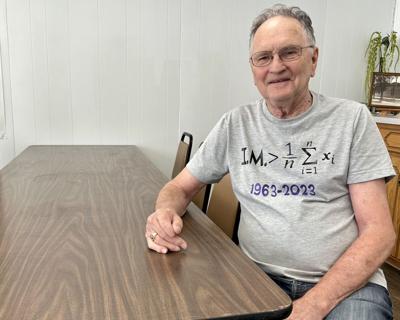
Carlton Urdahl decided in fourth grade that he wanted to a teacher.
There was something about helping younger classmates in the District 68 one-room schoolhouse about a mile south of his family’s farm in rural Litchfield that gave him great joy.
Prior to fourth grade, Urdahl said, he had the misconception that teaching was not a profession open to men. Then one day his older brother enlightened him.
“I can remember my oldest brother, I said, ‘I wish guys could be teachers,’ and he said, ‘Well, you know, Mr. Duncombe is a man, and he teaches.’
“And honestly, that’s where I knew I was going to be a teacher,” Urdahl said. “I never thought anything else. And basically, right away I thought, ‘I’m going to teach math.’”
He never really veered from that course. And in late May, at the end of his 60th year of teaching math, Urdahl called it a career.
Well, sort of. The 82-year-old taught his last class in the Buffalo-Hanover-Montrose School District after five decades there. But after a summer off, Urdahl hopes he can find work as a substitute teacher in some schools a little closer to home starting next school year.
Teaching is in his blood and gives him too much enjoyment to just walk away. Six decades of teaching might seem like a lot to some — maybe most — people. But Urdahl figures every new class of students presents new opportunities to make a difference. It’s a sort of fountain of youth.
“People have asked for years, ‘Are you going to retire?’ And I said, ‘I’m going to give it another year,’” Urdahl said. “And I didn’t mean just one more. I’d say ‘another.’ I didn’t know how many more.
“There’s this guy I have coffee with, we started teaching the same year. And he retired, I think he said, this is his 23rd year of retirement,” Urdahl said. “And I think, holy cow, I could have been retired for 23 years. But what would I do — why would I do that?”
Urdahl graduated in 1959 from Litchfield High School, then attended Concordia College in Moorhead where he earned a double major in German and math. And shortly after college graduation in 1963, he landed his first job, teaching both subjects in Granite Falls for a decade. Then, on what seemed like a whim, he decided he needed to move on. The next year, 1973, he took a job at Buffalo-Hanover-Montrose Public Schools. He taught junior high math and German for three years, then moved exclusively to math, teaching seven more years at the junior high before moving to Buffalo High School, where he spent the next 40 years.
Adding up
He started the Advanced Placement calculus course at Buffalo in 1990, saying now, “that actually is one of the things that kept me going in teaching.” He challenged himself every year to help more students earn college credit than the year before. He didn’t always succeed, he admits. But his success rate was impressive.
The school reported that of the almost 800 AP calculus students he had over the years, more than 81% scored well enough on the exam to earn college credit.
That success as an educator, in addition to a caring demeanor, earned him high praise from fellow teachers and Buffalo administrators.
“He has been a mentor to me during my 15 years here at BHS, and quite honestly, BHS will probably never see another Carlton Urdahl,” Principal Mark Mischke told the BHM Insider, a district newsletter. “I think the quote is, ‘Don’t be sad it’s over; be thankful it happened.’ I’m thankful that BHS has had the honor to have had Carlton Urdahl serve our students, staff and community over the last 50 years.”
Urdahl never stopped trying to improve his understanding of calculus and his ability to impart that wisdom to his students. He was a regular attendee of the Summer Liberal Arts Institute at Carleton College where he took workshops on teaching AP calculus, including the summer of 2022, by which time he’d pretty much decided the 2022-2023 school year would be his last as a full-time teacher.
When he registered, Urdahl said, one of the administrators told him “you’re a legend around here.”
“I said, ‘Oh sure,’ and I just laughed,” Urdahl said. “But she said, ‘You came here the first time in 1995. You’ve been coming here over the years … this is your 15th time.’ And she said, Nobody in the history of the institute has done that. I said, ‘Well, I’m just a slow learner.’”
More like constant learner who wanted others to be able to learn from him.
“I felt like I owed it to my kids,” Urdahl said of his summer workshop attendance. “AP would change their emphasis every so often, and I would always want to know what that would be, so I could pass that on. I just felt, that’s my job to do that. And I enjoyed it. I really enjoy being over there.”
Urdahl lives on the farm site where he grew up, having purchased the buildings and about 60 acres of the 160-acre farm in 1986. For a time, he continued to operate the farm while he was teaching. He had 120 cattle and rose at 3:30 a.m. every day to do chores before heading out on the 45-mile drive to school in Buffalo. More recently, his farm operation is down to care of just three cows, meaning he’s been able to sleep in until 4 most mornings.
It seems like a lot, but Urdahl said teaching energized him, and he fell into a comfortable routine through the years. He didn’t mind the drive from rural Litchfield to Buffalo, which he called “an easy 45” miles. He’d leave home at 5 and arrive at the Perkins restaurant in Buffalo, where he’d eat breakfast while pouring over his calculus workbook.
That routine stood up every day — rain, shine or snowstorm. Urdahl laughed as he recalled a few winter mornings when he was sitting at Perkins eating breakfast and immersed in a calculus equation when a waitress — the staff got to know him well over the years — would walk over to tell him that school had been canceled for the day due to the weather.
Life lessons
Students learned more than mathematics and calculus in Urdahl’s classroom. Through their interactions with him, they learned about life. And through gestures large and small over the course of half a century of teaching, Urdahl received thanks from students.
He remembered his first year in Buffalo, when he was still teaching German, how he tried to encourage order in his classroom by mandating all students be in their seats when the bell rang at the start of school. The next day, one student got up to sharpen his pencil moments before the bell rang, and seemed to intentionally test Urdahl’s “in your seat” rule. The teacher responded the only way he felt he could, sending the student to the office for a pass.
“He went to the office and he came back and he pouted the whole hour,” Urdahl recalled. “So, at the end of the hour … I said ‘come on up here.’ So, he came up, and I said, ‘You know, it wasn’t that big a deal, but I’ve got to have you sitting in your seat.’ He said, ‘yeah, I know.’”
The encounter opened the door to a long-lasting relationship. The student began coming to school early every day to get help from Urdahl with math problems. The student invited Urdahl to a college concert, and to his wedding.
“So, he calls me on Father’s Day this year,” said Urdahl, who never married and has no children. “And he said, ‘Urdahl, you’ve been my father, you’ve been the best father I could have ever had.’ And it shocked me. But I said, ‘If that’s the case, it makes you the best son I could ever have.’”
Another student, whose parents were divorced, handed Urdahl an envelope at the end of the school year around 2000 and walked away without saying anything.
“It was a card, and it says, ‘Happy Father’s Day,’” Urdahl said. “To be honest, I went into a room and I just cried like a baby. That just blew my mind. And after that, he would call me on Father’s Day. He got married in late 2016 down in Chattanooga, Tennessee. I was in his wedding. I’ve been really, really blessed in ways like that, because that’s something I never expected.”
Hard to say goodbye
It’s moments like that, then, that might explain why it is so difficult for Urdahl to conceive of doing anything but continuing to teach. Even after 60 years.
“I don’t think people realize that there is a lot of reward in teaching,” he said. “Hopefully, I did give the kids what they needed. But there’s also the satisfaction you get when a kid comes up and says, ‘Geez, I enjoyed your class.’ You just need one or two of them, and that just kind of fires you up, and you’re ready for another year. I just really, honestly, enjoy teaching. It’s going to be hard not doing it. I just feel I have to do something.”