

4-H projects and activities feature prominently every year at the Meeker County Fair.
But the spotlight on the organization intensified this past weekend at the fairgrounds in Litchfield. Among the cattle, goat and fowl shows, and the photography, seamstress and science exhibits that are regular 4-H fare, a display created largely by a pair of 4-H alumni captured the essence and evolution of the organization during the past 100 years.
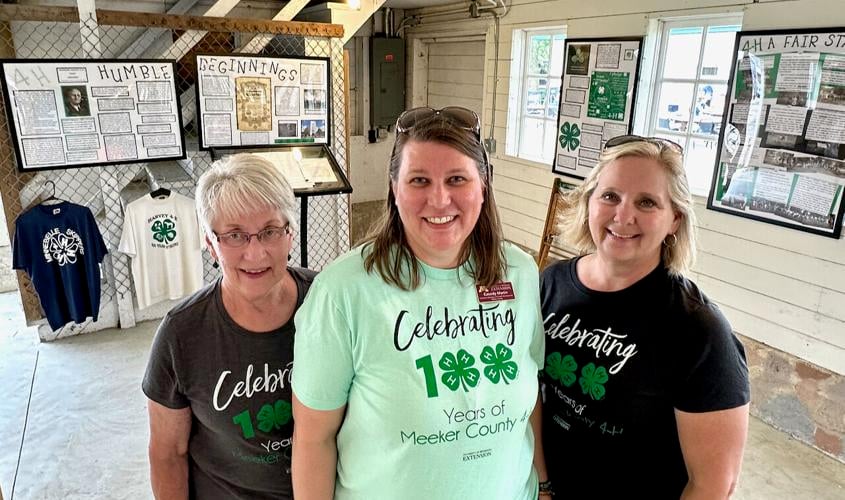
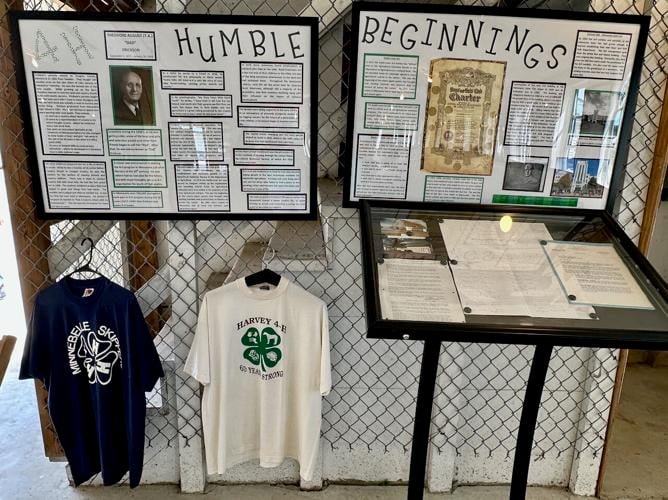
In 38 picture boards along with artifacts that included club chairs, T-shirts from the State Fair and scrapbooks, in addition to news reel-type footage from an early 4-H parade and interview with an early 4-H’er that played on a loop, a display in the old barn at the fairgrounds told the story of the first century of Meeker County 4-H.
The observance of Meeker County 4-H’s centennial year began several years ago, when the 4-H office was located in Meeker County Family Services building. A staff member found boxes of Extension reports that detailed 4-H club activities in the county. That find provided a foundation for the century history project, documenting the organization’s birth in Meeker County in 1923.
“We had intended to start things much sooner, and then COVID happened,” said Cassidy Martin, Extension educator and 4-H youth development director for Meeker County. “It was really this winter that it was like, ‘OK, it’s time.’”
A county 4-H board member suggested Mimi Davis as someone who might be able to help move the project forward. A lifelong Meeker County resident and a former 4-H’er herself, whose children also participated, Davis jumped in.
“She had done such a big job helping them with the 150th (anniversary of the Meeker County Fair in 2022) stuff,” Martin said.
Davis began attending planning meetings, compiling information from documents and photo slides throughout this past winter. But as she worked, Davis kept turning to someone else for information — her sister, Bonnie Giese. The sisters were Dollerschells while growing up on a farm in the Forest City area.
“I would send her some pictures from the Forest City Livewires (4-H club) and would say, ‘Who are these people?’” Davis said. “And she said, ‘Well, I might have to come and look at them closer so I can see them.’”
Giese showed up on a day the committee was meeting, and before the meeting was over, she had been drafted to join her younger sister in creating the history display.
In addition to the Extension notes about 4-H activities, Martin put out a call to past and present 4-H members, asking for any additional documentation they might have.
“Anybody that wanted to get rid of any of their old scrapbooks, we would happily take them off their hands,” Martin said. “We’d hate for that history to be lost.”
And many scrapbooks did show up.
“It’s getting to be that they won’t fit under my desk anymore,” Martin said. “But not a whole building or anything. For 100 years, there’s probably more out there.”
History committee member Geri Moen researched much of the history. Davis and Giese also spent significant time at the G.A.R. Hall and Meeker County Museum poring through old newspapers and other documents.
Though it might have been easy to be overwhelmed by the sheer volume of information, Davis and Giese said they enjoyed the process, excited about handling decades-old 4-H club scrapbooks.
“There were some of them that were very old and fragile,” Giese said.
“Yes, a lot of brittle pages,” Davis said.
“But one of the coolest ones, there was a scrapbook that was still made with oil cloth as the paper,” Martin said. “That was a South Koronis one, I believe.”
They worked with Martin and Kayla Huhn in the Extension office to have copies made of the old scrapbooks for display. Among the artifacts were more than 1,000 pictures, as well as newspaper clippings and the slides.
“We got to a point where the fair is coming,” Martin said. “This is how much time we have. This is how much we can accomplish.”
What they could accomplish was a lot. One of the first boards tells the story of Theodore August “Dad” Erickson, the man considered the godfather of Minnesota 4-H. Erickson spent 60 years working with rural youth as a school teacher and administrator, as well as a rural service consultant for General Mills, where he developed 4-H literature that’s still used nationally.
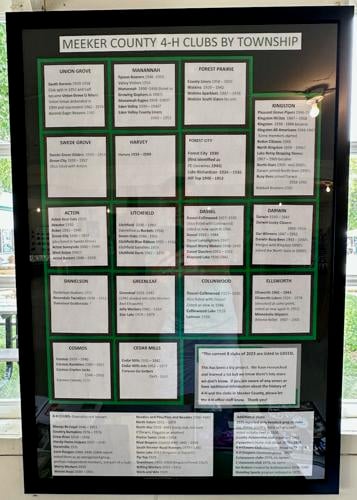
Another early board includes a Boys’ and Girls’ Club Charter certificate for the South Koronis 4-H Club from 1939. Further on, a board tracks, by township, all of the 4-H clubs in Meeker County, from the beginning.
Meeker County currently has eight 4-H clubs, but the history counts nearly 90 clubs that have come and gone during the past century. That does not include the livestock project clubs, an automobile club and shooting sports club that existed outside the traditional 4-H club format.
Like many research projects of this nature, the Meeker County 4-H history continues to evolve as more pieces of the story are uncovered.
“Since I made that board, we’ve already discovered some errors, because, you know, the history that we find evolves,” Giese said.
“The club piece was hard to determine,” Martin said. “One of the things people talked about right away is, it would be great to have a list of all the clubs and where they were. The problem is that the maps that showed in the reports had a stamp where a club was, but they didn’t’ necessarily label that. So, the narrative, it sometimes listed a number of them but it didn’t list all of them either. It’s to the best of our interpretation, as we’ve been able to figure out and with the gaps in history.”
Similarly, documentation indicates that the earliest club probably formed in the Kingston area, Davis said, beginning as a Boys’ and Girls’ Club, the precursor to today’s 4-H clubs. Kingston had a one-day fair at the time, at which the top three finishers in four different cattle classes were chosen to advance to the Litchfield fair, which was held in Central Park.
What’s not certain is the significance of the one-day Kingston fair, if it was a “county fair” or a regional one to determine those who would advance to the larger fair in Litchfield.
Whatever the case, fairs were as big of an attraction in 4-H’s infancy as they are today, as is evidenced by the video that was part of the century display.
“One of the coolest finds, I think, was we found a film reel in the box. That’s the video that’s out there (in the display) — the footage of the cattle and horses and the parade. And then the dairy show in Central Park, that was listed as 1939….”
The video shows 4-H’ers parading down Litchfield’s Sibley Avenue with animals and on floats in advance of the fair that was held in Central Park at the time. Additionally, Extension intern Shelby Dengerud interviewed Art Olson, a 4-H’er from that era, who provides commentary about 4-H participation and the excitement of the fair.
Bringing together the bits and pieces of 4-H history was a big job that led to some sleepless nights, especially as the county fair approached, Davis and Giese said. But it was a job they are glad they took on — even if relieved to now have it done.
“Going back and, you know, seeing all these different people, and ‘This is what we did,’ and ‘That’s how it was,’ brought back so many memories,” Giese said.
“I really enjoyed it so much,” Davis said. “4-H was always a big part of our lives. It was very important. So, it was fun to go through all the pictures, especially the old Forest City Livewires club … recognizing faces and trying to remember names. It was really fun. I loved it.”
There’s no definite plan for the display now that the Meeker County Fair has passed. But everyone involved seemed to agree it should make an annual appearance at the fair, in addition to finding other venues at which to feature it.