

Time feels like it’s standing still during the long winter months. The lack of snow limits outdoor activities such as cross-country skiing, sledding, ice skating or ice fishing, so it’s time to think about what can I do indoors?
As a lover of history, I’m always encouraging folks to visit a museum. Remarkably, we have four museums within 20 miles of Hutchinson. There’s the Meeker County Museum at the G.A.R. Hall in Litchfield, Dassel History Center and Ergot Museum in Dassel, McLeod County History Museum in Hutchinson and the Cokato Museum in Cokato.
With Valentine’s Day just a week away, you can set your heart and that of your loved one ablaze with pictures and words from Vintage Valentines through Feb. 14 at the Meeker County Museum at the G.A.R. Hall. Visitors are welcome to celebrate Valentine’s Day by creating their own Valentine cards. The museum has copied some of its collection of vintage valentines for visitors to cut and paste into their own unique “vintage” Valentine cards. Express your creativity for love 10 a.m.-4 p.m. Tuesday through Friday, and noon to 4 p.m. Saturday. Admission is free for museum members and children 12 or younger. General admission is $3.
Are you a puzzle person? The museum wants you for its Puzzle Exchange, a fundraiser for the Meeker County Museum at the G.A.R. Hall, 7 p.m. Thursday, Feb. 29. Bring up to five jigsaw puzzles of 500-plus pieces to exchange with others. Admission is $5 and includes light refreshments, puzzles to work on and a museum to explore.
In case you’re wondering how the Meeker County Museum came to be at the G.A.R. Hall, the story begins in 1866 when the national organization of the Grand Army of the Republic was formed. It’s motto: “Fraternity, Charity and Loyalty.” Its purpose: To maintain fellowship for the men who fought to preserve the Union and to help disabled veterans and the widows and orphans of veterans.
The local G.A.R. chapter built its meeting hall in 1885. The building — across the street from Litchfield’s Central Park — was 56 years old when the Meeker County Historical Society was officially formed March 5, 1941 — nine months and two days before the Japanese military launched a surprise attack on the United States Naval Base at Pearl Harbor, Hawaii, ushering America’s official entry into World War II.
“From the early days the Society sought to work with the G.A.R. Hall as a place for the museum,” said Danelle Erickson, executive director. “Sadly the minutes for the early years are a bit sporadic, but it appears the Society continued to meet at the Hall and might have had some museum displays there.”
In 1956, the Civil War and local Litchfield-area history were officially linked when the Meeker County Historical Society entered into a formal agreement with the city of Litchfield stating the Society was to maintain the G.A.R. Hall as a memorial to the Grand Army of the Republic and could also place museum displays of Meeker County history.”
Four years later, the Meeker County Museum was established with a two-story addition built at the rear of the G.A.R. Hall. The original hall features Civil War artifacts, with the meeting room telling the stories of the county’s citizen soldiers. The museum highlights artifacts relating to the history of Native Americans, Minnesotans in war, schools of Meeker County and more.
A SALUTE TO SNOWMOBILING
According to local records, residents of McLeod County began to establish local historical societies as early as 1906. This grew out of late 19th-century gatherings of old settlers sharing their stories.
The McLeod County Historical Society was formally established and incorporated local historical societies in 1940. The society was reorganized in 1952. Today it can be found in its own home at the McLeod County History Center in Hutchinson, which features permanent exhibits of the nine towns in the county, as well as the Les Kouba and Emanual Albrecht galleries, a research library, archives, plus rotating exhibits.
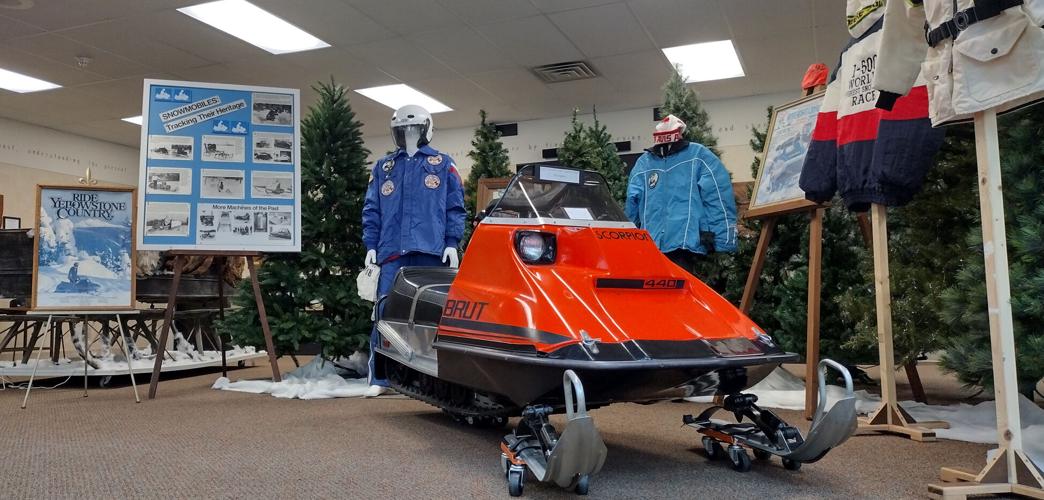
Snowmobiling has long been a popular Minnesota winter recreational sport. It’s also the subject of a special rotating exhibit at the McLeod County History Museum. It features a 1975 Scorpion snowmobile, photos, clothing, signs and more. View it through February.
For those interested, the MCHS’s Breakfast Club is meeting at 10:30 a.m. Monday, Feb. 19, and the topic is vintage snowmobiles. All snowmobile enthusiasts are invited to attend and share stories about their past snowmobile adventures. Admission is free.
FOLLOW THE YELLOW BRICK ROAD
While valentines are the focus in Litchfield and snowmobiles are revving it up in Hutchinson, the Dassel History Center and Ergot Museum is changing exhibit space on the fourth floor as a salute to Dassel’s own — Hildred Olson. The exhibit tells the story of Olson’s journey from Dassel to Hollywood where she performed as a Munchkin in the Judy Garland movie, “The Wizard of Oz,” and home again. The exhibit includes a 13-minute video created by Paul Johnson.
And for those who like to know the rest of the story, there were 120 actors cast in the roles of Munchkins for the 1939 movie. Their Yellow Brick Road took them to Oz in the form of the Hollywood Walk of Fame where they were honored with their star. Unfortunately, only nine survived with seven attending the ceremony Nov. 20, 2007. Among those who had died was Hildred Olson. In honor of her participation and in conjunction with the museum’s exhibit, a monument was unveiled June 17, 2023, at the Dassel Cemetery. It includes a star — thus, the name of the exhibit.
When you’re through visiting “Hildred Gets Her Star,” take time to view the other permanent exhibits: Ergot: From Blight to Blessing, Dassel Seed Corn, Peterson Pharmacy and Magnus Johnson. To experience a snippet of each exhibit, visit dassel.com/hs/page/ergot and click on any of the thumbnail images to view a slideshow.
And while you’re there, don’t miss the museum’s collection of public art. The fence murals can be seen outdoors along the west edge of the parking lot. The panels were created by 13 artists with ties to the Dassel area. They range in style and subject matter reflecting the viewpoint of the artist.
Unlike the MCHS, Dassel’s historical society is a relatively new addition to the community. Formed in 1987 with “$78 in the bank,” it proudly shares a membership roster of approximately 500 households and businesses, with 100 active volunteers.
The Dassel Area Historical Society’s home is the Universal Laboratory building, which was given to them in 1993. Thanks to grants from the Minnesota Legislature, Minnesota Historical Society, city of Dassel and donations, the building was renovated. A annex for offices, meeting rooms, storage, kitchen and lobby was added in 2008.
Looking forward, the Dassel History Center also serves as the home of the FungusAmongus Players of Dassel-Cokato. The local theater troupe is performing Arthur Miller’s “The Crucible” 7 p.m. Friday and Saturday, March 15-16 and March 22-23, and 2 p.m. Sunday, March 17, 24. Tickets are on sale and can be purchased at the Dassel History Center, 320-275-3077.
Also coming up is “Unsinkable Women” 7 p.m. Friday, April 19. Sponsored by the Dassel-Cokato Arts Association, Deborah Jean Templin, a Glencoe native and New York actress, will perform the program, which centers around stories and songs from the Titanic. The RMS Titanic was the largest ship afloat at the time. It sank after hitting an iceberg during its maiden voyage April 15, 1912.
BUILD IT AND THEY WILL COME
New at the Cokato Museum is its eighth escape room puzzle — “The Curveball Caper” — which is expected to open in February. This is the ultimate locked room mystery. It’s an immersive game where the players — usually a group of 4 to 6 — are required to solve a series of challenges against a set time limit. The goal of the quest is finding the key to unlock the room.
The good news is ... you don’t need to know Cokato’s history to participate. It’s also free but groups are required to post a $20 refundable damage deposit. Advance registration is required.
What does an escape room have to do with local history? In essence, it’s a form of entertainment programming that combines fun and education to attract new audiences.
According to Johanna Ellison, executive director, the escape room has brought new faces into the museum including families, work groups, friends groups and school groups.
“It’s a unique way to learn about Cokato history,” she said.
When the Cokato Museum launched its first escape room, it was the first or among the first museums in the state to offer this new interactive experience.
“It was exciting to be part of that,” Ellison shared.
While the new escape room is coming in February, there’s plenty of other exhibits to view right now. Most recently it has added a new city of Cokato exhibit and updated its railroad display by broadening it to show other methods of transportation that changed the city including the introduction of the automobile, airplane and eventually the school bus. In addition to providing more information, the expansion allows the museum to showcase more artifacts from its collection.
Another claim to fame for the museum is the Akerlund Studio, the only known early 20th-century photographic studio still standing in the Upper Midwest.
The award-winning site is the fully restored commercial photography studio of August “Gust” Akerlund, a Swedish immigrant. It features Akerlund’s original furnishings — a snapshot of how they were arranged in the 1930s — as well as his cameras, equipment, a collection of more than 14,000 negatives of which more than 11,000 are glass plate negatives, and a 12-foot skylight. It was listed on the National Register of Historic Places in 1977 for its local significance in architecture and commerce.
While there are plenty of anniversaries to observe throughout history, this year marks the 50th anniversary of the Cokato Historical Society, which was organized in 1974. It supports the Cokato Museum, which opened in 1976, and is operated through a partnership with the city of Cokato, and the Akerlund Studio. It was son Ted Akerlund who donated the studio and its contents to the city for restoration. It opened to the public in 1986.