George Washington Carver might not be someone your average seventh-grader knows a lot about.
Carver’s story, or at least Grayson Swenson and Westin Sonsalla’s telling of it, captivated Litchfield Middle School seventh-graders during the annual American History March Madness tournament, helping the pair emerge as champions from the 64-team tournament that serves as equal parts history lesson, research project and audio-visual editing experience.
Oh, and an even larger part fun.
“It was fun,” Swenson said. “After we researched a little bit about him, I learned that he did some funny stuff, so we put that into our video.”
American History March Madness is the brain child of history teacher Bill King, who launched the tournament 10 years ago. A takeoff of the NCAA basketball tournament, the project sees individuals and teams of students research and create multimedia presentations about famous and influential Americans. Student teams are put into a bracket format for head-to-head competition, with voting by classmates in King’s history classes deciding who advances to the next round of the tournament. Six head-to-head wins are needed to claim the crown in the 64-team field.
It all starts with students drawing a name from a bowl stocked with slips of paper listing the names of famous people from American history — a group that includes standards like George Washington and Abraham Lincoln, but also lesser known and more recent historical figures such as Clara Barton, founder of the American Red Cross, and Pat Tillman, NFL player-turned-soldier who was killed while serving in Afghanistan.
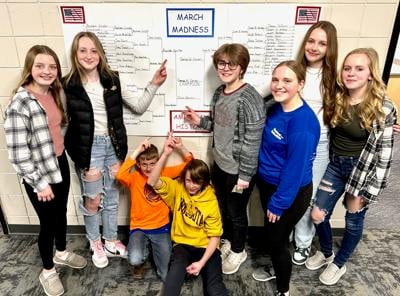
This year’s American History March Madness Final Four included Swenson and Sonsalla, with George Washington Carver, along with Alexandra Turck and Antonia Muellerleile (Clara Barton), Ali Pollock and Bella Moes (Alexander Hamilton), and Stella Braaten and Sophie Minton (Susan B. Anthony).
Swenson and Sonsalla defeated Turck and Muellerlelie in the finals.
That, despite their initial lack of knowledge of their subject.
“He (Sonsalla) thought it was George Washington at first!” Swenson said with a laugh. “I’d heard of him, but I didn’t really know who he was.”
They quickly learned.
“He invented, like, over 300 products, peanut products,” Sonsalla said, among them “axle grease, coffee ... .”
“Not peanut butter though,” Swenson interjected.
Swenson and Sonsalla compiled some of those inventions and Carver’s death in 1943 from falling down stairs at his home into a video that earned praise from classmates.
Muellerleile and Turck didn’t know anything about Clara Barton when they drew her name either, but they quickly learned of her work led to creation of the American Red Cross. They also were fascinated by her many other career pursuits.
“Oh my gosh, there was so much,” Turck said.
“There was,” Muellerleile agreed. “She did not stop working until she was 89. She as deputy of the missing soldiers department (during the Civil War), and she started the first free school in New jersey … that’s just so much for one person to do.”
That resume created its own challenges, they said.
“We had to find a way to incorporate all that” within the parameters of a 2-minute, 30-second video presentation, Muellerleile said.
“Our original recording was, like, five minutes long,” Turck said, and the pair had to trim about half of their script.
Their experience was similar for all of the final four teams, whose members said that researching the subjects was easier than assembling that research into a video that would be entertaining and informative enough to draw votes from their classmates.
Pollock and Moes said one of the facts from Alexander Hamilton’s life — that he was shot by Aaron Burr during a duel — fell to the cutting room floor because wasn’t time for it in their production, which started as a newscast and transitioned to a rap video.
Braaten and Minton went the rap video route with their telling of Susan B. Anthony’s story, as well.
“We did a lot of research,” Minton said, “and a lot of copy-and-pasting.”
“We started a song, and it didn’t work out, so we had to come up with a whole new song,” Braaten said. “That took the longest time, writing the song and making sure it was on beat, and then the last day I had (Minton) over to my house so we could film the video.”
The students all agreed the work was worth it — both as an academic exercise and in terms of creating something their classmates would enjoy.
“We definitely were going for a good grade,” Pollock said. “But we realized at the same time, we didn’t want to do something ordinary … we didn’t want to just talk, we wanted to find something fun to do as well.”