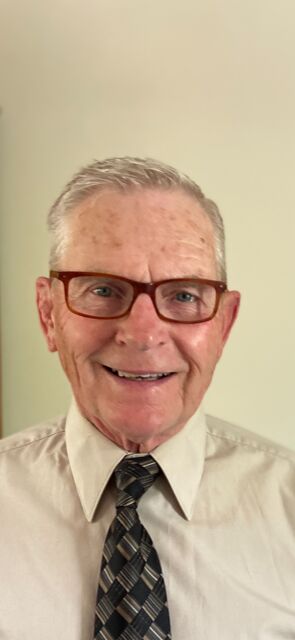

Tom Smith grew up on a farm right across from the John Deere implement dealership in Litchfield, the son of Ervin and Maxine Smith.
Farming was in Tom’s blood, he says, but was not necessarily his passion. His dad was a Navy man who served in World War II in the South Pacific and returned to Minnesota to work as a boiler operator while he farmed with his own father. Throughout his life, he spent much of his down time fishing and playing ball, and these interests were passed on to young Tom.
If you ask him, Tom will say that as a young man he was passionate about sports, and less passionate about schooling. There were days he wondered if he would graduate and noted that it was only with the help of friends and teachers who saw his potential that he made it through school. Had there been a category “least likely to succeed,” he feels he would have been a candidate.
But succeed he did.
Not being ready for college after leaving high school, Tom found himself at a crossroad, and he volunteered for the Navy during the time of conflict in Vietnam. Tom was assessed through a battery of tests that would determine if he was prepared for work as a submariner, one of the most difficult and stressful positions in the Navy. To qualify to live in a small, underwater vessel out to sea for months at a time, recruits must be found psychologically and physically able to withstand rigorous and socially intense living conditions. Tom passed those requirements and served on the USS Sailfish (SS572) as a torpedoman for most of his four-year tour.
Sailfish was the first submarine built expressly for radar picket service, designed to increase radar detection range, and was intended for higher surface speed than prior crafts. The submarine served Pearl Harbor with the Seventh Fleet in the western Pacific, and Tom was on three of those runs, including operations off the coast of Vietnam during the conflict.
The submarine was only about 350 feet long and 30 feet wide, and oceanic conditions can be brutal, especially in the North Atlantic, another area that Tom served. Tom said that it wasn’t much fun being out there in the brutal temperatures, but he grew up in Minnesota and was adept at dealing with the frigid conditions. In an unusual twist, Tom spent three-and-a-half years on the same ship, never rotated out, and there was limited ability to communicate with his family back home.
It was a time before cell phones and internet, and he spent the better part of his time away with no telephone service or visits home, instead relying on letters from his mom to keep him up to date.
Tom returned to the United States, this time ready for post-secondary schooling. He first attended University of Minnesota Technical College at Crookston, where he met his wife, Shirley. He then went on to earn a degree in soil and water conservation and agricultural education.
He taught at Onamia High School and formed their agriculture and natural resources program, also coaching baseball and wrestling.
To Tom, technical programs are absolutely necessary components of education, and he supports them fully.
Tom’s agriculture background, while maybe not his passion, definitely stayed an integral part of his career. After he left teaching, he became a livestock consultant with with Land O’Lakes, spending time consulting with dairy farmers and co-ops in his area. He eventually earned a securities license to become an investment banker. But the financial crisis of 1987 caused Tom to re-think his options, and once again his farming background served him well, as he moved into a commercial/agricultural lending position at Center National Bank.
Returning to Litchfield, Tom became involved in the Litchfield Baseball Association and was an integral force in the emergence of Optimist Park from the former Litchfield Airport. He maintains a position on the board and has enriched the lives of Litchfield families by supporting the baseball association. He is a member of the Litchfield Baseball Hall of Fame. He has served on the Chamber of Commerce, Pheasants Forever, and the Lake Ripley Improvement Association.
Tom also serves as a member of the Litchfield Military Honor Guard, and he feels that this, perhaps, is the role that is the most important, honoring veterans.
Tom will tell you that he was an “obscure” student, had no interest in farming or being a public servant. However, it appears life had different ideas for the less-than-stellar student, who says “with the help and encouragement of good people along the way, I was fortunate to ascend to a position as a community banker, positively impacting clients and coworkers as they pursued their careers.
“My hope is that I also had a positive impact in the community as a volunteer and member of a number of organizations right here in my hometown,” he added.
He said he’s humbled that someone found him worthy of the Litchfield High School Hall of Fame induction and noted that he is but one of four from the class of 1967 who are in the Hall of Fame.
He continues to volunteer for various organizations in Litchfield and has recently become a voice for Lake Ripley, in hopes of creating a stronger, healthier environment within the lake.
He spends time enjoying his grandchildren, who adore him, one of whom said to him,
“Grandpa, we don’t need cartoons, we have you!” He is Agent 86 to Shirley’s Agent 99, and if you see him around town, ask him that story.
Tom’s words of wisdom, while a bit unconventional hit a pragmatic bone:
“Consider alternatives to secondary education if you are not quite ready,” he says. “The military is a great option ... . Or find a good local job for a while.”
Additionally, he’s proud of his hometown.
“Litchfield is a great place to call home — with lots of volunteer opportunities,” Smith said. “Please give back no matter where you land and lead by example — someone is always watching!”