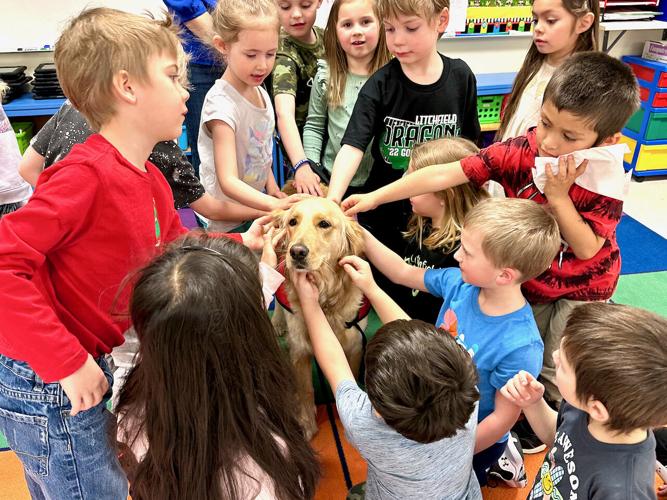
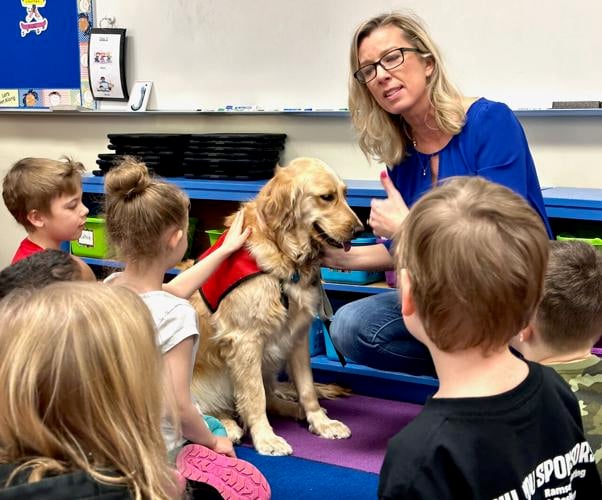


The red-vested golden retriever stood dutifully at her handler’s side in the school hallway as children quietly paraded by. Some of the students reached out to pet the dog. Others were cheerful, excited that this was Tenley’s day to visit their classroom.
At Ripley Elementary School in Litchfield, students don’t only have one dog visit their school regularly — but three — Tenley and Tucker, two golden retrievers, with handler Angie Huhner, a second grade teacher at the school, and Millie, with handler and Dean of Students Stephanie Hansen.
There had been talk of looking into different therapy approaches for student behavioral issues in the school for a couple years, according to Principal Chris Olson. Then COVID-19 hit.
Huhner knew during this period more help was needed in school for therapy. After COVID, Hansen started talking about therapy with dogs. She contacted Pat Cram from Star Dreamer Ranch about training her dog, Piper, a lab/wire hair mix and herself to become therapy certified. Huhner thought about her two dogs and felt they would be good candidates for the program, too. They all started training in May 2022.
Sadly, Piper died unexpectedly after having received his certificate. A border collie named Millie was introduced to Hansen, who adopted and began training her. Millie passed quickly through the different stages.
Olson, Huhner and Hansen met and planned how they could make a therapy dog program work at Lake Ripley. Post-COVID, it was clear the school had to access something different — something outside the box to reach students. They felt the therapy should be available to all students. As a result, they were willing to see what could be done with the dogs.
Tenley and Tucker began working in October 2022. Millie followed in December of the same year. All three — Olson, Hansen and Huhner — are pleased with what they’ve observed so far.
“I have personally witnessed when a high anxiety student went to one of the dogs. I saw their demeanor instantly change,” Olson said. “I saw the student’s shoulders loosen, they instantly calmed down, the dog laid on the floor and the student followed, curling up next to the dog for a while. Eventually, the student got up and went to where they were supposed to (be), like no drama had taken place prior.”
“I see the kids engaged, excited to come to school,” Hansen chimed in. “Millie is very calming. For students who have difficulty self-regulating and then see Millie, they immediately calm down. I have one student who is very shy in the classroom, but with Millie, she is talking all the time. For many, Millie is the bright spot in their day.”
Huhner has seen the dogs de-escalate many tense situations.
“A student didn’t want to go to gym class because they had some physical difficulty,” she said. “I got a ball and asked the student, ‘Could you throw Tenley the ball?’ They did without an issue and the dog fetched it and brought it back to the student. I asked the student to throw the ball again, which they did and the dog brought it back. The game was fun and the student forgot why they didn’t want to go to gym, which the student eventually did go to.
“The dogs calm the kids, redirect them and distract them to think in a different way,” Huhner added.
Olson clarifies that the dogs aren’t used in a reward and consequence way.
“The dogs are for all the kids,” he said. “We aren’t going to use the dogs to encourage students to do something ‘so they can pet the dog’ nor are we going to threaten them that they lose their privilege of time with the dog if they aren’t behaving the way we want them to. We let the dog and the child figure things out together.”
Olson is enthusiastic with what he’s seeing across the board at the school.
“Kids get excited and have new energy when they see the dogs,” he said. “They feel responsible and respectful around them. Even staff want to pet the dogs.”
Olson hopes to do a quantified study determining students behavior around the dogs vs. not.
Huhner has heard from parents, too, about having the dogs in school. “The parents say, “‘Wow! My child likes to come to school more now!’” she said.
TRAINING DOGS AND HANDLERS
Therapy dog training that Hansen, Huhner and their dogs engaged in is different than that for service dogs. While service dogs are dedicated to a specific owner, therapy dogs have a much broader role to play, they said, helping people feel and stay calm. The dogs rely on their social instincts and skills to offer socio-emotional, cognitive, and health benefits to the people they spend time with.
The first step the dog and handler go through is Canine Good Citizen test sponsored by the American Kennel Club. This test measures obedience and agility.
Once the dog passes this step, the team (handler and dog) practice for the Alliance of Therapy dog test. This process ensures that the dog has the right temperament as the team is observed during multiple sessions. The team attends class for one hour a week, learning to work together, and practice continues at home the rest of the week.
When the dog receives its certificate for this test, there is still training to acclimate the dog to the school environment. All three dogs were brought to Lake Ripley School during the evening to get used to the hallways, classrooms, furnishings, sounds (buzzers and phones) and smells. It started with short visits, increasing to longer ones.
Other logistics had to be thought through, too, such as baby gates at doorways, kennel placement, dog beds and allergy forms for parents to fill out in case a student is allergic to dogs. With these things in place, the dogs were brought to the school during the day. Millie is there two-and-a-half days a week, with students coming to Hansen’s office either individually or in a pair. Tenley and Tucker are each there one day a week in Huhner’s classroom. It is a challenge for Huhner to handle a dog and teach at the same time.
“My life is multi-tasking,” she says with a big smile.
Besides the socio-emotional use of the dogs, they are also used for students to read to them.
“Some students read better to dogs,” Hansen says. “Reading to a dog is less stressful and students have less anxiety than to a human or peer.”
Huhner would like to expand the therapy dog opportunity beyond Lake Ripley School. She and her husband, who has also gone through the therapy dog training, have brought their dogs to Litchfield middle and high schools, Gloria Dei Senior Living and Cathedral High School in St. Cloud. They would like to visit other area districts and show them the value the dogs bring to the classroom.
“We’re teaching in a different era post-COVID. We need to be teaching in a different way.” Huhner said.
She, Hansen and Olson believe therapy dogs are that positive option.